
LiveChat Review 2025: Honest Pros, Cons & Pricing
Turning website visitors into paying customers often comes down to a single moment: when they reach out for help. LiveChat promises to make that moment frictionless. With over 35,000 businesses using it, the platform is known for its fast chat widget, broad integration ecosystem, and tools that bridge customer service and sales. But under the polish, there are pricing quirks and automation limits that might break the deal for smaller teams. In this LiveChat review, we’ll dig into features, real-world performance, costs, and alternatives—so you can decide if it’s the right fit.
TL;DR – LiveChat delivers a superb agent experience, a lightning-fast widget, and a massive app marketplace. However, essential features like a full chatbot, advanced reporting, and HIPAA compliance live behind paywalls or expensive add-ons. It’s a powerful tool if you can justify the price; otherwise, all-in-one alternatives might give you more for less.
Key Features of LiveChat

LiveChat Review 2025: Honest Pros, Cons & Pricing product interface and feature overview.
LiveChat isn’t just a chat box. It’s a communication hub that packs AI assistance, omnichannel messaging, and sales-focused analytics. Here’s what stands out.
AI-Powered Chat Tools
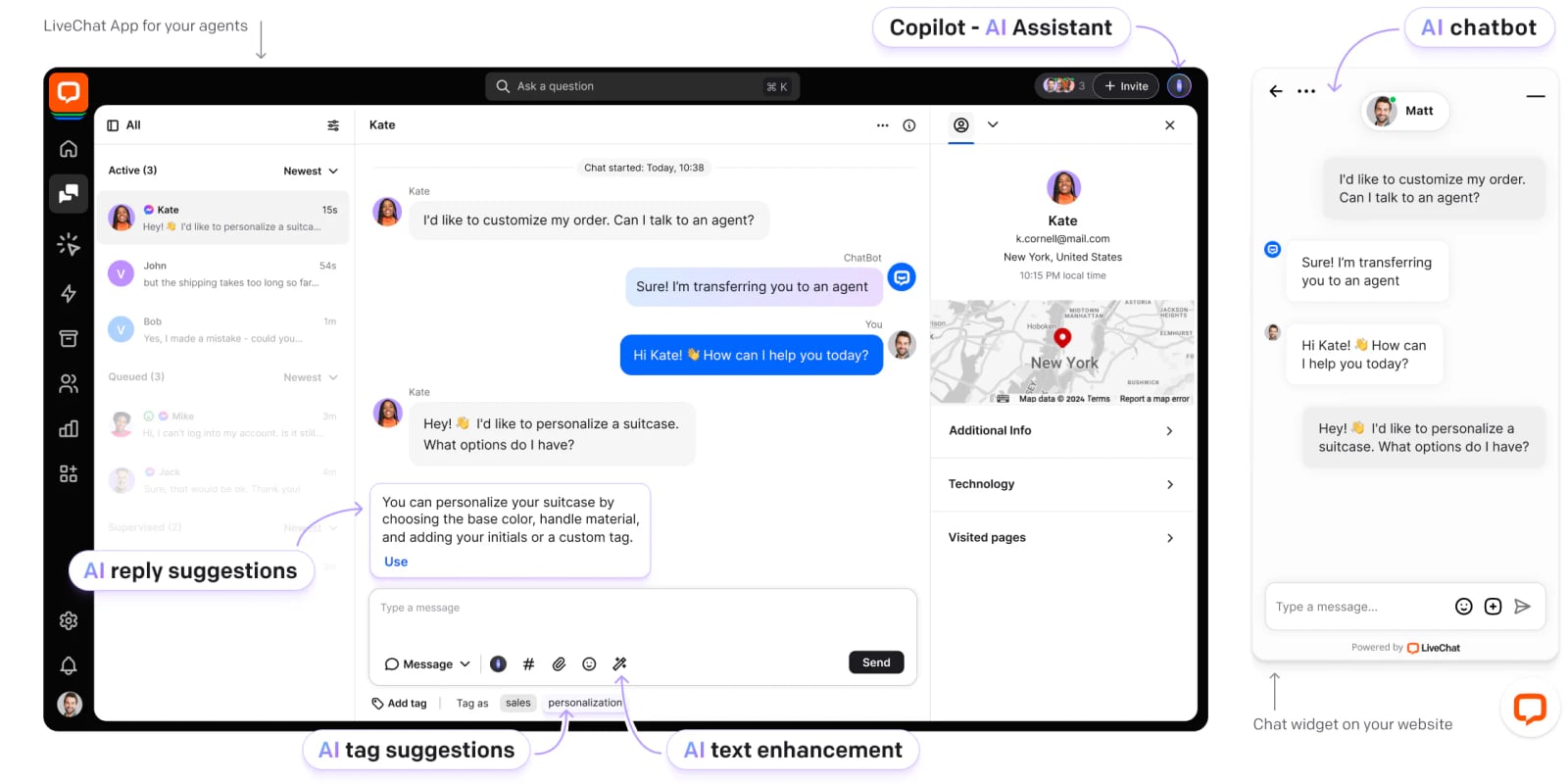
LiveChat’s AI comes in two flavors. First, there’s the Copilot, a built-in assistant that suggests replies, improves writing, and auto-tags conversations. It helps agents respond faster without replacing them. Second, the platform offers a separate AI agent (via the ChatBot product) that can handle full conversations on its own. While powerful, this full automation requires an additional subscription—more on that later.
Omnichannel Inbox
Don’t let the name fool you: LiveChat supports more than just website chat. It pulls in messages from Facebook Messenger, WhatsApp, SMS, email, and Apple Messages for Business into a single unified inbox. A revenue counter even shows you the estimated value of each chat, which is handy for sales teams.
200+ Integrations
LiveChat’s integrations are a real strength. With over 200 apps in its marketplace, you can connect natively to Shopify, Salesforce, HubSpot, Zendesk, and many more. This makes it a flexible bridge between your chat and the rest of your tech stack. Teams that rely on these platforms will appreciate the depth of the connections.
Widget Performance and Mobile Apps
A chat widget that slows down your site is a non-starter. LiveChat loads asynchronously from its own servers, meaning it doesn’t block your page render. In our tests and independent speed analyses, the widget remains one of the lightest and fastest on the market—on par with minimalist tools like tawk.to, but with far more features packed in. The mobile apps for iOS and Android are also well-executed, giving agents full access to chats, canned responses, and push notifications while on the go.
Setting Up LiveChat

LiveChat Review 2025: Honest Pros, Cons & Pricing product interface and feature overview.
Getting started is straightforward. After a 14-day free trial (no credit card required), you add a small JavaScript snippet to your site or install a plugin for WordPress, Shopify, or other platforms. The setup wizard walks you through customizing the chat widget’s colors, greeting messages, and targeting rules. You can define departments and routing rules right away. Most teams can have a working chat widget live within an hour.
Where LiveChat Shines
LiveChat Review 2025: Honest Pros, Cons & Pricing product interface and feature overview.
Superior Agent Experience
Agents love LiveChat because it’s built for speed. Features like message sneak peek (seeing what the customer types before they send) and canned responses cut response times. Intelligent routing assigns chats to the right team or person based on rules, so no one wastes time on misrouted conversations. The unified inbox handles all channels without friction, and the interface stays snappy even with multiple chats open.
Integration Ecosystem That Actually Works
LiveChat’s integrations aren’t just checkboxes. The native apps for CRMs and ecommerce platforms sync data bidirectionally. For example, when a customer chats, you can see their Shopify order history or Salesforce lead status without leaving the chat window. This tight integration is a major productivity saver for mid-size and larger teams.
Fast and Reliable Widget
As noted, the widget is a top performer. A slow chat tool can hurt your Core Web Vitals, but LiveChat’s off-site loading keeps your site snappy. This is a crucial advantage for any business where page speed correlates with conversions and SEO.
Mobile App That’s a True Extension of the Desktop Experience
Many live chat vendors treat mobile as an afterthought. LiveChat’s mobile apps are feature-rich and stable, allowing agents to manage the entire workload from a phone. Push notifications are instant, so no lead slips through when you step away from the desk.
LiveChat’s Limitations (and Where the Price Bites)

LiveChat Review 2025: Honest Pros, Cons & Pricing product interface and feature overview.
Fragmented AI Automation
LiveChat’s AI story is a classic “good, but not cheap.” The Copilot is included, but it only helps agents—it doesn’t replace them. To get a true chatbot that answers visitors on its own, you need the separate ChatBot product, which starts at $65 per month. That’s a steep upsell, especially when competitors like SaleSmartly vs Tidio vs LiveChat often bundle AI agents directly into their plans.
History and Reporting Are Paywalled
On the Starter plan, you only get 60 days of chat history. Want to keep records for quality assurance or training? You’ll need to upgrade to a higher tier. Basic analytics are available, but richer reporting (e.g., agent performance dashboards, goal tracking) is locked behind the Business plan. This can frustrate small teams who need data without the enterprise price tag.
Compliance Costs
LiveChat is GDPR compliant out of the box, with EU data center options. However, HIPAA compliance is restricted to the Enterprise plan, which requires a custom quote. If you’re in healthcare or handle sensitive health data, be prepared for a significant price jump.
Premium Pricing for Premium Features
LiveChat’s plans start at $20 per agent per month (billed annually) for the Starter tier. The Team plan is $41/agent/month, and Business is $59/agent/month. Add-ons like the ChatBot (from $65/month) and HelpDesk (for ticketing) quickly inflate the bill. Many critical features—such as ticketing and full AI automation—are separate subscriptions, making the total cost of ownership much higher than the base plan suggests.
LiveChat Pricing at a Glance
- Starter – $20/agent/month (billed annually). Core chat, 60-day history, basic widget customization. Good for tiny teams just starting with live chat.
- Team – $41/agent/month. Adds full chat history, advanced reporting, agent groups, and more customization. Fits growing support teams.
- Business – $59/agent/month. Unlocks work scheduling, staffing predictions, goal reports, and priority support. Best for mid-size organizations.
- Enterprise – Custom quote. Includes HIPAA compliance, SSO, dedicated infrastructure, and security audits.
Separate add-ons: ChatBot ($65+/month), HelpDesk (ticketing, starts at $29/month), and KnowledgeBase ($7/month). These are frequently needed to round out the feature set, so factor them into your budget.
Who Should Use LiveChat?
LiveChat is ideal for:
- Sales-driven teams that want to engage visitors proactively, capture leads, and connect chat conversations to CRM deals.
- Mid-size to large businesses that can afford the Team or Business plan and need deep integrations with Salesforce, HubSpot, or Shopify.
- Teams that value agent efficiency above all else; the sneak peek, routing, and unified inbox genuinely speed up response times.
- Companies already using the LiveChat ecosystem (e.g., existing HelpDesk or ChatBot users) who benefit from tighter cross-product integration.
LiveChat is less suitable for:
- Startups or small businesses that need an all-in-one platform on a tight budget. A free tool like tawk.to might cover basic needs, and all-in-one alternatives often include chat, chatbot, and ticketing without upselling.
- Healthcare providers who require HIPAA compliance but can’t swing an Enterprise plan.
- Those who want a built-in, comprehensive AI chatbot without paying for a separate product.
LiveChat Alternatives
If LiveChat’s pricing or add-on model gives you pause, here are a few strong contenders:
- SaleSmartly – Combines live chat, AI agents, omnichannel messaging, and built-in translation in one platform. See how it stacks up in our SaleSmartly vs Tidio vs LiveChat comparison.
- Tidio – An affordable alternative with a free plan that includes basic chatbots. Often cited as a user-friendly option for small ecommerce stores.
- tawk.to – Completely free live chat with optional paid add-ons. It’s lightweight and straightforward, though lacks the advanced integrations and AI of LiveChat. Read the full tawk.to review.
- Intercom – A powerhouse for SaaS businesses, but pricing can be even higher than LiveChat. Better suited for product-led companies that need in-app messaging.
For a broader look at the landscape, check out our list of the top 10 AI omnichannel communication platforms—useful if you need multilingual cross-border support out of the box.
Related reading
- How to Use SaleSmartly with Slack: Integration Guide for Teams - Learn to connect SaleSmartly's omnichannel AI support with Slack. Automate alerts, route chats, and turn customer conversations into team actions.
- SaleSmartly vs HubSpot vs SleekFlow: AI Omnichannel Compared - We compare SaleSmartly, HubSpot Customer Platform, and SleekFlow on omnichannel messaging, AI agents, translation, security, and pricing to help you choose the right platform.
Sources and further reading
- LiveChat® Reviews & Testimonials | LiveChat® | LiveChat.com - Check out LiveChat® reviews and learn how our software helped users connect with customers. Our customers wrote over 1,600 positive testimonials.
- LiveChat Reviews 2026: Details, Pricing, & Features - LiveChat Reviews 2026: Details, Pricing, & FeaturesG2https://www.g2.com › ... › LiveChat › LiveChat ReviewsG2https://www.g2.com › ... › LiveChat › LiveChat ReviewsWhat I like best about LiveChat is how easy and fast it makes communication. I can get help or answers in real time without having to wai
- LiveChat Review: Is It The Best For Your Business? - BlogVault - Struggling to turn website visitors into loyal customers? This LiveChat review breaks down whether this popular tool is the right solution for your business.
Frequently Asked Questions
Is LiveChat worth the price?
It depends on your needs. If you value a fast widget, exceptional agent tools, and deep CRM integrations, the cost can be justified. But if you need an all-in-one solution with built-in AI and ticketing, alternatives like SaleSmartly or Tidio may give you more value.
Does LiveChat have a free plan?
No. LiveChat offers a 14-day free trial (no credit card), but no permanent free tier. You’ll need a paid plan after the trial.
How easy is it to set up LiveChat on WordPress?
Very easy. There’s an official plugin, and many third-party connectors. Adding the supplied JavaScript snippet to your theme also works.
Can LiveChat handle WhatsApp and Facebook messages?
Yes. The omnichannel inbox includes WhatsApp, Facebook Messenger, Instagram, email, SMS, and Apple Messages for Business. You manage all these from one dashboard.
What is the difference between LiveChat and its ChatBot add-on?
LiveChat provides the agent-facing chat tool and a helpful Copilot for suggestions. ChatBot is a separate product that automates full conversations without a human. The two can work together, but they are billed separately.
Does LiveChat offer HIPAA compliance?
Yes, but only on the Enterprise plan. Small healthcare businesses may find this cost-prohibitive.
Final Verdict
LiveChat remains a top-tier live chat platform for teams that can afford the full stack. Its chat widget is fast, the agent interface is polished, and the integration marketplace is one of the best. However, the piecemeal pricing model—where advanced AI, ticketing, and compliance are locked behind expensive add-ons—makes it a tough sell for budget-conscious businesses. We recommend it if your team will genuinely use the advanced routing, reporting, and CRM sync, and if the enterprise-grade reliability is non-negotiable. For everyone else, there are compelling all-in-one alternatives worth exploring. At SaleSmartly, we help you navigate these trade-offs so you can pick the right tools for your business growth.