
SaleSmartly vs HubSpot: How to Choose a Cross-Border Customer Service System?
When cross-border teams prepare to build a customer communication system, they often hesitate between two types of products: one is a system built around omnichannel live chat, like SaleSmartly, and the other is an all-in-one platform built on a CRM foundation that covers marketing, sales, and service, like HubSpot. Both can handle customer conversations, but their design focus, channel depth, and cost structure differ significantly. This article starts from the real scenarios of cross-border business, breaks down the differences item by item, and offers actionable selection advice.
First, Clarify: What Problem Does Each Actually Solve?
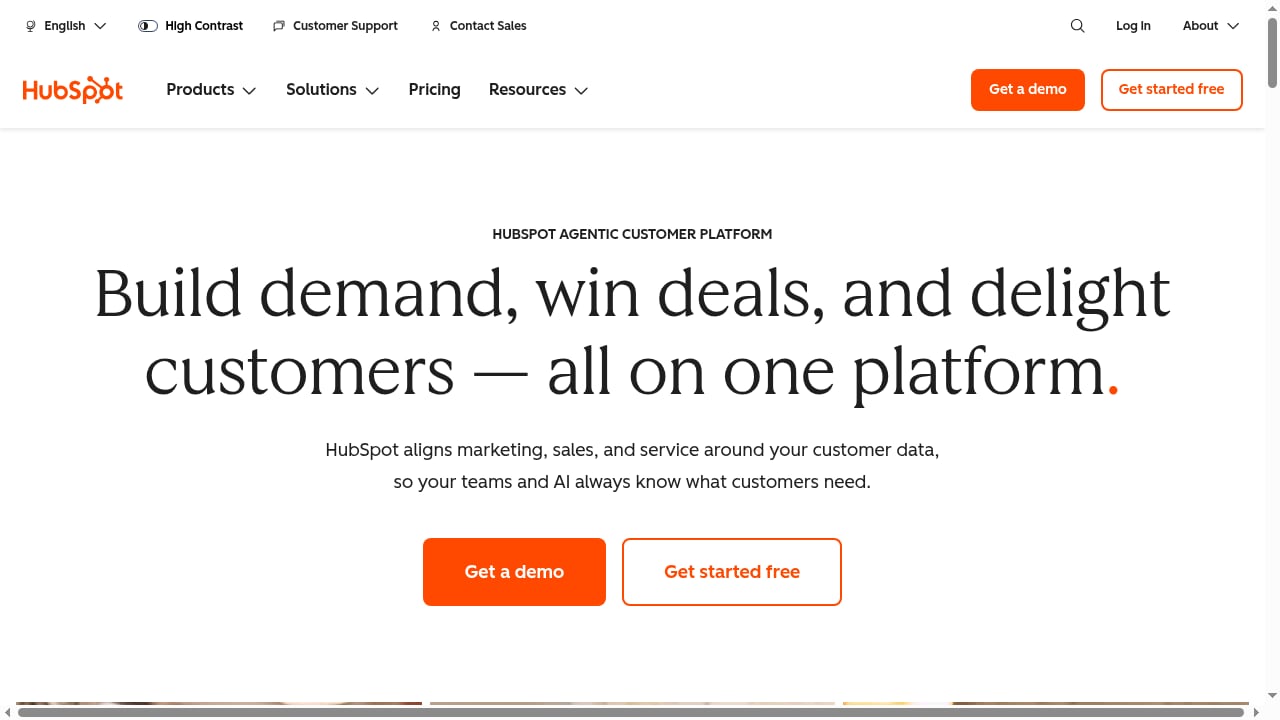
First viewport screenshot of www.hubspot.com.
SaleSmartly's Positioning: Omnichannel Customer Service and Marketing Communication
SaleSmartly is an omnichannel customer communication system centered on human agents with AI-powered customer service as a supplement. It supports connecting channels such as WhatsApp, Facebook Messenger, Instagram, Telegram, LINE, Email, VKontakte, WeChat, Zalo, and YouTube, covering pre-sales, in-sales, and after-sales stages. Its core value lies in aggregating customer conversations scattered across multiple social and instant messaging channels into one backend, allowing customer service teams to handle inquiries in a unified way, manage customer profiles in a unified way, and support cross-border scenarios through bulk messaging, automated workflows, and real-time translation.
HubSpot's Positioning: An Integrated Customer Platform Built on a CRM Foundation
HubSpot integrates marketing, sales, customer service, and CRM software into one suite, emphasizing collaboration around a unified customer data foundation so that both human teams and AI agents can get the context they need. It includes multiple Hubs such as Marketing, Sales, Service, and Content, as well as Smart CRM and AI capabilities across versions. HubSpot serves more than 190,000 businesses and growing teams, offers free tools and a Starter entry-level version, and also has Professional and Enterprise versions for complex needs, using a per-seat billing model.
In one sentence: SaleSmartly starts from "conversations" and goes deep on customer service channels; HubSpot starts from "customer data" and connects marketing, sales, and service into one line.
Channel Coverage: Whose Conversation Entry Points for Cross-Border Customer Service Are More Complete?
First viewport screenshot of www.hubspot.com.
The most typical pain point in cross-border business is that customers are scattered across different apps in different countries. Southeast Asian customers often use LINE and Zalo, Middle Eastern and Latin American customers prefer WhatsApp, European and American customers may inquire via Instagram DMs or email, and Russian-speaking users also use VKontakte.
SaleSmartly connects the above channels as native capabilities, so agents can switch and reply within one workspace without customers needing to jump elsewhere. For cross-border sellers whose main transaction scenarios are instant messaging, this aggregation directly determines response speed and handling efficiency.
HubSpot's Service Hub also supports multichannel tickets and conversations, including email, live chat, knowledge base, and some social channels, but its channel list leans more toward mainstream European and American email and website chat, and its native support depth for regionally strong channels such as WhatsApp, LINE, Zalo, and VKontakte is not as deep as customer service systems focused on cross-border business. If the team's main inquiry volume comes from these channels, the integration method and cost need to be evaluated separately.
How Humans and AI Collaborate: Which Fits Customer Service Teams Better?
First viewport screenshot of www.hubspot.com.
SaleSmartly: Human-Led, AI-Assisted
SaleSmartly's product logic is "human customer service first, AI customer service as a supplement." AI is used to assist replies, translation, and automated routing, but key conversations are still overseen by humans. This is important for cross-border business: in multilingual scenarios, machine translation can lower the communication barrier, while complex after-sales and dispute handling still require human judgment. The system also provides operational tools such as bulk messaging plan management, failure rate tracking, and send logs, making it easy for teams to combine customer service and marketing actions.
HubSpot: AI Across the Entire Platform
HubSpot embeds AI capabilities into every version and positions itself as an "agentic customer platform," emphasizing that AI agents and human teams share customer data context. Its advantage is that once marketing, sales, and service data are connected, AI can make recommendations based on the complete customer journey. But if the team's core need is high-frequency, multilingual, multi-account instant messaging reception, HubSpot's AI capabilities need to be used together with its overall suite, and the implementation path is longer.
Customer Operations and Marketing Capabilities: Each Has Its Strengths
HubSpot's strengths lie in marketing automation, email marketing, landing page and blog content creation, campaign management, and attribution analysis. If an enterprise needs a complete inbound marketing system, HubSpot's Marketing Hub provides a mature toolchain.
SaleSmartly's marketing capabilities are closer to cross-border private-domain scenarios: tag-based customer segmentation, WhatsApp template message bulk sending, scheduled batch sending, multilingual automatic translation, and customer profile management connected with customer service conversations. It does not seek to replace a complete marketing suite, but rather to capture "conversion opportunities generated during communication."
If the team already has a separate marketing tool, SaleSmartly's customer service and private-domain operations capabilities can complement it; if the team wants marketing, sales, and service all closed-loop within one platform, HubSpot's integration level is higher.
Pricing and Onboarding Cost: Per Seat or Per Agent?
HubSpot uses per-seat billing. Free tools and the Starter version lower the entry barrier for small teams, but costs for Professional and Enterprise versions rise quickly as seats increase. For cross-border teams with many customer service agents and 7×24 shift rotations, seat fees need to be calculated in advance.
SaleSmartly's pricing is designed around customer service agents and channel scale, making it friendlier for teams focused on instant messaging reception. Specific prices vary with the number of channels and feature modules. When selecting, it is recommended to plug the three variables of "number of agents × number of channels × message volume" into the calculation and separately compute the total annual cost of both vendors, rather than only looking at the monthly list price.
Key Differences at a Glance
| Dimension | SaleSmartly | HubSpot |
|---|---|---|
| Product focus | Omnichannel live chat and marketing communication | Integrated CRM and marketing, sales, and service platform |
| Channel coverage | WhatsApp, Messenger, Instagram, Telegram, LINE, Email, VKontakte, WeChat, Zalo, YouTube, etc. | Email, website chat, knowledge base, and some social channels; limited support for regionally strong channels |
| AI positioning | Human-led, AI-assisted, including real-time translation | AI across the entire platform, agentic collaboration |
| Marketing capabilities | Tag segmentation, template bulk sending, automated workflows | Email marketing, campaign attribution, landing pages and content |
| Billing method | Around agent and channel scale | Per-seat billing, with Free, Starter, Professional, and Enterprise tiers |
| Suitable teams | Cross-border sellers, multilingual customer service teams | Growing enterprises, teams needing a closed loop of marketing, sales, and service |
Decision Advice: When to Choose Which
Scenarios where SaleSmartly should be prioritized:
- Customer inquiries mainly come from instant messaging channels such as WhatsApp, LINE, Zalo, and VKontakte;
- The customer service team needs multilingual real-time translation and is mainly human-led;
- You want to complete tag segmentation, template bulk sending, and private-domain repurchase operations within the customer service backend;
- There are many agents, and you need to control the cost brought by per-seat billing.
Scenarios where HubSpot should be prioritized:
- The enterprise needs a complete CRM to connect marketing, sales, and service data;
- The marketing team relies on email marketing, campaign attribution, and content management;
- The team is small and can start with free tools or the Starter version;
- Customer service channels are mainly email and website chat, with low dependence on regionally strong channels.
Scenarios where both can be used together: Some cross-border enterprises use HubSpot to manage marketing leads and sales pipelines, use SaleSmartly to handle customer service reception on instant messaging channels, and then sync customer data through integration. This combination suits teams that already have a CRM system but have scattered customer service channels. If you are evaluating more alternatives, you can refer to SaleSmartly vs EngageLab and Front: How to Choose a Cross-Border Customer Service System and SaleSmartly vs Fin: Key Differences in Cross-Border Customer Service Selection to make a horizontal comparison from the perspectives of channel coverage, AI collaboration, and cost.
Three Practical Reminders for Implementation
First viewport screenshot of www.salesmartly.com.
- First, take stock of the share of inquiries by channel. Count the sources of inquiries over the past three months by channel. The top two or three channels by share must be natively supported by the candidate system; otherwise, the value of an aggregated backend will be greatly reduced.
- Calculate the real agent cost. For products billed per seat, costs rise noticeably when staffing is expanded during peak season. It is recommended to calculate the total annual cost separately using the "off-season agent count" and the "peak-season agent count."
- Verify the data integration path. If you plan to use both systems together, confirm in advance whether customer profiles, conversation records, and ticket status can be synced bidirectionally. When you need to connect business tools through automation, you can refer to How to Integrate SaleSmartly with Zapier: A Practical Guide to Cross-Border Customer Service Automation.
Frequently Asked Questions
Can SaleSmartly and HubSpot be used at the same time?
Yes. A common approach is to use HubSpot to manage marketing leads and sales pipelines, use SaleSmartly to handle customer service conversations on instant messaging channels such as WhatsApp and LINE, and then sync customer data through integrations or automation tools. Whether it is worth using both depends on whether the team already has a CRM system and the size of channel inquiry volume.
Does HubSpot support WhatsApp customer service?
HubSpot's Service Hub supports multichannel conversations, but its native support depth for regionally strong channels such as WhatsApp, LINE, Zalo, and VKontakte is limited. If these channels are the main inquiry entry points, it is recommended to focus on verifying the integration method, message type restrictions, and additional fees during selection.
Which metrics matter most when choosing a cross-border customer service system?
It is recommended to focus on four items: the degree of native support for target channels, multilingual translation and human collaboration capabilities, the total annual cost calculated by agent, and the data integration path with existing CRM and marketing tools. Once all four are satisfied, then consider bonus items such as AI.
Can SaleSmartly's AI replace human customer service agents?
SaleSmartly is positioned as human customer service first, with AI customer service as a supplement. AI is used to assist replies, translation, and automated routing. Complex after-sales and dispute handling are still recommended to be followed up by humans, which can both improve efficiency and control communication risks.
Conclusion
SaleSmartly and HubSpot are not direct substitutes in the same lane: the former goes deep on customer service reception for cross-border instant messaging channels, while the latter connects customer data with marketing, sales, and service into one integrated whole. The core of selection is not comparing the length of feature lists, but answering one question—where do your customers mainly talk, and where does your team need to accumulate data? Once the answer is clear, the choice becomes obvious.
References:
Related reading
- SaleSmartly and Product Fruits Integration Guide: Cross-Border Customer Service and User Onboarding Collaboration - A detailed explanation of how SaleSmartly's omnichannel customer service system and the Product Fruits user onboarding platform work together, covering setup steps, practical scenarios, and common questions to help cross-border enterprises improve trial conversion and customer retention.
Sources and further reading
- Partners - SocialEcho - Work with outstanding companies around the world to jointly drive social media marketing innovation and provide users with more complete solutions.
- Aimiz Cross-Border Going Global Navigation - Discover useful AI and cross-border going-global tools, a directory of commonly used going-global resources - Popular recommendations; Cross-border going-global section. E-commerce platforms; Independent sites; Pride of domestic brands; Literature, film and television; Private-domain tools; Affiliate marketing; Digital stores. Global network services. Base routes; Fingerprint browsers; Overseas IPs; Cloud phones; IP detection ...