
SaleSmartly and PayPal Open Integration: A Guide to Cross-Border Customer Service and Payment Collaboration
In cross-border business, customer service and payment collection often belong to two separate systems: customer service answers questions in a chat tool, but customers have to jump to another page to complete payment, and countless orders are lost in between. SaleSmartly, as an omnichannel customer communication platform, combined with PayPal Open, a unified payment platform, allows customer service to guide payments directly within conversations, and payment data can also feed back into service decisions. This article will explain how this combination solves the disconnect between cross-border communication and payment collection, from collaboration logic and setup steps to real-world scenarios.
Why Customer Service and Payment Should Be Put Together
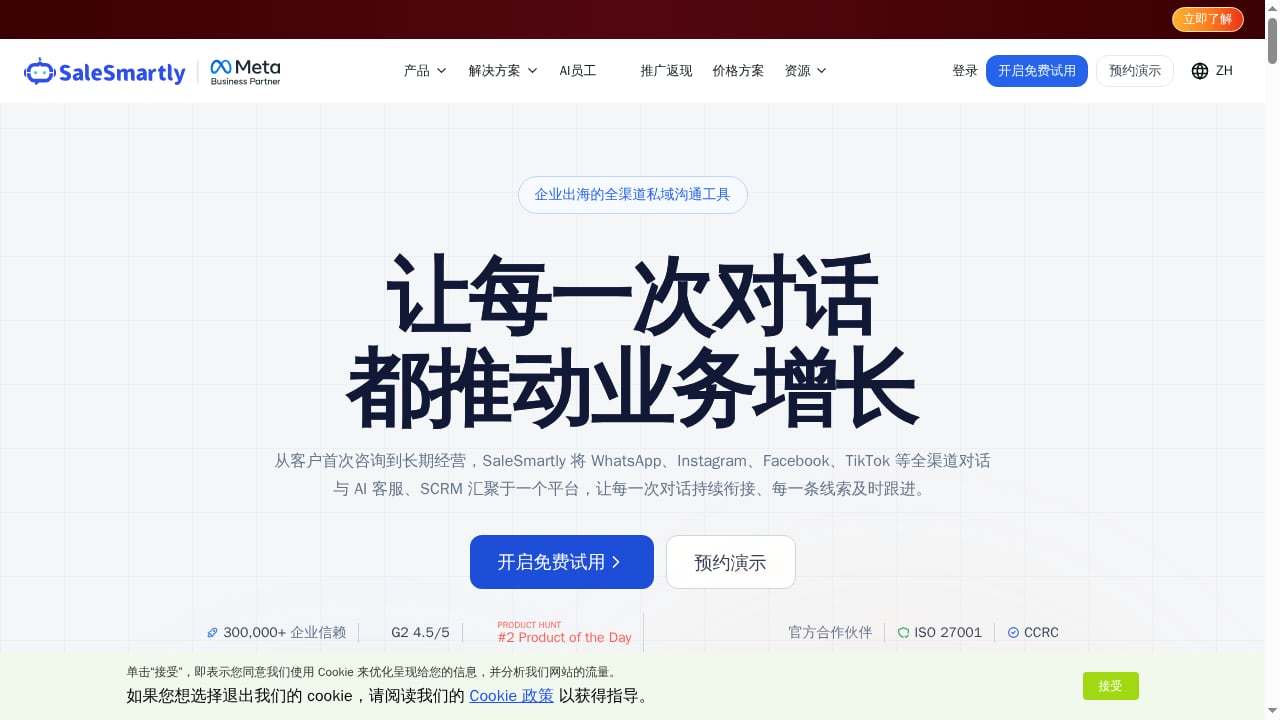
First viewport screenshot of www.salesmartly.com.
Cross-border customers usually have many questions before purchasing: shipping costs, return and exchange policies, and whether the payment method is secure. If customer service can only answer "please place an order on the website," customers need to find the payment entrance themselves, and the conversion path is lengthened. SaleSmartly supports integration with channels such as WhatsApp, Facebook Messenger, Instagram, Telegram, LINE, Email, WeChat, and Zalo, so customer service can complete pre-sales Q&A within the chat window familiar to customers; while PayPal Open provides payment capabilities covering more than 200 markets and over 130 currencies, supporting bank cards, digital wallets, and installment payments. Combining the two is equivalent to putting "communication" and "transaction" in the same conversation flow.
In addition, PayPal Open provides embedded payment solutions for platform-type businesses, including merchant onboarding, PCI compliance, risk management, and payment distribution. For service teams using SaleSmartly to manage multi-channel customers, this means that compliance and risk control in the payment process are handled by PayPal, and the customer service team can focus on communication itself.
How the Two Work Together: How the Communication Layer and Payment Layer Connect

Home and Field Contractor Business Solutions | PayPal US.
This combination can be understood as a two-layer structure:
- Communication layer (SaleSmartly): aggregates messages from various social media and email channels, with human customer service as the main force and AI intelligent customer service as a supplement, covering pre-sales consultation, order follow-up, and after-sales handling.
- Payment layer (PayPal Open): responsible for payment collection, currency conversion, fraud protection, and fund management, supporting multiple payment methods and a global consumer account network.
The connection points are two pieces of information: "payment link" and "order status." After customer service confirms customer needs in a SaleSmartly conversation, they send a PayPal payment link or bill; after the customer completes payment, customer service can update conversation tags and trigger subsequent processes (such as shipping notifications and after-sales follow-up) based on the payment result. This process does not require customers to leave the chat window to search for a payment entrance, nor does it require customer service to repeatedly switch between multiple backends.
Setup Steps: Building a Collaborative Process from Scratch
Step 1: Complete Channel Integration in SaleSmartly
Log in to the SaleSmartly backend and integrate channels such as WhatsApp, Messenger, Instagram, Telegram, LINE, and Email according to business needs. It is recommended to prioritize the two or three channels with the largest customer inquiry volume to avoid rolling out all at once and failing to keep up with responses. After integration, set up customer service groups and assignment rules to ensure that payment-related inquiries are routed to members with the appropriate permissions.
Step 2: Configure PayPal Open Payment Capabilities
Enable the required payment functions in the PayPal merchant backend and confirm the supported currencies and payment methods (bank cards, digital wallets, installments, etc.). If the business involves platform-type transactions, you can further explore PayPal Open's embedded payment and payment distribution capabilities. After configuration, obtain the payment links or bill templates used for payment collection.
Step 3: Establish Connection Rules for "Conversation—Payment—Follow-up"
Design standard actions for the payment stage in SaleSmartly:
- Customer service confirms the product, amount, shipping cost, and currency;
- Send the corresponding PayPal payment link or bill;
- After the customer pays, mark the conversation with a "Paid" tag;
- Trigger shipping notifications or after-sales instructions.
If using AI assistance, the bot can first collect customer intentions and order information, then transfer to a human agent to send the payment link, avoiding bot errors in amount confirmation.
Step 4: Use Data to Review Conversion Bottlenecks
Regularly review two types of data: inquiry volume and response time for each channel in SaleSmartly, and payment success rate and chargebacks on the PayPal side. Separately organize conversations where "inquiry did not lead to payment" and analyze whether the issue is price, shipping cost, or payment method, then optimize scripts or add payment options accordingly.
Real-World Scenarios: Three Typical Use Cases
Scenario 1: Direct Conversion from Social Media Inquiry
A Southeast Asian customer asks about the international shipping cost of a product in an Instagram direct message. After confirming the address in SaleSmartly, customer service directly sends a PayPal payment link that includes the shipping cost. The customer completes payment within the chat window, and customer service immediately sends a logistics notice. The entire process requires no redirection to an independent website, reducing the possibility of abandonment.
Scenario 2: After-Sales Supplementary Payment and Price Difference Handling
After receiving the product, a customer finds that accessories need to be replaced. Customer service explains the supplementary payment amount in a WhatsApp conversation and sends a PayPal bill. After payment is completed, customer service records the customer's after-sales history in SaleSmartly, so similar issues can be quickly retrieved later.
Scenario 3: Payment Guidance for Multi-Currency Customers
When serving customers in Europe and the Middle East, customer service can explain available currencies and payment methods in the conversation based on the currencies supported by PayPal Open, reducing payment failures caused by currency mismatches. For markets with high demand for installment payments, customer service can also explain installment options in advance, lowering the decision threshold.
What Problems Does This Combination Solve
First viewport screenshot of www.salesmartly.com.
| Common Problem | How the Combination Handles It |
|---|---|
| Customers ask about payment methods in chat, but customer service cannot collect payment directly | Customer service sends PayPal payment links within the conversation, shortening the transaction path |
| Messages from multiple platforms are scattered, and payment follow-up is missed | SaleSmartly aggregates messages and tags them, making payment status traceable |
| High pressure from cross-border payment compliance and risk control | PayPal Open handles payment compliance, risk control, and currency conversion |
| Chaotic after-sales supplementary payment process | Conversation records correspond to payment records, reducing reconciliation disputes |
It should be noted that this combination is not suitable for all businesses. If the average order value is extremely low and customers place orders almost without consulting, the marginal value of payment links is limited; if the business is mainly based on large offline contracts, the applicability of PayPal also needs separate evaluation. When making decisions, the main criteria should be "proportion of inquiries" and "payment method preference."
Comparison with Using a Customer Service System or Payment Tool Alone
Food and Beverage Business Solutions | PayPal US.
When using a customer service system alone, the team can reply to messages efficiently, but transactions still depend on customers placing orders themselves, and customer service lacks awareness of payment results. When using PayPal Open alone, the payment collection chain is complete, but no one handles pre-sales questions, making it difficult to control the abandonment rate. The value of combining the two lies in compressing "answering questions" and "payment" into the same conversation, especially suitable for inquiry-driven categories such as customized products, high-ticket accessories, and markets that require manual confirmation of shipping costs.
If the team is small, you can start with a single channel plus PayPal payment links, and after the process runs smoothly, expand to more channels and currencies. SaleSmartly provides multi-channel aggregation and AI assistance, and PayPal Open provides a global payment collection and risk control foundation. The combination does not require launching everything at once; advancing gradually according to business rhythm is more prudent.
Frequently Asked Questions
Which channels does SaleSmartly support?
SaleSmartly supports channels such as WhatsApp, Facebook Messenger, Instagram, Telegram, LINE, Email, VKontakte, WeChat, Zalo, and YouTube, and businesses can choose integrations based on target markets.
What payment methods does PayPal Open support?
PayPal Open supports multiple methods such as bank cards, digital wallets, and installment payments, covering more than 200 markets and over 130 currencies, and merchants can provide corresponding options based on the customer's market.
Is it safe for customer service to send payment links in conversations?
Compliance and risk control in the payment process are handled by PayPal. Customer service only needs to send officially generated payment links or bills and should not collect sensitive information such as customers' card numbers themselves.
What size of team is this combination suitable for?
It can be used from single-person customer service to multi-member groups. Small teams can first run the "inquiry—payment—follow-up" process on a single channel, then gradually expand channels and member permissions.
How to measure the effectiveness of the combination?
You can compare the inquiry conversion rate, payment success rate, and number of after-sales disputes before and after integration. Focus on whether the proportion of conversations where "inquiry did not lead to payment" decreases and whether the average customer service response time remains stable.
Conclusion
The combination of SaleSmartly and PayPal Open essentially reconnects the two links most likely to break in cross-border business—customer communication and payment collection. Customer service completes answering questions and guides payment within familiar channels, the payment platform handles compliance, risk control, and multi-currency processing, and the team continuously optimizes the process through conversation tags and payment data. For cross-border businesses with high inquiry volume and sensitivity to payment methods, this collaborative approach is worth trying first; for businesses with simple processes, the level of investment can be decided based on the actual proportion of inquiries.
Sources and further reading
- SaleSmartly-Partners-Integrated Software SaaS Service Platform - SaleSmartly works with many excellent partners to provide you with more comprehensive, more professional, and more efficient customer chat solutions. Here you can learn about our partner types, advantages, and how to contact them.
- What are some good online customer service systems currently? - SaleSmartly's answer - Zhihu - Mar 24, 2020 ... Crisp is an online customer service system tool specifically for startups, providing excellent real-time customer support and chatbot features. Supported social media integrations: aggregated live chat, Facebook ...
- 2023 Most Comprehensive Online Chat Customer Service System Aggregation Software Recommendations - In this era of globalization, cross-border expansion has become an inevitable choice for many companies to expand their business. However, the accompanying challenges cannot be ignored. Among the diverse social media platforms in the global market, how to quickly integrate multi-channel information has become the key for companies to acquire customers in the international market.