
SaleSmartly vs Fin: Key Differences for Cross-Border Customer Service Selection
Customer communication in cross-border business often spans multiple channels such as WhatsApp, Messenger, Instagram, and email. Teams need human agents to flexibly handle complex issues while also wanting AI to take on repetitive inquiries. Both SaleSmartly and Fin appear on shortlists, but their product positioning differs: the former is an omnichannel communication system built around human agents with AI as a supplement, while the latter is an AI customer agent focused on high resolution rates. This article provides an objective comparison across channel coverage, human-AI collaboration, AI capabilities, pricing, and use cases to help you choose based on your business stage.
1. Product Positioning: Omnichannel Communication System vs AI Customer Agent
Fin product interface.
SaleSmartly is positioned as a one-stop cross-border customer communication platform, centered on a unified inbox and a human agent workspace, with AI customer service as an auxiliary capability covering pre-sales, in-sales, and after-sales stages. It supports channels including WhatsApp, Facebook Messenger, Instagram, Telegram, LINE, Email, VKontakte, WeChat, Zalo, and YouTube, making it suitable for cross-border teams that need to manage multi-platform conversations from a single backend.
Fin is positioned as an AI customer agent, emphasizing autonomous AI resolution of customer issues. According to its public information, Fin serves over 12,000 brands, with an average resolution rate of about 76% and some customers exceeding 85%, handling approximately 2 million resolutions per week and claiming a resolution rate improvement of about 1% per month. Fin 4 is the current version, with extensions such as Fin Voice (voice support), Fin Sales Agent (sales conversations), and Operator (workflow automation).
Simply put, SaleSmartly is more like "the main battlefield for human agents, with AI as an assistant," while Fin is more like "an AI-first customer service agent, with humans as a supplement." This fundamental difference determines the comparisons that follow.
2. Channel Coverage Comparison

Fin product interface.
SaleSmartly: Broad Social Channel Coverage, Suited to Cross-Border Scenarios
SaleSmartly explicitly supports channels including WhatsApp, Facebook Messenger, Instagram, Telegram, LINE, Email, VKontakte, WeChat, Zalo, and YouTube, essentially covering the social messaging tools commonly used by cross-border e-commerce and global brands. For teams operating simultaneously in Southeast Asia, Latin America, the Middle East, and Europe and North America, this multi-channel unification capability reduces switching costs.
Fin: Primarily Website and Help Center, Social Channels Depend on Integrations
Fin's core scenarios are website chat, help center, and ticketing systems. Its public materials emphasize multi-brand help centers, data connectors (Salesforce, Stripe, Shopify, Statuspage), and integrations with tools such as Chili Piper, Calendly, and HubSpot Meetings. For SaaS or e-commerce brands focused primarily on independent website inquiries, this combination is fairly complete; however, if the business relies heavily on instant messaging channels such as WhatsApp, Telegram, or LINE, the integration approach needs additional evaluation.
Selection tip: First list the top 5 customer channels you actually use, then check them against each product's native support list to avoid discovering after launch that your main channel requires a workaround.
3. Human Agents and AI Collaboration Methods
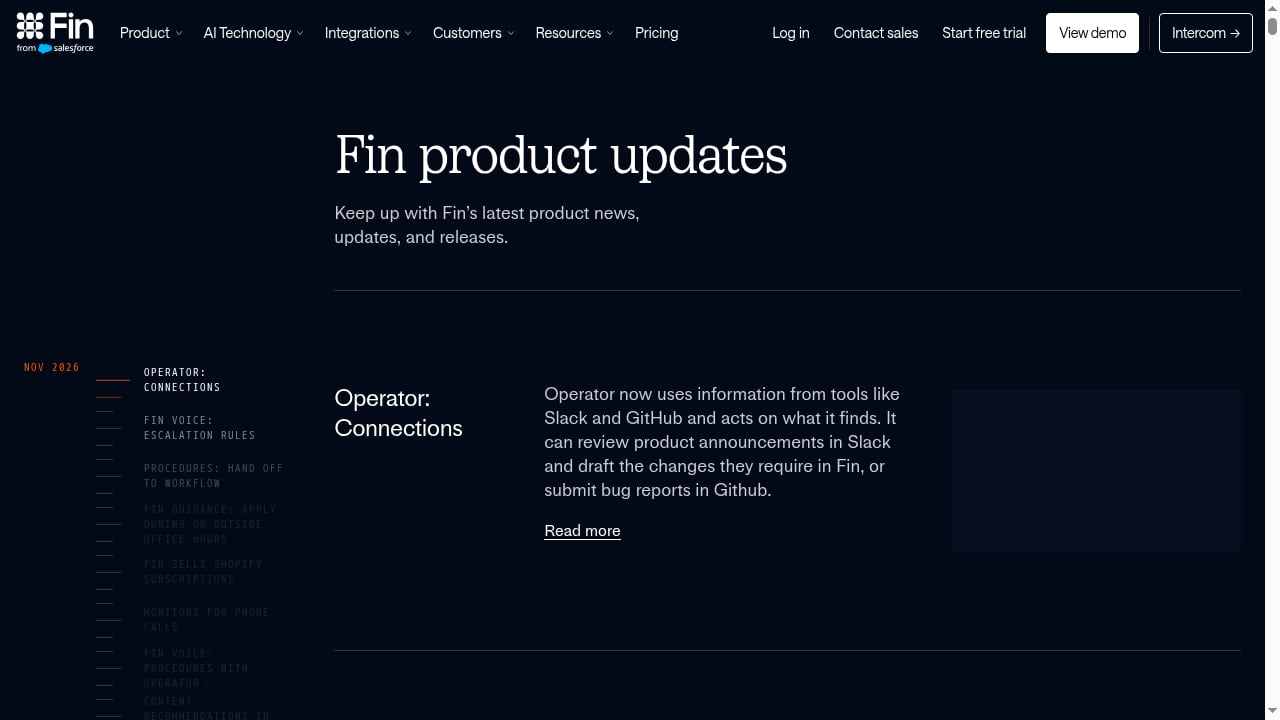
First viewport screenshot of fin.ai.
SaleSmartly: Human-Led with AI Assistance, Clear Handoff Path
SaleSmartly is designed with human agents at its core, with AI customer service handling auxiliary tasks such as automatic replies to common questions and multilingual switching. When a visitor triggers a handoff to a human, the conversation moves from bot management into a pending assignment queue to be handled by a human agent. This mechanism is friendly for teams that need "AI first reception, complex issues handed to humans." For team collaboration, it offers agent performance statistics, ticket assignment, and a quick reply library, suited to division of labor in small and medium teams.
Fin: AI-First, Human Intervention Requires Workflow Design
Fin's strength is autonomous AI resolution, with public data showing an average resolution rate of about 76% that continues to improve. It offers capabilities such as batch testing of answer quality, content guidance for source prioritization, and CX Score for measuring support quality, suitable for teams that want AI to handle most standard inquiries. It is worth noting that even a high AI resolution rate means some issues still require human backup, and teams need to design the trigger conditions and context transfer methods for handoff to humans.
4. AI Capabilities and Controllability
Fin stands out more in AI depth: resolution rate data, monthly improvement margins, the "agentic" direction of Fin 4, and extensions such as voice and sales agents all indicate that it treats AI as the product core. For teams pursuing high automation rates, focused primarily on English-speaking markets, and with mature knowledge base content, Fin's AI performance is worth prioritizing in evaluation.
SaleSmartly's AI leans more toward practical assistance: basic FAQ auto-replies, multilingual switching, and simple conversation flow configuration. It does not pursue "full AI agency" but rather lets AI share repetitive questions and leaves complex communication to humans. For cross-border sellers with higher average order values, a need for personable communication, or customer service teams still primarily human-led, this model is more prudent.
If you want to further understand how AI and humans can work together, you can refer to How to Combine SaleSmartly with OpenAI: A Cross-Border Customer Service AI Implementation Guide, which introduces large model integration and configuration approaches.
5. Pricing and Cost Structure
Fin uses a per-resolution billing model (a common industry practice), where the greater the AI resolution volume, the more costs fluctuate with usage. For businesses with high inquiry volumes and high standardization, this model may be more cost-effective; however, for businesses with volatile inquiry volumes or high average order values, monthly resolution volume and budget caps need careful calculation.
SaleSmartly's pricing typically revolves around seats and feature packages, with human agent team size being the main cost variable. For teams primarily relying on human service with AI as a supplement, costs are more predictable. For specific prices, please refer to the latest quotes on each product's official website; this article does not make absolute conclusions.
6. Use Cases and Selection Recommendations
First viewport screenshot of fin.ai.
| Dimension | SaleSmartly | Fin |
|---|---|---|
| Product positioning | Omnichannel communication system, human-led with AI assistance | AI customer agent, AI-first |
| Channel coverage | WhatsApp, Messenger, Instagram, Telegram, LINE, Email, VKontakte, WeChat, Zalo, YouTube, etc. | Primarily website chat and help center, social channels depend on integrations |
| Human collaboration | Unified inbox, ticket assignment, performance statistics, clear handoff mechanism | Requires workflow design for human backup |
| AI depth | Basic FAQ, multilingual, simple flows | High resolution rate, batch testing, content guidance, CX Score, voice and sales agents |
| Cost model | Primarily seats/packages, more predictable | Per-resolution billing, fluctuates with usage |
When to prioritize SaleSmartly:
- Customer communication is spread across multiple social channels such as WhatsApp, Telegram, and LINE;
- The customer service team is primarily human-led and needs a unified inbox, ticket assignment, and performance management;
- You want AI assistance without fully replacing humans, and the handoff path must be clear;
- The budget needs to be relatively predictable, with team size as the main cost variable.
When to prioritize Fin:
- The business is focused primarily on English-speaking markets and website inquiries, with mature knowledge base content;
- You pursue high AI resolution rates and are willing to pay per resolution;
- You need AI extensions such as voice support, sales agents, and workflow automation;
- The team has the operational capability to continuously optimize the knowledge base and AI answer quality.
If you are still comparing other tools side by side, you can read SaleSmartly vs eesel AI and NiCE CX: A Cross-Border Customer Service Selection Guide and SaleSmartly vs Re:amaze: A Cross-Border Customer Service System Selection Guide for a more comprehensive evaluation from the perspectives of channels, AI, and pricing.
7. Frequently Asked Questions (FAQ)
Can SaleSmartly and Fin be used together?
In theory, yes, but integration costs and data flow methods need to be evaluated. A more common approach is to choose one based on your main channels and team structure, avoiding scattered customer conversations caused by running two systems in parallel.
Does Fin's 76% resolution rate apply to all businesses?
This figure comes from Fin's public information and is a cross-customer average. Actual resolution rates depend on your knowledge base quality, issue complexity, and industry characteristics. It is recommended to run a small-scale test using your own historical inquiry data.
Cross-border sellers who value channel coverage more should choose which one?
If your main channels are instant messaging tools such as WhatsApp, Telegram, and LINE, SaleSmartly's native channel coverage is a better fit; if your main channels are website chat and help center, Fin's AI capabilities are more prominent.
Which is more suitable for larger human agent teams?
SaleSmartly is centered on a human agent workspace and offers collaboration capabilities such as ticket assignment, performance statistics, and quick replies, making it friendlier for organizations with larger human teams. Fin's AI-first model is better suited to organizations with lean human teams and a high proportion of standardized inquiries.
Can the pricing of the two products be compared directly?
Direct comparison of absolute values is not recommended. Fin bills per resolution, while SaleSmartly is primarily seat/package-based. The cost structures differ, so calculations should be based on your own inquiry volume, number of human seats, and AI automation goals.
Conclusion
The difference between SaleSmartly and Fin is essentially the difference between two paths: "human-led with omnichannel coverage" and "AI-first with high resolution rates." For cross-border businesses with dispersed channels, human-led teams, and a need for a clear handoff mechanism, SaleSmartly's omnichannel communication system is better suited to daily operations; for teams focused on website inquiries, with mature knowledge bases and a pursuit of high AI automation rates, Fin's AI agent capabilities are worth prioritizing in evaluation. It is recommended to first run a small-scale test with real inquiry data, then make a final decision based on cost structure.
Reference sources:
- SaleSmartly Partner Page
- Most Popular AI Customer Service Systems Recommended in 2025
- SaleSmartly Human Handoff Service Description
Related reading
- SaleSmartly and Product Fruits Integration Guide: Cross-Border Customer Service and User Onboarding Synergy - A detailed explanation of how SaleSmartly's omnichannel customer service system and the Product Fruits user onboarding platform work together, covering setup steps, practical scenarios, and common questions to help cross-border businesses improve trial conversion and customer retention.