
SaleSmartly vs HubSpot vs Intercom: Which Fits in 2026?
Choosing a customer communication platform in 2026 is less about feature checklists and more about fit. HubSpot and Intercom are two of the most recognized names in the category, and both are credible choices for the right team. SaleSmartly takes a different angle: it is built specifically for cross-border businesses that live inside messaging apps such as WhatsApp, Facebook Messenger, Instagram, Telegram, LINE, and Zalo.
This comparison looks at where each platform genuinely shines, where the trade-offs sit, and how to decide based on your channels, team structure, and budget. If you want a narrower head-to-head first, the SaleSmartly vs HubSpot breakdown covers that pairing in more depth.
Quick comparison at a glance

SaleSmartly vs HubSpot vs Intercom: Which Fits in 2026? - Where Intercom is genuinely strong.
| Criteria | SaleSmartly | HubSpot | Intercom |
|---|---|---|---|
| Primary positioning | Omnichannel messaging for cross-border businesses | Agentic customer platform spanning marketing, sales, service, and CRM | AI-first customer service platform |
| Standout strength | Unified social messaging plus real-time translation in 134 languages | Unified customer data across marketing, sales, and service teams | Fin AI Agent for automated resolution and Copilot for agents |
| Channel breadth | WhatsApp, Messenger, Instagram, Telegram, LINE, Email, VKontakte, WeChat, Zalo, YouTube | Live chat, email, and connected marketing/sales channels | Live chat, email, in-app messaging, phone, Help Center |
| AI approach | AI agents combined with human-led support and automation rules | AI layered across the CRM and hub workflows | Natively integrated AI Agent (Fin) plus Copilot |
| Pricing entry point | Freemium, paid plans starting around $12.72/month | Free tools available; premium tiers via demo | Free trial; outcome-based Essential, Advanced, and Expert plans |
| Best fit | SMBs to large enterprises selling across borders on messaging apps | Teams that want one platform for marketing, sales, and service | Support organizations prioritizing AI resolution rates |
Where HubSpot is genuinely strong
HubSpot has earned its reputation by solving a problem most support tools ignore: fragmentation between marketing, sales, and service. Its customer platform aligns all three functions around shared customer data, so a lead captured by marketing is visible to sales and to the service team handling the follow-up.
Key strengths worth crediting:
- One data spine across teams. Marketing automation, sales sequences, content, and service run on the same CRM record, which reduces handoff friction.
- A real free tier. Teams can start with free tools and upgrade later, which lowers the cost of experimentation.
- Broad ecosystem. Integrations, templates, and a mature partner network make it easy to extend.
- Continuous product investment. Regular updates across Sales Hub, Marketing Hub, and Content Hub keep the platform competitive.
HubSpot is a strong answer when your bottleneck is internal alignment rather than messaging-channel coverage. For a fuller assessment, see this HubSpot review for 2026.
Where Intercom is genuinely strong
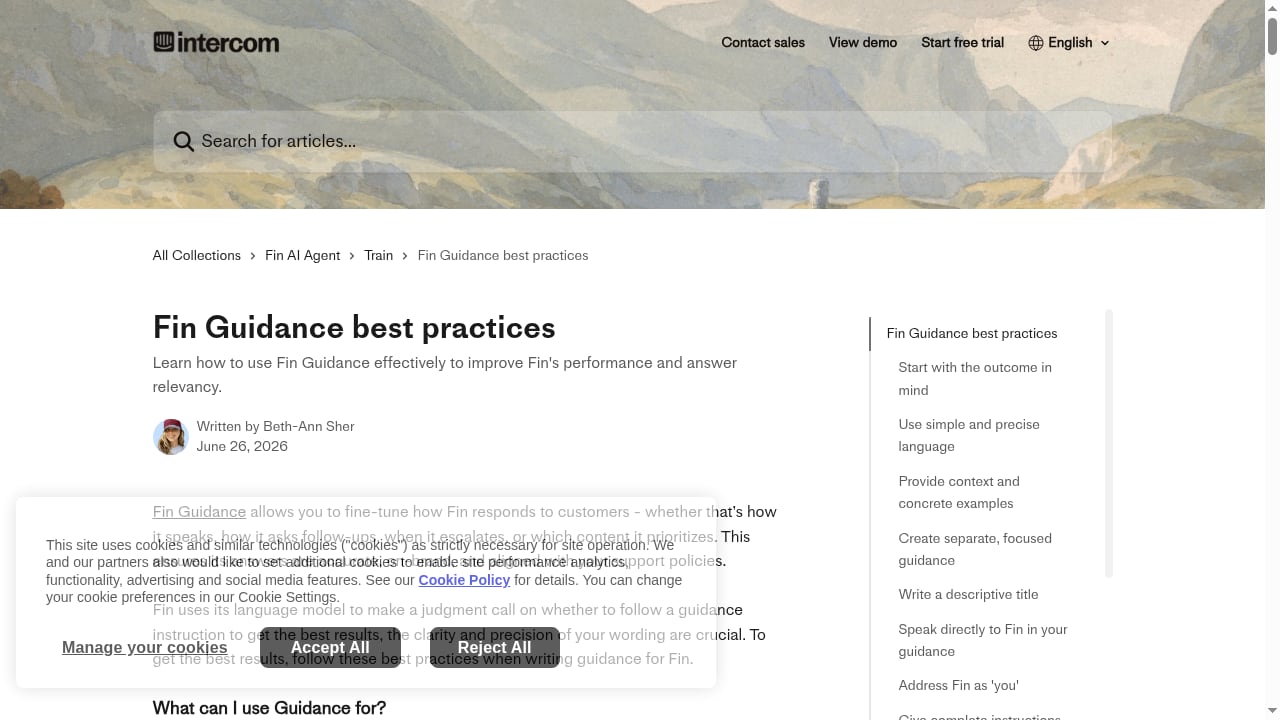
First viewport screenshot of Fin Guidance best practices | Intercom Help.
Intercom has repositioned itself around the AI Agent era, and that focus shows. Fin, its natively integrated AI Agent, is designed to resolve customer questions instantly rather than simply deflect them, while Copilot assists human agents in the background.
Key strengths worth crediting:
- Resolution-first AI. Fin is built into the helpdesk rather than bolted on, which tends to produce cleaner escalation paths.
- Strong self-service layer. The integrated Help Center turns documentation into a deflection and resolution asset.
- Multi-channel support. Live chat, email, in-app messaging, and phone are handled in one place.
- Analytics and outbound. AI Insights and outbound messaging extend the platform beyond reactive support.
- Enterprise credibility. Trusted by a large base of established brands, with a solution partner program for agencies.
Intercom is a strong answer when your priority is automating support volume at scale with measurable resolution outcomes.
Where SaleSmartly has a supported advantage
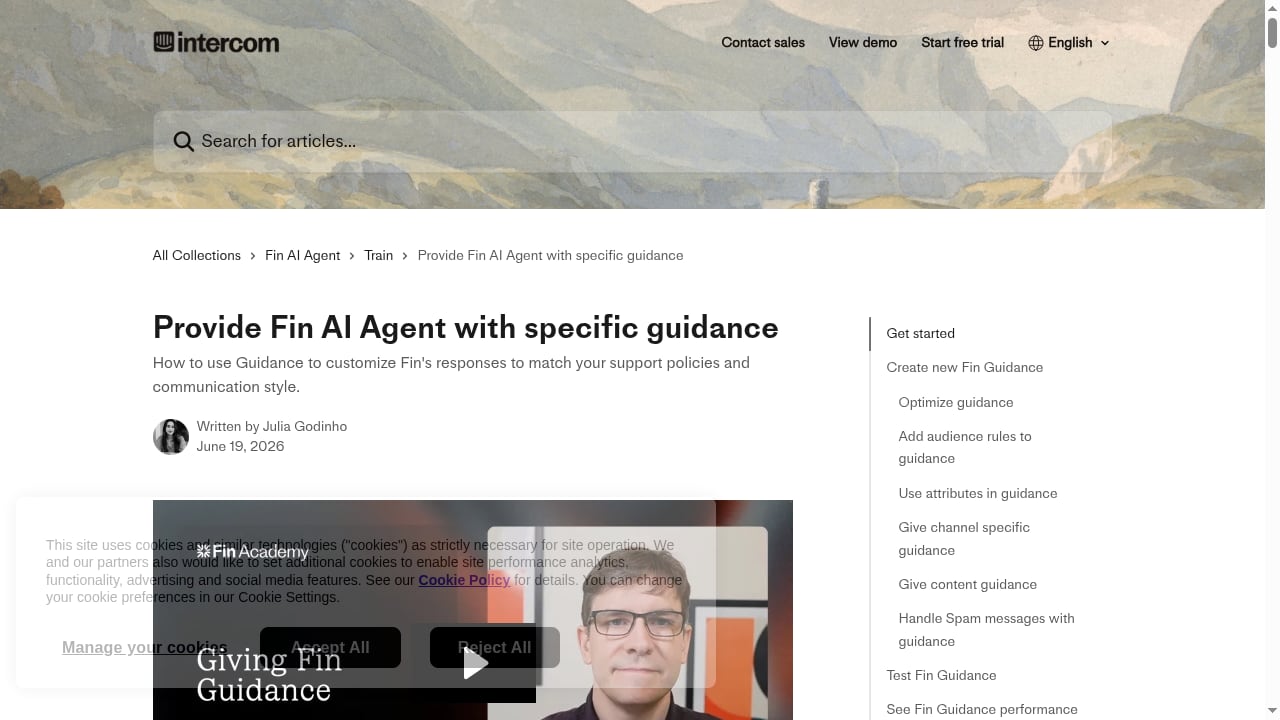
First viewport screenshot of Provide Fin AI Agent with specific guidance | Intercom Help.
SaleSmartly competes on a specific axis: helping cross-border businesses manage high-volume messaging conversations across many social and chat apps, in many languages, without adding headcount linearly.
Unified inbox across messaging-first channels
SaleSmartly integrates WhatsApp, Facebook Messenger, Instagram, Telegram, LINE, Email, VKontakte, WeChat, Zalo, and YouTube into a single interface. For merchants and B2B teams whose customers start conversations inside social apps rather than email, this reduces app-switching and lost threads.
Real-time translation in 134 languages
This is one of the clearest differentiators. Cross-border teams can respond to customers in a language the agent may not speak fluently, which matters for markets across Southeast Asia, Europe, and Latin America.
AI agents plus human-led support
SaleSmartly combines chatbot building and automation rules with AI agents, so routine questions are handled automatically while complex cases route to people. The platform also supports specialized workflows for WhatsApp private-domain marketing, Facebook social service, click-to-message ad conversion, B2B inquiry management, and e-commerce shopping guidance.
Built-in CRM and team collaboration
A built-in CRM keeps customer context next to the conversation, and collaboration tools help teams assign, review, and hand off threads without leaving the inbox.
Accessible pricing and security posture
SaleSmartly offers a freemium model with paid plans starting at $12.72/month, which keeps entry costs low for small teams. It holds ISO 27001, ISO 27701, and CCRC certifications, and reports over 300,000 businesses using the platform with a 4.6/5 rating.
Decision guide: which platform should you choose?
Use these questions to narrow the field quickly.
1. Where do your customers actually message you? If most conversations begin in WhatsApp, Messenger, Instagram, Telegram, LINE, or Zalo, a messaging-first platform fits better than a CRM-first one. If conversations mostly start on your website or in email, HubSpot and Intercom are both comfortable homes.
2. Do you need marketing, sales, and service in one system? If yes, HubSpot's unified data model is hard to beat. If your support stack is already separate and you only need service excellence, Intercom's focus is an advantage rather than a limitation.
3. How much of your volume can AI resolve? Intercom's Fin is built for resolution outcomes. SaleSmartly's AI agents plus automation rules are aimed at messaging-heavy, repetitive inquiry patterns. HubSpot's AI is strongest when it operates on top of your CRM data.
4. How many languages does your team handle? If agents routinely answer in languages they do not speak, SaleSmartly's real-time translation is a practical operational advantage.
5. What is your realistic budget? HubSpot's free tools and Intercom's free trial lower evaluation risk. SaleSmartly's freemium entry and sub-$13 starting plans keep ongoing costs predictable for growing teams.
6. How complex is your rollout? HubSpot and Intercom reward teams that can invest in configuration and adoption. SaleSmartly is designed to be operational quickly for messaging-driven support.
If you are weighing more messaging-centric alternatives alongside these three, the SaleSmartly vs HubSpot vs Respond.io comparison and the SaleSmartly vs HubSpot vs SleekFlow comparison extend the same evaluation criteria to other platforms.
Practical examples by scenario
Cross-border e-commerce store on WhatsApp and Instagram. Orders, shipping questions, and pre-sale inquiries arrive in multiple languages. SaleSmartly's unified inbox, translation, and e-commerce shopping guidance workflows fit this pattern directly.
B2B SaaS with a website-led funnel. Leads arrive through forms and chat, then move through a sales pipeline. HubSpot's shared CRM record across marketing, sales, and service is the natural fit.
Support organization optimizing resolution rate. High ticket volume with a strong knowledge base. Intercom's Fin AI Agent and Help Center are built for exactly this.
Agency managing support for multiple clients. Intercom's solution partner program and HubSpot's partner ecosystem both support this model; SaleSmartly suits agencies running social-first support for cross-border clients.
Related reading
- SaleSmartly vs HubSpot vs DelightChat: 2026 Comparison - Compare SaleSmartly, HubSpot, and DelightChat on omnichannel messaging, AI, Shopify fit, pricing, and cross-border support to choose the right platform.
- SaleSmartly vs HubSpot vs ChatMaxima: 2026 Comparison - Compare SaleSmartly, HubSpot, and ChatMaxima on omnichannel messaging, AI agents, CRM depth, multilingual support, and pricing to pick the right platform.
Sources and further reading
- SaleSmartly - SaleSmartly - Omnichannel customer communication platform with live chat and chatbot integration.
- Which apps are tracked? - Store Leads - The platform for ecommerce data.
- AgentBookSite Directory | Public AgentBooks Sites - Explore public knowledge bases, SEO blogs, documentation hubs, and resource sites built with AgentBooks.
FAQ
Is SaleSmartly a full CRM replacement for HubSpot? No. SaleSmartly includes a built-in CRM focused on conversation context and customer communication. HubSpot's CRM spans marketing, sales, and service data across the entire customer lifecycle. If you need deep lifecycle CRM, HubSpot is the stronger choice.
Does Intercom support WhatsApp and other social messaging apps? Intercom supports multi-channel support including live chat, email, in-app messaging, and phone, with an integrated Help Center. Teams whose primary channels are social and chat apps such as WhatsApp, Telegram, LINE, WeChat, or Zalo should evaluate channel coverage carefully during a trial.
Which platform is cheapest to start with? HubSpot offers free tools, Intercom offers a free trial, and SaleSmartly offers a freemium model with paid plans starting at $12.72/month. The cheapest entry point depends on which features you need on day one.
Can I use more than one of these platforms together? Yes. Some teams run a CRM-first platform for lifecycle data and a messaging-first platform for social and chat support. The trade-off is integration overhead and duplicated context.
What matters most for cross-border support? Channel coverage, language handling, response speed, and cost per conversation. Real-time translation and unified messaging inboxes reduce the operational load more than any single AI feature.
Conclusion
HubSpot, Intercom, and SaleSmartly are not interchangeable, and that is the point. HubSpot wins when the goal is aligning marketing, sales, and service around one customer record. Intercom wins when the goal is AI-driven resolution at scale with a strong self-service layer. SaleSmartly wins when the goal is managing high-volume, multilingual conversations across messaging apps for cross-border customers, at a price point that works for growing teams.
Start with your channels and your language mix. Those two answers usually make the decision obvious.