
SaleSmartly vs HubSpot vs LiveChat: Which Fits in 2026?
Choosing a customer communication platform in 2026 means deciding how you want conversations to flow: through a broad CRM suite, a focused live chat tool, or an omnichannel messaging hub built for cross-border teams. SaleSmartly, HubSpot, and LiveChat each solve a different version of that problem. This comparison breaks down where each platform is genuinely strong, where the trade-offs sit, and which one matches your team's actual workflow.
The short answer

LiveChat product interface.
- HubSpot is the broadest option: a full customer platform that ties marketing, sales, service, and CRM data together. Best for teams that want one system of record and are ready to invest in it.
- LiveChat is the most focused option: fast, polished website chat with AI assistance and a large integration library. Best for teams whose main channel is their website.
- SaleSmartly is the most messaging-native option: an AI-powered omnichannel inbox built for social and messaging apps, with real-time translation and cross-border workflows. Best for teams that live in WhatsApp, Messenger, Instagram, and similar channels.
Where HubSpot is strong
HubSpot's core advantage is breadth. It aligns marketing, sales, and service around a shared customer record, so a support ticket, a deal, and a campaign can all reference the same contact history. If your team already runs campaigns in Marketing Hub or pipelines in Sales Hub, adding Service Hub keeps everything in one place instead of stitching tools together.
HubSpot also lowers the entry barrier with free tools. You can start with a free CRM and basic tools at no cost, then move to premium tiers when you need advanced automation or reporting. The trade-off is that the deepest capabilities sit in higher-priced bundles, and the platform's center of gravity is CRM and marketing operations rather than high-volume social messaging.
Choose HubSpot if: your priority is a unified customer database and you want marketing, sales, and service under one roof.
Where LiveChat is strong
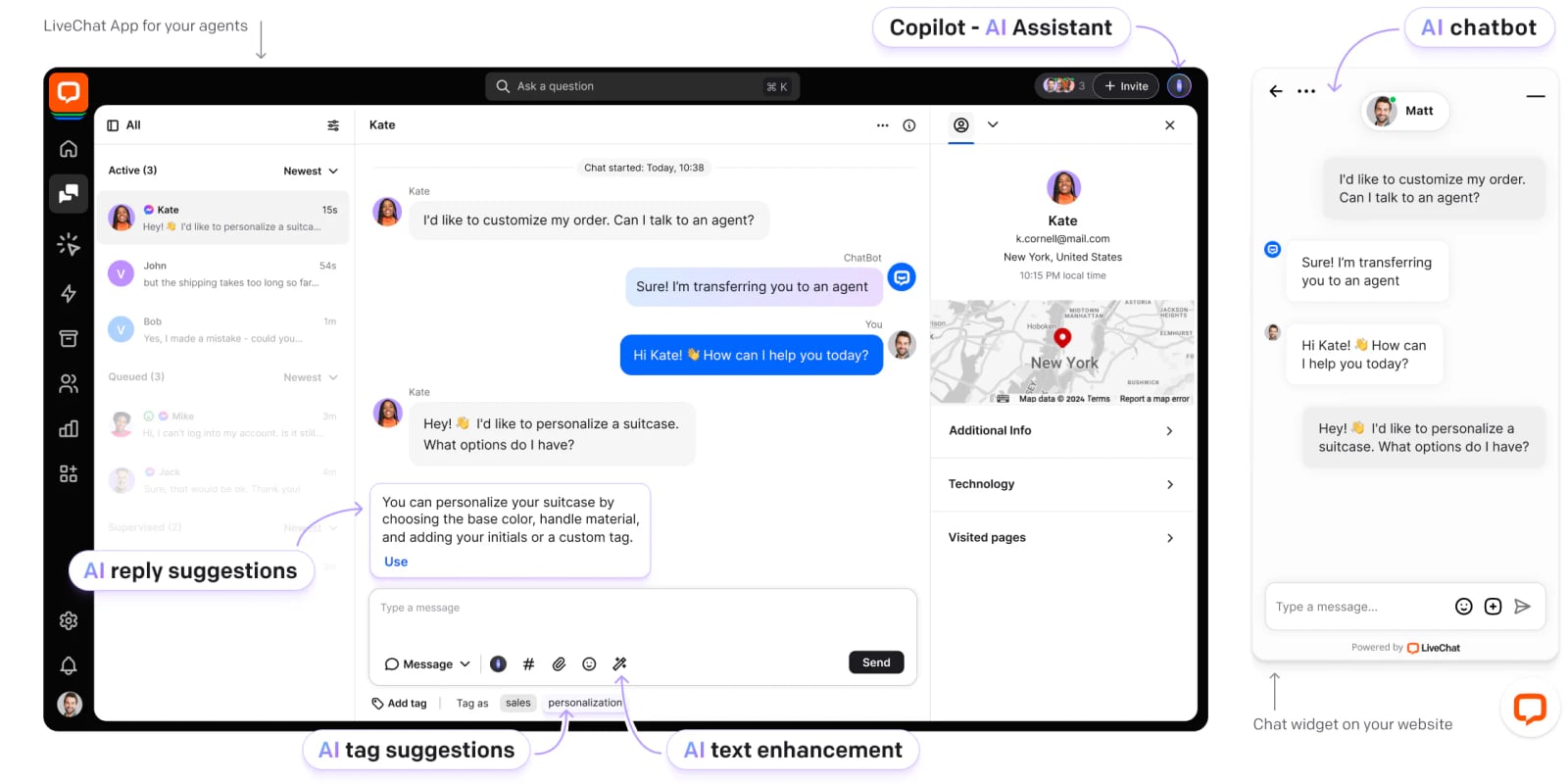
LiveChat product interface.
LiveChat does one thing very well: real-time website conversations. The customizable chat widget, canned responses, chat routing, and reporting are mature and easy to deploy. Its AI features, including Copilot and AI agents, help agents draft replies and handle routine questions without leaving the chat window.
Its integration library is a real asset. With 200+ apps, including Shopify, Salesforce, and HubSpot, LiveChat slots into an existing stack rather than replacing it. It also supports several messaging channels beyond the website, such as Facebook Messenger, WhatsApp, SMS, and email, so it is not strictly a website-only tool. For enterprise buyers, LiveChat offers security, reliability, and scalability commitments.
Choose LiveChat if: website chat is your primary support and sales channel, and you want a tool your team can master quickly.
Where SaleSmartly fits best
SaleSmartly is built around a different assumption: that customer conversations increasingly happen in messaging apps, not on a single website widget. It consolidates WhatsApp, Facebook Messenger, Instagram, Telegram, LINE, Email, VKontakte, WeChat, Zalo, and YouTube into one unified inbox, so agents do not switch between apps to answer the same customer.
Three capabilities stand out for cross-border teams:
- Real-time translation in 134 languages. Agents can read and reply in their own language while the customer receives the message in theirs. For teams serving multiple regions, this removes the need to hire per-language coverage for every shift.
- AI agents plus human handoff. Chatbot building and automation rules handle routine questions, then route complex cases to people. This is the pattern that keeps response times low without making customers feel stuck in a bot loop.
- Message-based growth workflows. Beyond support, SaleSmartly supports WhatsApp private-domain marketing, click-to-message ad conversion, B2B inquiry management, and e-commerce shopping guidance, which connects conversations to revenue rather than treating them as a cost center.
SaleSmartly also includes a built-in CRM, team collaboration tools, and advanced analytics, with ISO 27001, ISO 27701, and CCRC security certifications. Pricing starts at $12.72/month with a freemium entry point, which makes it accessible for small teams while still scaling to larger operations.
Choose SaleSmartly if: your customers reach you through messaging apps across multiple countries, and you need translation, automation, and a shared inbox in one place.
Head-to-head comparison
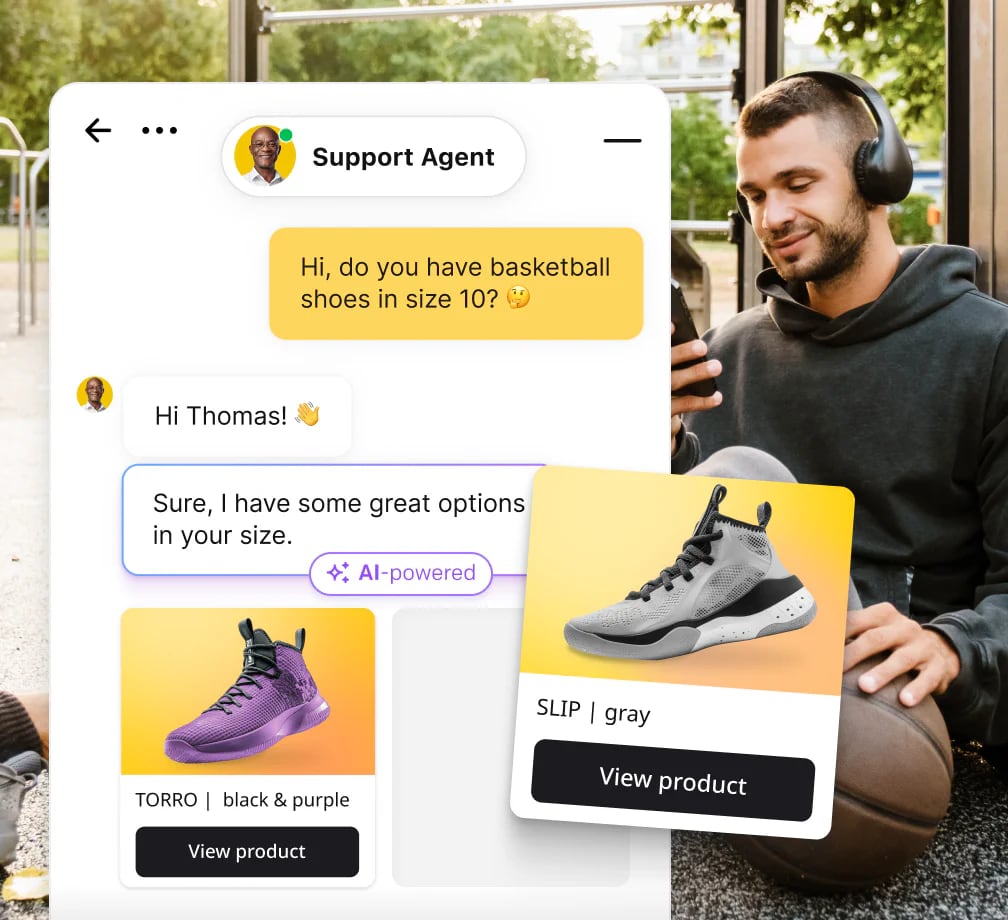
LiveChat product interface.
| Criteria | SaleSmartly | HubSpot | LiveChat |
|---|---|---|---|
| Primary strength | Omnichannel messaging and AI automation | Unified CRM, marketing, sales, and service | Website live chat with AI assistance |
| Channel coverage | WhatsApp, Messenger, Instagram, Telegram, LINE, Email, VKontakte, WeChat, Zalo, YouTube | Website, email, and connected channels via integrations | Website, Facebook Messenger, WhatsApp, SMS, email, Apple Messages for Business |
| Real-time translation | 134 languages | Not a core feature | Not a core feature |
| AI and automation | AI agents, chatbot builder, automation rules | AI across marketing, sales, and service workflows | Copilot, AI agents, canned responses, routing |
| CRM | Built-in CRM | Full CRM platform | Via integrations |
| Integrations | Messaging-first integrations | Large app ecosystem | 200+ apps including Shopify, Salesforce, HubSpot |
| Entry pricing | Freemium; from $12.72/month | Free tools; premium tiers via demo | Paid plans with tiered features |
| Best fit | Cross-border, messaging-led teams | Teams standardizing on one customer platform | Website-centric support and sales teams |
How to decide in practice

LiveChat product interface.
Work backward from where your conversations actually start.
- If most conversations start on your website, LiveChat's focused chat experience and integration depth are hard to beat. You will not pay for channels you do not use.
- If you need one customer record across marketing, sales, and service, HubSpot's platform approach avoids the integration work of connecting separate tools. Budget for the tier that includes the automation you need.
- If conversations start in WhatsApp, Messenger, or other messaging apps across regions, SaleSmartly's unified inbox, translation, and AI agents address problems the other two largely leave to integrations.
A practical test: list your top five inbound channels and your top three languages. If that list is mostly messaging apps and more than one language, an omnichannel messaging platform will usually reduce tooling and staffing complexity faster than a CRM suite or a website chat tool.
For deeper comparisons against other tools in the same category, see SaleSmartly vs HubSpot vs Respond.io and SaleSmartly vs HubSpot vs Intercom. If your stack is Shopify-heavy, SaleSmartly vs HubSpot vs DelightChat covers that scenario in more detail.
Related reading
- SaleSmartly vs HubSpot vs Wati: Best AI Engagement Platform - Compare SaleSmartly, HubSpot, and Wati on omnichannel messaging, AI agents, CRM, translation, and pricing to choose the right customer engagement platform.
- SaleSmartly vs HubSpot vs Olark: Best Fit for 2026 - Compare SaleSmartly, HubSpot, and Olark on omnichannel messaging, AI agents, CRM, translation, and pricing to pick the right platform for 2026.
- SaleSmartly vs HubSpot vs Zendesk: Which Fits in 2026? - Compare SaleSmartly, HubSpot, and Zendesk on omnichannel messaging, AI agents, CRM, translation, pricing, and cross-border support to pick the right fit.
Sources and further reading
- Sleekflow vs Salesmartly - Which Omnichannel Platform is Better? - Sleekflow vs Salesmartly - Which Omnichannel Platform is Better? In case you’re struggling to keep up with customer messages across WhatsApp, Facebook, and y...
- How to Scale Your Marketing With AI for Business Growth? - Want to scale your marketing with AI for business growth? This guide covers content, email, ads, and automation with step-by-step advice for any team size.
- SaleSmartly - SaleSmartly - Omnichannel customer communication platform with live chat and chatbot integration.
FAQ
Is SaleSmartly a replacement for HubSpot?
Not exactly. HubSpot is a full customer platform spanning marketing, sales, and service. SaleSmartly focuses on omnichannel customer communication, AI automation, and a built-in CRM for messaging-led teams. Some businesses use SaleSmartly for conversations and keep HubSpot for marketing operations.
Does LiveChat support WhatsApp and other messaging apps?
Yes. LiveChat supports website chat plus Facebook Messenger, WhatsApp, SMS, email, and Apple Messages for Business. Its center of gravity, however, remains website live chat, while SaleSmartly is designed messaging-app-first.
Which platform offers real-time translation?
SaleSmartly offers real-time translation in 134 languages, which is a core part of its cross-border positioning. HubSpot and LiveChat do not list real-time translation as a core feature.
How does pricing compare?
HubSpot offers free tools with premium tiers available via demo. LiveChat uses paid plans with tiered features. SaleSmartly offers a freemium model with plans starting at $12.72/month, which makes it easy to test before committing.
Can I use more than one of these platforms together?
Yes. A common setup is HubSpot as the CRM and marketing system, with SaleSmartly or LiveChat handling live conversations. LiveChat also integrates with HubSpot, so that combination is supported natively.
Conclusion
There is no single winner here, because the three platforms optimize for different starting points. HubSpot wins when you need one customer platform across marketing, sales, and service. LiveChat wins when website chat is your primary channel and you want a focused, fast-to-deploy tool. SaleSmartly wins when your customers live in messaging apps across multiple languages and you need translation, AI automation, and a unified inbox without stitching together separate products.
Start with your channel list and your language list. Those two inputs will point you to the right platform faster than any feature checklist.