
SaleSmartly vs Intercom vs DelightChat: Which Platform Wins?
Choosing between SaleSmartly, Intercom, and DelightChat comes down to one question: what kind of business are you running? Intercom is built for AI-first support operations at scale. DelightChat is purpose-built for Shopify merchants who want support and WhatsApp marketing in one place. SaleSmartly sits between them, targeting cross-border teams that need broad channel coverage, built-in translation, and automation without enterprise pricing. This comparison breaks down the strengths of each platform so you can match the tool to your actual workflow.
Quick Verdict
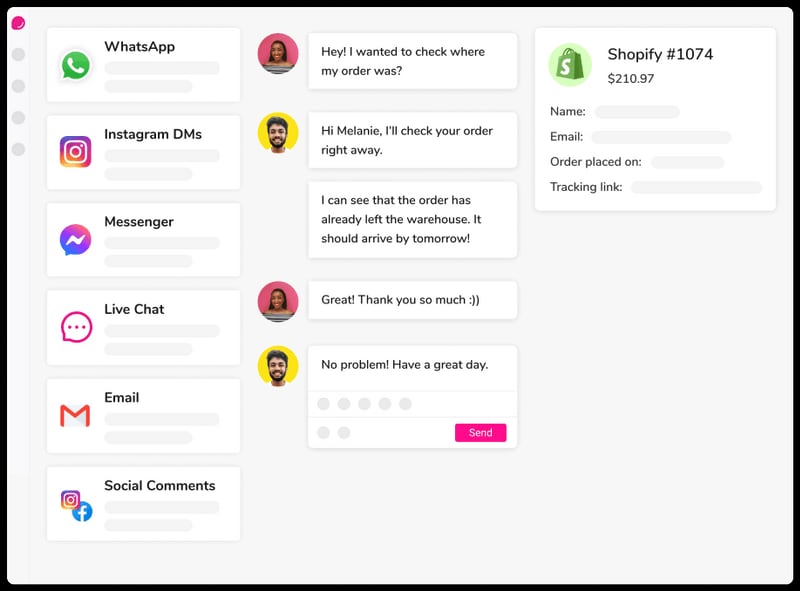
DelightChat product interface.
- Choose Intercom if you run a mid-market or enterprise support team and want a mature AI Agent, advanced automation, and a polished helpdesk.
- Choose DelightChat if you operate a Shopify or D2C store and want WhatsApp marketing, abandoned cart recovery, and order-aware support in a single tool.
- Choose SaleSmartly if you serve customers across many countries and channels, need real-time translation in 134 languages, and want AI automation at a lower starting price.
How the Three Platforms Compare at a Glance
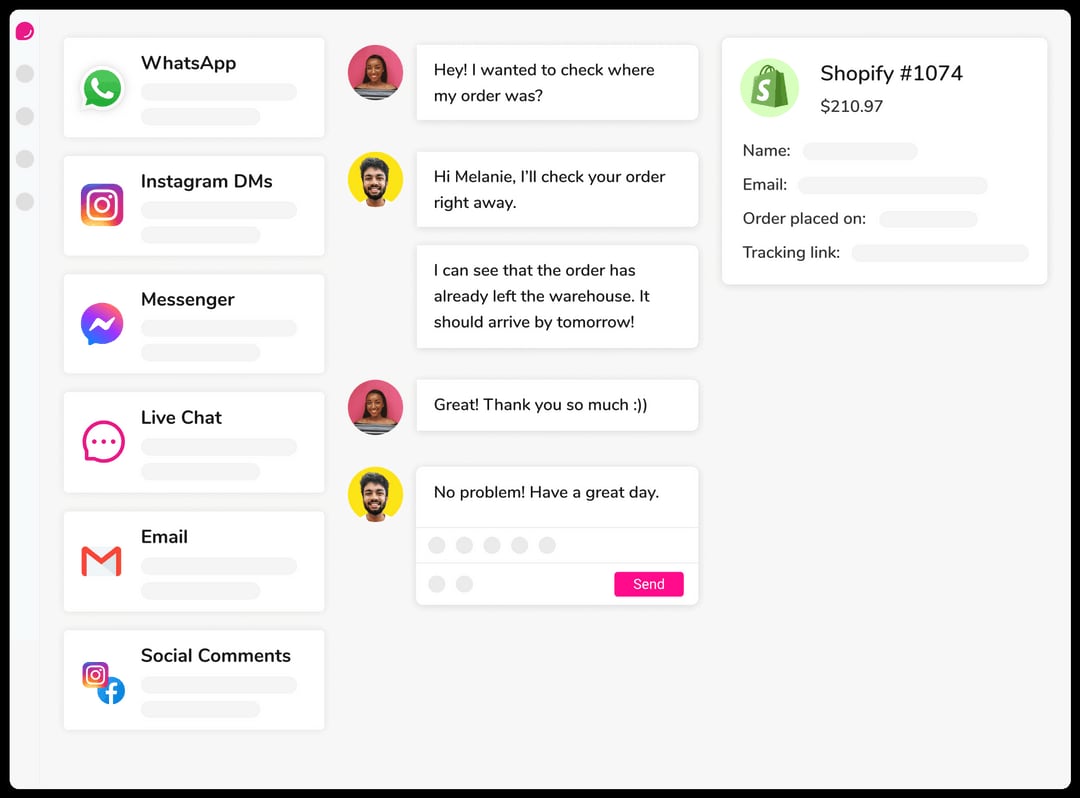
DelightChat product interface.
| Criteria | SaleSmartly | Intercom | DelightChat |
|---|---|---|---|
| Core positioning | AI-powered omnichannel communication for cross-border businesses | AI-first customer service platform for the AI Agent era | Omnichannel support and WhatsApp marketing for Shopify brands |
| Starting price | $12.72/month | $39/month (Essential plan) | $29/month |
| Free tier | Yes | Free trial only | 14-day free trial |
| Channel coverage | 10+ channels including WhatsApp, Messenger, Instagram, Telegram, LINE, Email, VKontakte, WeChat, Zalo, YouTube | Live chat, email, in-app messaging, phone, WhatsApp, Messenger, Instagram | WhatsApp, Instagram, Facebook, Email, Live Chat |
| Built-in translation | 134 languages | Fin AI supports 45 languages | Not a headline feature |
| Shopify integration | Available | Available | Deep native integration |
| WhatsApp marketing | Broadcasts and private-domain marketing | Outbound messaging | Broadcasts, abandoned cart, COD verification, order notifications |
| Best fit | Cross-border sellers, SMBs to enterprises | Mid-market and enterprise support teams | Shopify and D2C ecommerce brands |
Intercom: The AI-First Support Powerhouse
First viewport screenshot of Provide Fin AI Agent with specific guidance | Intercom Help.
Intercom has repositioned itself aggressively around AI. Its flagship Fin AI Agent resolves conversations end-to-end, while Fin AI Copilot assists human agents with suggested replies and summaries. For teams that treat support as a core operational function, this is a serious advantage.
Where Intercom Excels
A mature AI Agent ecosystem. Fin is not a bolt-on chatbot. It is natively integrated into the helpdesk, trained on your help center content, and capable of resolving a meaningful share of inbound conversations without human intervention. Intercom also provides AI Insights to surface recurring issues and automation opportunities. For support leaders who want to reduce ticket volume rather than just manage it faster, this is the strongest offering of the three.
A polished, agent-first helpdesk. The shared inbox, collision detection, macros, and workflow builder are refined through years of enterprise use. Teams that handle complex, multi-step support scenarios will appreciate the depth of routing and escalation controls.
Outbound and lifecycle messaging. Intercom supports proactive messaging through in-app banners, email, and chat. This makes it useful not only for reactive support but also for onboarding, feature announcements, and re-engagement campaigns.
Where Intercom Demands Caution
Pricing is the most common friction point. The Essential plan starts at $39 per seat per month, but Fin AI usage is billed separately at $0.99 per resolution. For high-volume teams, AI costs can scale unpredictably. Intercom also assumes a certain operational maturity; smaller teams may find the platform's depth more than they need.
DelightChat: Shopify-Native Support Meets WhatsApp Marketing
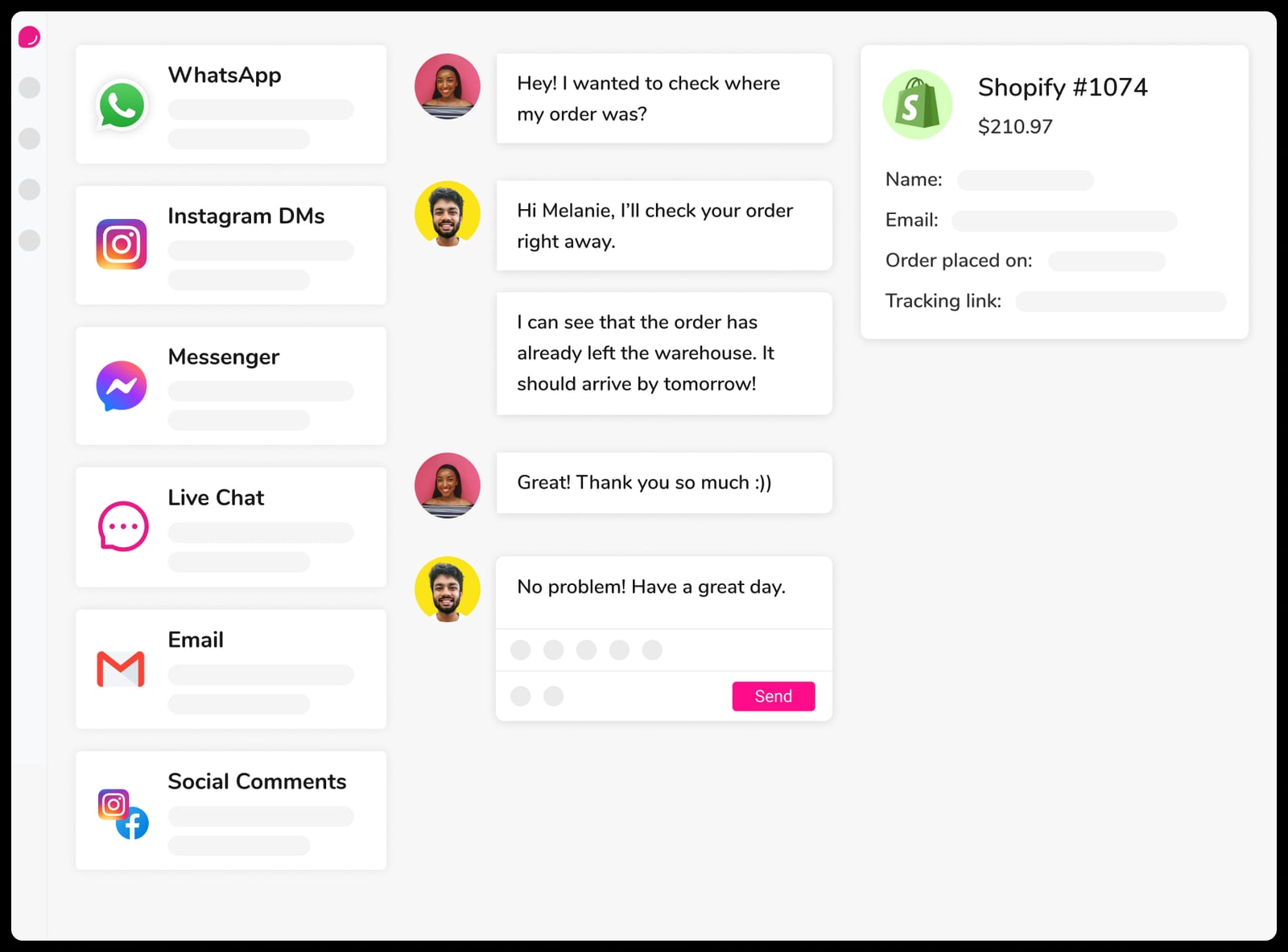
DelightChat product interface.
DelightChat takes a different path. Instead of trying to serve every type of business, it goes deep on one vertical: Shopify and D2C ecommerce. That focus shows in everything from the inbox design to the marketing features.
Where DelightChat Excels
Deep Shopify integration. Order data appears directly in the inbox, so agents see what a customer bought, when it shipped, and whether a return is in progress without leaving the conversation. For ecommerce support teams, this context dramatically reduces resolution time.
WhatsApp marketing built in. DelightChat uses the Official WhatsApp Business API to send promotional broadcasts, recover abandoned carts, automate order notifications, and verify cash-on-delivery orders. The platform reports that WhatsApp marketing can deliver returns up to 26x investment with conversion rates 7.1x higher than email. For D2C brands, this turns the support tool into a revenue channel.
Unlimited team members. Unlike seat-based pricing from Intercom, DelightChat plans include unlimited team members. For growing ecommerce teams, this removes a major cost variable.
Strong Shopify App Store reputation. A 4.9 rating across more than 1,000 merchants signals consistent satisfaction within its niche.
Where DelightChat Shows Limits
DelightChat is not a general-purpose platform. If your business is not on Shopify, most of its differentiators disappear. Channel coverage is also narrower than SaleSmartly's: no Telegram, LINE, VKontakte, WeChat, or Zalo. For cross-border sellers targeting Southeast Asia, Latin America, or Eastern Europe, that is a material gap.
SaleSmartly: Broad Channel Coverage for Cross-Border Teams
SaleSmartly's core bet is that global businesses need to meet customers on whatever channel they already use. It integrates WhatsApp, Facebook Messenger, Instagram, Telegram, LINE, Email, VKontakte, WeChat, Zalo, and YouTube into one inbox. That is meaningfully broader than either Intercom or DelightChat.
Where SaleSmartly Excels
Real-time translation in 134 languages. For cross-border teams, this is a differentiator neither competitor matches. Intercom's Fin supports 45 languages; DelightChat does not position translation as a core feature. SaleSmartly lets a small team in one country serve customers in Thai, Vietnamese, Arabic, Turkish, and dozens of other languages without hiring multilingual staff.
Freemium entry point. SaleSmartly offers a free tier, and paid plans start at $12.72 per month. Intercom starts at $39 per seat with AI billed separately. For budget-conscious SMBs, SaleSmartly's entry cost is substantially lower.
Automation and chatbot building without usage-based AI fees. SaleSmartly includes automation rules, chatbot flows, and AI agent replies in its plans. There is no per-resolution surcharge like Intercom's Fin pricing model.
Security certifications for enterprise buyers. ISO 27001, ISO 27701, and CCRC certifications matter for businesses handling customer data across borders, particularly in regulated industries.
Where SaleSmartly Requires Trade-offs
SaleSmartly is not as deep as Intercom in enterprise helpdesk workflows, and it is not as Shopify-native as DelightChat. Teams that need advanced ticket routing, SLA management, or complex lifecycle automation may find Intercom more capable. Shopify merchants who want turnkey WhatsApp marketing flows may find DelightChat's templates and order-aware campaigns more immediately useful.
Head-to-Head: Key Decision Criteria
AI and Automation
Intercom leads in AI maturity. Fin's ability to resolve conversations autonomously, combined with Copilot for agents and AI Insights for analytics, makes it the strongest choice for teams that want to reduce headcount pressure through automation. SaleSmartly offers solid AI agent capabilities, intent detection, and automated workflows at a lower price point, but without the same depth of enterprise AI tooling. DelightChat uses GPT-generated drafts and rewrites to speed up agent responses, but its AI is assistive rather than autonomous.
Omnichannel Reach
SaleSmartly wins on breadth. Ten-plus channels including region-specific apps like Zalo, LINE, VKontakte, and WeChat make it the default choice for cross-border sellers. Intercom covers the mainstream Western channels well but lacks the same regional depth. DelightChat covers the channels that matter to Shopify merchants: WhatsApp, Instagram, Facebook, Email, and Live Chat.
Multilingual Support
SaleSmartly's 134-language real-time translation is the clear winner. Intercom's Fin supports 45 languages, which is respectable but narrower. DelightChat does not emphasize built-in translation, making it less suitable for teams serving linguistically diverse markets.
Ecommerce Depth
DelightChat wins for Shopify stores. Order data in the inbox, abandoned cart recovery, COD verification, and WhatsApp broadcast templates are purpose-built for D2C workflows. SaleSmartly offers ecommerce shopping guidance and WhatsApp private-domain marketing, but without the same Shopify-native depth. Intercom can integrate with Shopify but treats ecommerce as one use case among many.
Pricing and Total Cost of Ownership
SaleSmartly has the lowest entry point at $12.72/month with a free tier. DelightChat starts at $29/month with unlimited team members, which is compelling for larger ecommerce teams. Intercom starts at $39 per seat with Fin AI billed at $0.99 per resolution, which can become the most expensive option at high volumes.
Decision Guide: Which Platform Fits Your Business?
Choose Intercom if...
- You run a mid-market or enterprise support team
- You want an AI Agent that resolves tickets autonomously
- You need advanced helpdesk workflows, routing, and analytics
- You are willing to pay per-seat plus AI usage fees
- Your channels are primarily live chat, email, in-app messaging, and phone
Choose DelightChat if...
- You run a Shopify or D2C ecommerce brand
- You want WhatsApp marketing and support in one platform
- You need abandoned cart recovery and COD verification
- You want unlimited team members without per-seat costs
- Your customers contact you through WhatsApp, Instagram, Facebook, or email
Choose SaleSmartly if...
- You sell across multiple countries and regions
- You need real-time translation in 134 languages
- You want broad channel coverage including Zalo, LINE, Telegram, and VKontakte
- You want AI automation without per-resolution fees
- You are budget-conscious and want a freemium entry point
For a deeper look at how SaleSmartly stacks up against other popular platforms, see our comparisons with tawk.to and Respond.io. If you are evaluating HubSpot's customer platform alongside these tools, the SaleSmartly vs HubSpot vs Wati comparison adds useful context.
Related reading
- SaleSmartly vs Olark vs Respond.io: Which Chat Platform Wins? - Compare SaleSmartly, Olark, and Respond.io on AI agents, omnichannel reach, multilingual support, pricing, and cross-border fit. Find your best match.
Sources and further reading
- DelightChat vs. SaleSmartly Comparison - SourceForge - Compare DelightChat vs. SaleSmartly using this comparison chart. Compare price, features, and reviews of the software side-by-side to make the best choice for your business.
- Compare DelightChat vs. SaleSmartly in 2026 - What’s the difference between DelightChat and SaleSmartly? Compare DelightChat vs. SaleSmartly in 2026 by cost, reviews, features, integrations, and more
- How to Choose the Right Customer Service System for Global Teams: Features, Team Fit & Budget - Compare SaleSmartly, ManyChat, Intercom & Zendesk for global customer service. Learn key features, pricing, and how to choose the best tool for your expanding business.
Frequently Asked Questions
Is Intercom worth the higher price?
For teams that can use Fin AI Agent to resolve a meaningful share of conversations, yes. The per-resolution fee can be offset by reduced agent workload. For small teams with low ticket volume, the math is less favorable, and SaleSmartly or DelightChat may deliver better value.
Can DelightChat work for non-Shopify businesses?
Technically yes, but its core advantages—order data in the inbox, abandoned cart recovery, COD verification—are built around Shopify. Non-Shopify businesses would be paying for features they cannot fully use.
Does SaleSmartly support WhatsApp Business API?
Yes. SaleSmartly integrates WhatsApp including Business API, enabling broadcasts, automated replies, and private-domain marketing campaigns.
Which platform is best for a small cross-border ecommerce team?
SaleSmartly is often the best starting point due to its free tier, low starting price, 134-language translation, and broad channel coverage. As the business grows, teams can evaluate whether Intercom's deeper AI or DelightChat's Shopify-native marketing justifies a switch.
How do the AI features differ?
Intercom's Fin is an autonomous AI Agent designed to resolve conversations. SaleSmartly's AI agents automate conversations and support human agents with intent detection and routing. DelightChat's AI assists agents with GPT-generated drafts and rewrites rather than acting autonomously.
Conclusion
Intercom, DelightChat, and SaleSmartly are all strong platforms, but they solve different problems. Intercom is the enterprise-grade, AI-first helpdesk for teams that treat support as a strategic function. DelightChat is the Shopify-native tool that turns customer communication into a revenue channel through WhatsApp marketing. SaleSmartly is the cross-border workhorse that unifies the widest range of channels and languages at the most accessible price point.
The right choice depends on your business model, your markets, and your budget. A Shopify merchant in a single market will likely find DelightChat's focus refreshing. A scaling SaaS company with complex support needs will appreciate Intercom's depth. A cross-border seller serving customers across Southeast Asia, Latin America, and Europe will get the most immediate value from SaleSmartly's translation and channel coverage. Match the platform to the problem you actually have, not the one in the vendor's demo.