
Top 10 AI Omnichannel CRM and Customer Experience Platforms for 2026
Customers now expect one continuous conversation with a brand, whether they start on WhatsApp, browse a product page, message Instagram, or call support. AI omnichannel CRM and customer experience platforms promise to make that possible by unifying channels, customer data, and automation in one system. But the category is crowded, and vendors define "omnichannel" very differently.
This review ranks ten platforms that genuinely operate as AI omnichannel CRM or customer experience platforms in 2026. Each entry explains what the product actually does, where it fits, and what to watch out for. We also explain our evaluation criteria so you can adapt the ranking to your own priorities.
How We Evaluated These Platforms
First viewport screenshot of www.omnichat.ai.
No single score fits every business, so we weighted five criteria and used vendor documentation, published pricing, and independent reviews as evidence.
- Channel breadth and depth: Native support for messaging apps, live chat, email, voice, and social channels, not just connectors that require extra tools.
- AI capability: Whether AI resolves issues end to end, assists agents, or only suggests replies. Resolution quality matters more than deflection volume.
- Customer data and CRM depth: Unified profiles, segmentation, journey orchestration, and integration with eCommerce, POS, and back-office systems.
- Operational fit: Ease of setup, admin controls, reporting, and suitability for the teams who will actually use it.
- Pricing transparency and scalability: Published plans, usage-based costs, and how costs behave as contact volume grows.
We excluded pure helpdesks, standalone survey tools, and chatbot builders that do not manage customer relationships across channels. Products are ranked by how completely they deliver the combined promise of omnichannel CRM and customer experience.
The Top 10 Platforms for 2026
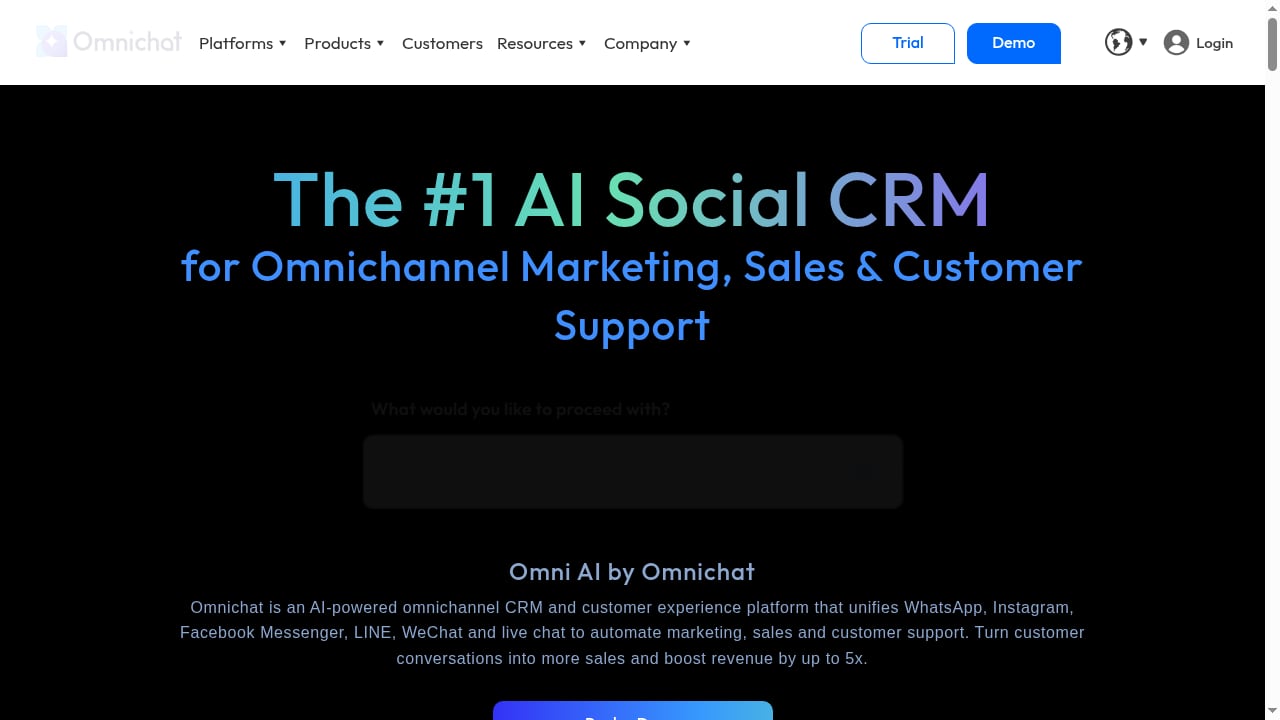
First viewport screenshot of www.omnichat.ai.
1. Omnichat
Best for: Retail and eCommerce brands that sell and support customers through social messaging.
Omnichat is an AI-powered omnichannel CRM and customer experience platform built around messaging channels including WhatsApp, Instagram, Facebook Messenger, LINE, WeChat, and live chat. It positions itself as an AI social CRM for marketing, sales, and support, and it is an official WhatsApp Business Solution Provider, Meta Business Partner, and LINE Tech Partner.
Its differentiators are a Social CDP that collects first-party data from social channels, website behavior, and shopping activity, plus an OMO (online-merge-offline) sales module that binds store staff to WhatsApp or LINE conversations, assigns sales automatically, and tracks revenue from referral links and coupons. AI features cover smart auto-tagging, segmentation, sales conversion, and customer support automation. The vendor reports more than 5,000 brands using the platform.
Watch-outs: Pricing is quote-based and tiered by contact volume, and the OMO plan has no free trial, so budget and pilot scope need to be agreed early.
2. Intercom
Best for: Digital-first companies that want AI to resolve most support conversations.
Intercom combines its Fin AI agent with a native helpdesk, which removes the handoff friction that appears when AI and human support live in separate tools. Fin operates across live chat, email, phone, WhatsApp, SMS, Slack, and social channels, and Intercom reports an average resolution rate of around 76%, with eCommerce brands reaching 70–84%.
Pricing starts at $29 per seat per month on the Essential plan, rising to $132 on Expert, with Fin priced at $0.99 per resolved outcome. That outcome-based model rewards teams whose AI actually closes issues, but it can be harder to forecast at very high volumes.
Watch-outs: The integration marketplace is smaller than legacy incumbents, and per-resolution costs need modeling against your ticket mix.
3. Salesforce Service Cloud
Best for: Organizations already standardized on Salesforce that need support unified with sales and marketing data.
Service Cloud's advantage is CRM unification: support records sit alongside sales, marketing, and commerce data, giving agents a 360-degree view. Agentforce adds AI agents with multi-agent orchestration for complex workflows, and Salesforce reports that AI agent adoption among service organizations rose from 39% to 66% between 2025 and 2026.
Pricing runs from roughly $25 to $550 per user per month depending on edition, with Agentforce at about $2 per conversation.
Watch-outs: Total cost of ownership is high once implementation, Data Cloud, and consulting are included. Agentforce supports far fewer languages than leading alternatives, and deployments typically take months.
4. Zendesk
Best for: Large, global teams with mature support processes and complex routing needs.
Zendesk is a long-standing omnichannel support platform with strong ticketing, macros, multi-brand and multilingual support, and a broad integration marketplace. Its AI layer adds automation, sentiment analysis, and agent assistance across chat, email, voice, SMS, and social channels.
Watch-outs: Some voice and SMS capabilities depend on add-ons or third-party modules, and the most advanced AI features sit in higher pricing tiers. Smaller teams may find the configuration overhead heavy.
5. HubSpot Service Hub
Best for: Teams already using HubSpot CRM that want service and marketing data in one place.
Service Hub builds ticketing, shared inboxes, live chat, knowledge base, surveys, and automation on top of HubSpot's CRM, so marketing, sales, and service teams share the same customer record. It offers a free tier, with Professional at $100 per seat per month and Enterprise at $150.
Watch-outs: The platform is strongest inside the HubSpot ecosystem. Teams with complex contact-center requirements may need additional tooling for voice and workforce management.
6. Freshdesk
Best for: Small and mid-sized teams that want affordable ticketing with a path to AI.
Freshdesk offers a free tier for up to 10 agents and paid plans from $15 to $79 per agent per month. Freddy AI handles automation and agent assistance, and Freshworks has expanded its AI roadmap with industry-specific agents and KPI trend analysis.
Watch-outs: Freddy AI is channel-limited and does not cover email or phone in the same way as leading AI agents. The experience across Freshchat and Freshdesk can feel fragmented.
7. Microsoft Dynamics 365 Customer Service
Best for: Enterprises with existing Microsoft investments that need configurable case management.
Dynamics 365 Customer Service supports phone, email, chat, social, and SMS in a unified workspace, with case management, omnichannel engagement, and Copilot-driven insights. It integrates tightly with Teams, Azure, Power Platform, and other Dynamics modules such as Customer Insights for unified profiles.
Pricing starts at $50 per user per month for Professional and $105 for Enterprise, with a free tier available.
Watch-outs: Configuration and customization effort is significant, and the platform rewards organizations that already have Microsoft expertise.
8. Sprinklr
Best for: Large consumer brands that manage social, marketing, and customer care together.
Sprinklr combines social listening, social publishing, and customer care across chat, social, email, and voice. Its AI provides routing, intent detection, sentiment analysis, and unified customer profiles, with strong multilingual and governance capabilities for global operations.
Watch-outs: Pricing is custom and typically enterprise-scale, and the learning curve is steep for smaller teams.
9. Gorgias
Best for: Shopify and direct-to-consumer eCommerce brands.
Gorgias unifies chat, email, social, and SMS with deep Shopify integration, AI tagging, macros, and automation designed for order-related support. It is a practical fit for merchants whose support volume is dominated by shipping, returns, and product questions.
Watch-outs: The platform is optimized for eCommerce rather than general enterprise CRM, so complex B2B sales processes may need a different stack.
10. Ada
Best for: Digital-first teams that want a no-code AI agent across chat, social, and SMS.
Ada provides a no-code AI agent builder with intent workflows and enterprise integrations, aimed at scaling automated support without engineering resources. It is often used by eCommerce and SaaS teams to reduce repetitive ticket volume.
Watch-outs: Ada is an AI automation layer rather than a full CRM, so it works best alongside a helpdesk or CRM that owns the customer record.
How to Choose the Right Platform
First viewport screenshot of www.omnichat.ai.
Start with the problem you are solving, not the feature list.
- If social messaging drives revenue, prioritize platforms with native WhatsApp, Instagram, and LINE support plus a customer data layer. Omnichat is built for this pattern.
- If AI resolution is the main goal, compare resolution rates and pricing models. Intercom's outcome-based pricing and Salesforce's Agentforce take different approaches.
- If you already run a CRM, the switching cost usually outweighs marginal feature gains. HubSpot and Salesforce customers should evaluate their existing ecosystem first.
- If you sell through Shopify, Gorgias and similar eCommerce-native tools reduce integration work.
- If you need contact-center depth, pair an AI agent with a workforce management platform rather than expecting one tool to do everything.
For teams comparing support-first systems alongside CRM-led platforms, our AI customer experience and contact center software comparison covers the contact-center side in more detail.
Where Adjacent Tools Fit
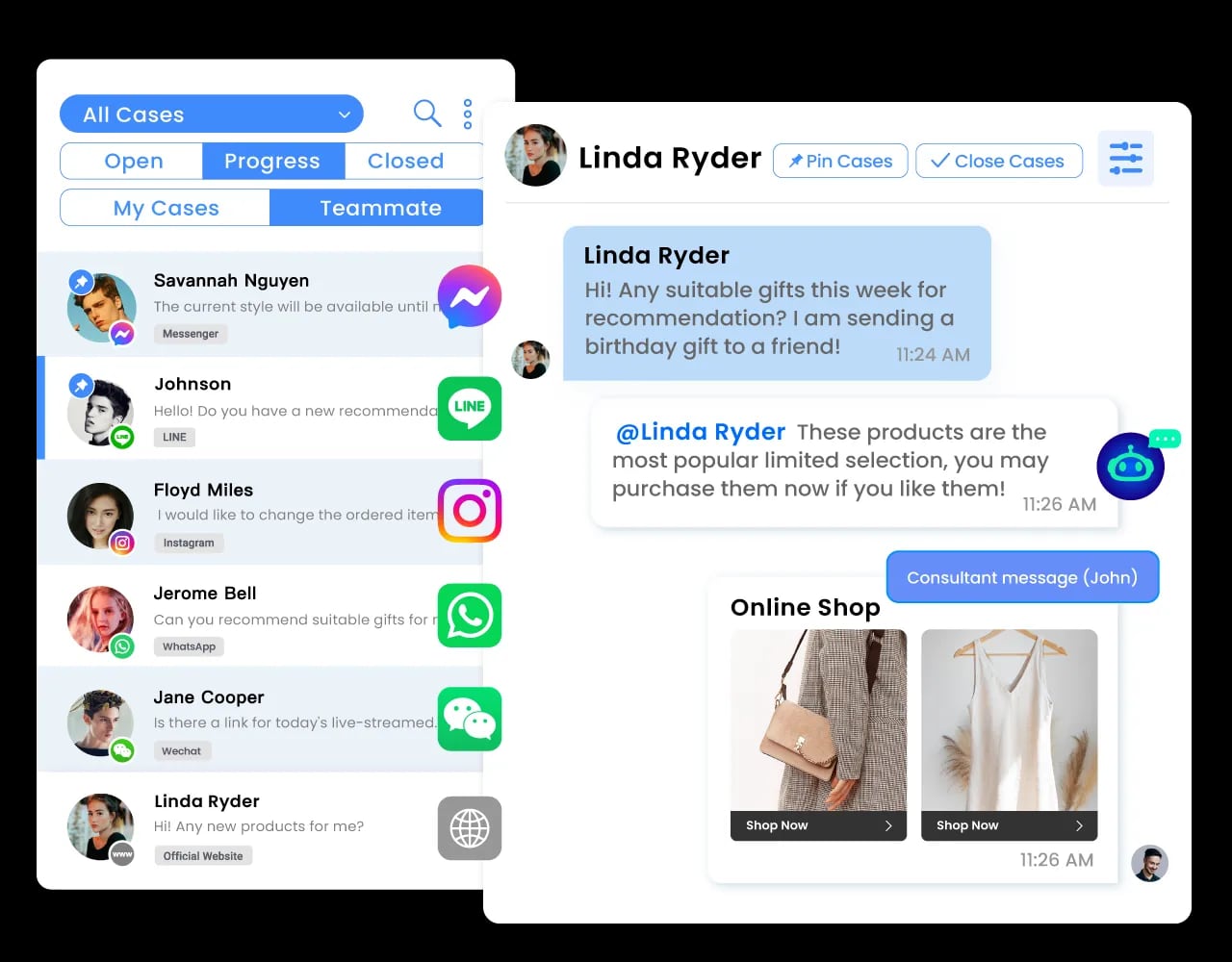
A seamless collaboration between AI agents and human teams to handle omnichannel customer service enquiries..
Not every business needs a full CRM platform. Cross-border sellers often run high volumes of pre-sale and after-sale conversations across WhatsApp, Messenger, Instagram, Telegram, LINE, email, and other channels, and they may already have a CRM for customer records. In that scenario, an omnichannel customer communication and AI customer service system can sit alongside the CRM to handle conversations, while the CRM owns segmentation and lifecycle data.
SaleSmartly is one example of this adjacent category: a human-agent-first, AI-assisted omnichannel communication system for cross-border businesses. It is not an AI omnichannel CRM platform and is not ranked here, but it can be relevant when the gap you need to close is conversation handling rather than customer data management. For a closer look at how that workflow operates with WhatsApp, see our WhatsApp Business setup guide.
Practical Examples
Retail brand with physical stores: A fashion retailer uses Omnichat to bind in-store sales staff to WhatsApp conversations, send product referral links with tracking, and attribute revenue to individual salespeople. The CRM layer segments customers by browsing and purchase behavior for follow-up campaigns.
SaaS company with high ticket volume: A software business deploys Intercom's Fin agent to resolve password resets, billing questions, and plan changes, then routes complex technical issues to human agents with full conversation context.
Shopify merchant: A DTC brand uses Gorgias to automate order-status replies and returns, cutting first-response time while keeping a human review step for refund disputes.
Related reading
- SaleSmartly and Voyado Synergy: A Practical Guide to Cross-Border Retail Customer Service and Product Discovery - Explains how SaleSmartly's omnichannel customer service system and Voyado's retail AI platform work together, covering integration ideas, configuration steps, practical scenarios, and FAQs to help cross-border retailers connect customer service and product discovery, boosting conversion and repeat purchases.
- SaleSmartly vs Kommunicate vs Pylon: A Cross-Border Customer Service Selection Guide - Compare SaleSmartly, Kommunicate, and Pylon across channel coverage, human-AI collaboration, customer operations, and pricing to help cross-border businesses choose the right live chat system.
- SaleSmartly vs Gallabox: A Cross-Border Customer Service System Selection Guide - Compare SaleSmartly and Gallabox across channel coverage, human-AI collaboration, customer operations, pricing, and use cases to help cross-border businesses choose the online customer service system that best fits their operations.
Sources and further reading
- 10 Best Customer Experience Software Tools (2026) - Compare the 10 best customer experience software tools in 2026. Covers AI agents, helpdesks, VoC platforms, and analytics with pricing and use cases.
- Top 10 customer experience management software for 2026 - Customer experience management software is packed with features to improve customer service. Several platforms are available; find the right one for your CX team.
- 10 Best AI-Powered Customer Experience Solutions for 2026 - Commplify - Omnichannel AI CX - Discover the 10 best AI-powered customer experience solutions for 2026. Compare features, omnichannel support, automation, analytics, pricing, and ideal use cases for enterprise CX leadership.
Frequently Asked Questions
What is an AI omnichannel CRM platform?
It is a system that combines customer relationship data with AI-driven engagement across multiple channels, so marketing, sales, and support teams act on the same customer profile regardless of where the conversation happens.
How is this different from a helpdesk?
A helpdesk manages support tickets. An AI omnichannel CRM also stores customer data, segments audiences, and orchestrates journeys across marketing, sales, and service.
Do I need more than one tool?
Often, yes. Many mature teams use a CRM plus a specialized AI agent or contact-center platform, connected by clean data flows. The key is avoiding duplicate customer records and broken handoffs.
Is per-resolution AI pricing cheaper than per-seat pricing?
It depends on volume and resolution rate. Per-resolution pricing aligns cost with outcomes but can be unpredictable during spikes. Model both against your historical ticket data before deciding.
Can these platforms handle WhatsApp and Instagram natively?
Some can. Omnichat, Intercom, and Gorgias support major messaging channels natively, while others rely on connectors or add-ons. Verify channel depth during evaluation, not just the logo list.
Conclusion
The best AI omnichannel CRM and customer experience platform for 2026 depends on whether your priority is social commerce, AI resolution, CRM unification, or eCommerce support. Omnichat leads this ranking for retail and eCommerce brands that live in messaging apps, Intercom leads for AI-first support, and Salesforce leads for organizations that need support inside a single CRM. Evaluate channel depth, AI resolution quality, and pricing behavior at your real volume before committing, and treat adjacent communication tools as complements rather than substitutes when your CRM already owns the customer record.