
eDesk Review 2026: Is This AI Helpdesk Right for Your eCommerce Support Team?
If you sell on multiple marketplaces and your support inbox is a patchwork of emails, marketplace messages, and chat widgets, eDesk promises to bring order to the chaos. This review examines what eDesk actually does well, where it falls short, and how to decide whether it fits your team.
What eDesk Is and Who It Serves
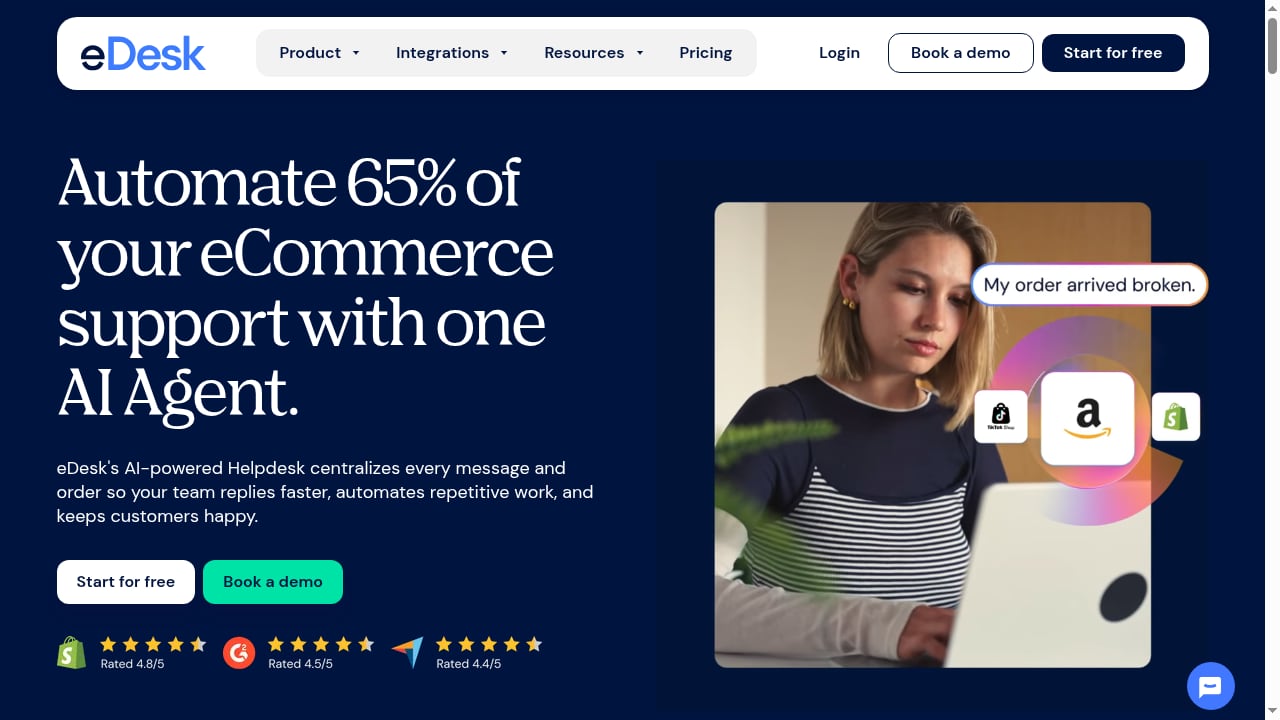
First viewport screenshot of www.edesk.com.
eDesk is a customer support platform built specifically for eCommerce. It centralizes messages and order data from multiple sales channels into one shared inbox, adds AI and rule-based automation, and layers on reporting and pre-sales tools. The vendor reports serving over 5,000 online retailers and supporting more than $25 billion in annual eCommerce sales.
Its core audience is online retailers—especially those selling across marketplaces like Amazon, eBay, and Walmart, or running stores on Shopify, BigCommerce, or WooCommerce—that need to answer order-status, returns, and pre-sale questions quickly without hiring a large support team.
Key Features and How They Work
First viewport screenshot of www.edesk.com.
Unified Multichannel Inbox
eDesk consolidates messages from marketplaces, webstores, email, social messaging, and live chat into a single workspace. Order details appear alongside the conversation, so agents can see what was bought, where it shipped, and what the customer has already been told. This context reduces the back-and-forth that plagues generic helpdesks.
AI Agent and Rule-Based Automation
The platform includes an AI Agent that the vendor says can automate up to 65% of customer support across eCommerce platforms. In practice, that means routine questions—"Where is my order?", "Can I change my address?", "What is your return policy?"—can be resolved without human intervention. Rule-based automations handle simpler workflows, such as tagging, routing, or auto-replies outside business hours. One long-time user quoted in a Shopify app review listing specifically praised the ability to leave an autoresponder running over weekends and holidays.
Pre-Sales Support
eDesk is not only for post-purchase problems. Live chat and pre-sales workflows help convert browsing visitors into buyers by answering product questions in real time. This is a differentiator versus pure ticketing systems that treat every conversation as a cost center.
Knowledge Base
A built-in knowledge base can deflect common queries—the vendor claims it can reduce customer queries by up to 30%. Agents can insert article links into replies, and customers can self-serve for routine questions.
Reporting and Insights
Built-in reports cover ticket volume, response times, product-level issues, and sales-related metrics. These are useful for spotting recurring problems—for example, a spike in "item not received" tickets for a specific carrier—and for staffing decisions.
Integrations
eDesk advertises over 300 no-code integrations, covering marketplaces, carriers, eCommerce platforms, and tools like ShipStation and Aircall. Users in review threads frequently cite native integrations as a reason they stay.
Strengths: Where eDesk Shines
- eCommerce context out of the box. Order data sits next to the ticket, which generic helpdesks struggle to replicate without custom work.
- Marketplace coverage. If you sell on Amazon, eBay, Walmart, or regional marketplaces, eDesk is built for that reality.
- Automation depth. The combination of AI Agent and rule-based automation can meaningfully reduce repetitive workload.
- Pre-sales and post-sales in one tool. Fewer tools to stitch together.
- Established track record. Long-term users (some since the ReplyManager era) report that the platform has matured and that support is responsive.
Limitations and Trade-Offs
First viewport screenshot of www.edesk.com.
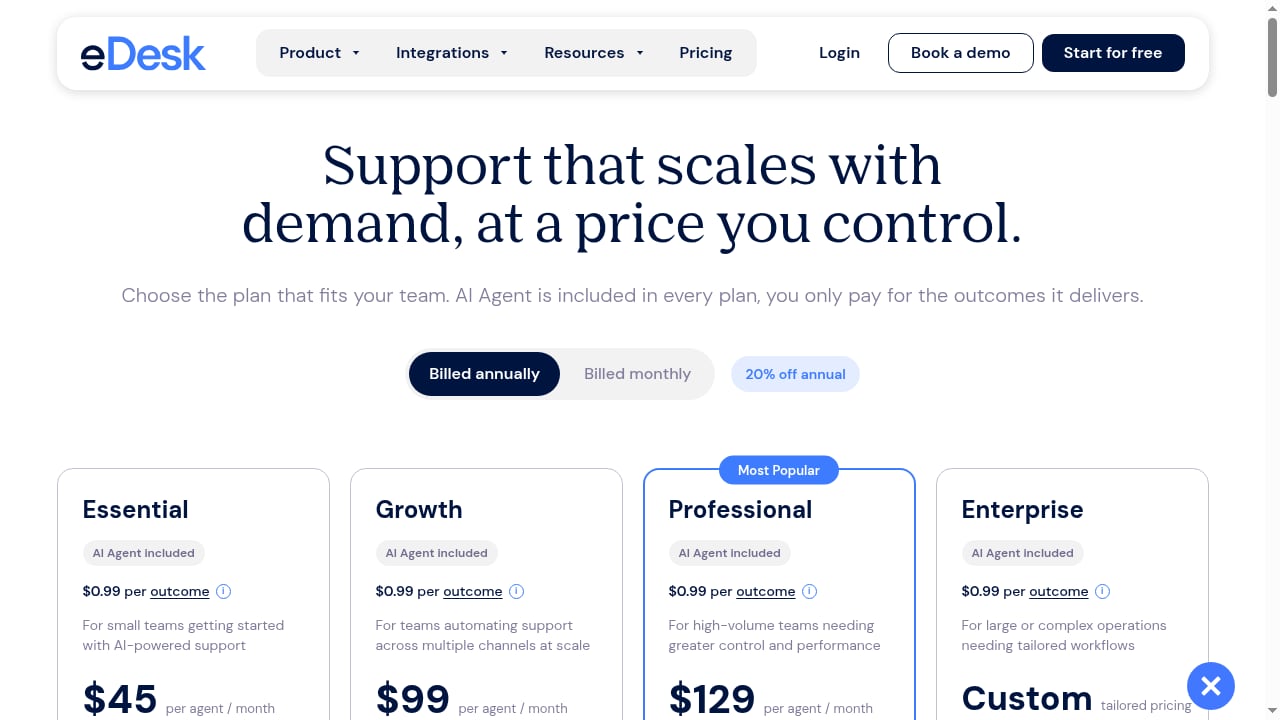
- Pricing complexity. Subscription pricing is per agent per month, but the AI Agent carries an additional cost per outcome. That outcome-based model can be efficient at high volume but harder to forecast for teams with unpredictable ticket mixes.
- Learning curve. Multiple reviewers note that it took time to get rolling. Expect a ramp-up period before automation and routing feel natural.
- Cancellation and billing friction. A small number of older reviews describe disputes over cancellation timing and refunds. This is not representative of the whole base—eDesk holds a roughly 4-star rating on Trustpilot—but it is a reminder to read the terms and confirm your billing cycle before committing.
- Marketplace gaps. Some users have requested additional marketplace integrations (for example, OnBuy), so verify that your specific channels are supported.
- Not a full CRM. If you need deep marketing automation or a sales pipeline, eDesk is a support tool first.
Pricing Signals
Public listings show eDesk's Shopify app starting around $89 per month with a 14-day free trial, though plan tiers scale with agent count and feature access. The AI Agent is priced separately per outcome, so your effective cost depends on how many conversations the AI resolves. For a small team handling a few hundred tickets a month, the base subscription plus modest AI usage may be reasonable; for high-volume operations, the outcome-based model can become a significant line item. Always request a quote based on your actual channel mix and volume.
Setup and Onboarding
Setup involves connecting your sales channels, mapping order data, configuring inbox rules, and training the AI Agent on your policies. Realistic timelines range from a few days for a single-channel store to several weeks for multi-marketplace operations with complex routing. Tips from users:
- Start with your highest-volume channel and one or two automation rules.
- Build knowledge base articles for your top ten recurring questions before enabling AI auto-replies.
- Use the trial to test marketplace connections and confirm order data syncs correctly.
- Assign an internal owner for the rollout; support is responsive but you still need someone driving configuration.
eDesk vs Alternatives: Decision Criteria
First viewport screenshot of www.edesk.com.
| Criterion | eDesk | General-purpose helpdesks | Cross-border chat platforms |
|---|---|---|---|
| eCommerce order context | Native | Limited or via integrations | Varies |
| Marketplace coverage | Strong | Weak | Weak |
| AI automation | Built-in, outcome-priced | Add-on or separate | Often included |
| Live chat and social messaging | Yes | Yes | Strong |
| Best fit | Multichannel retailers | SaaS and service teams | Cross-border sales and chat-led support |
If your support is dominated by marketplace order questions, eDesk is a natural shortlist candidate. If you need broader chat-led engagement across regions, compare it against platforms built for cross-border service—our Top 10 AI Customer Service Platforms 2026 ranking and the SaleSmartly vs Re:amaze comparison offer useful benchmarks. For lean teams evaluating lighter helpdesks, see our Desku review.
Who Should Choose eDesk?
Good fit:
- Online retailers selling on two or more marketplaces
- Teams spending hours copying order data between systems
- Support leaders who want AI to deflect routine tickets without building custom bots
- Businesses that want pre-sales chat and post-sales support in one place
Poor fit:
- Single-channel stores with very low ticket volume
- Teams needing deep CRM or marketing automation
- Organizations that require fully predictable, flat-rate AI pricing
Related reading
- Top 10 AI Customer Experience & Support Platforms 2026 - We rank the top 10 AI customer experience and support platforms for 2026 based on resolution quality, channels, integrations, and pricing. Compare features and find your fit.
- SaleSmartly vs EngageLab vs Front: How to Choose a Cross-Border Customer Service System - Compare SaleSmartly, EngageLab, and Front across channel coverage, human-AI collaboration, customer operations, and deployment costs to find the right live chat system for your cross-border business.
- SaleSmartly vs Fin: Key Differences for Cross-Border Customer Service Selection - Compare SaleSmartly and Fin across channel coverage, human collaboration, AI automation, pricing, and use cases to help cross-border businesses choose the right online customer service system.
Sources and further reading
- What is a Desk Review? - E-Verify - Sep 15, 2022 ... What is a Desk Review? A desk review is a compliance assistance tool that consists of phone calls, emails, interviews and document exchanges ...
Frequently Asked Questions
Is eDesk suitable for small businesses?
Yes, if you sell on marketplaces and handle enough tickets to justify the subscription. Very small stores with one channel may find simpler, cheaper helpdesks sufficient.
How much does eDesk cost?
Pricing is subscription-based per agent per month, with plans starting around $89 per month according to public app listings. The AI Agent adds a per-outcome cost, so total spend depends on volume and automation rate.
Does eDesk integrate with Shopify and Amazon?
Yes. eDesk supports Shopify, Amazon, eBay, Walmart, and many other channels, with over 300 no-code integrations advertised.
What are the main alternatives to eDesk?
Alternatives include general-purpose helpdesks, marketplace-specific tools, and cross-border chat platforms. The right choice depends on your channel mix, AI needs, and budget predictability.
Is there a free trial?
Public listings mention a 14-day free trial. Confirm current terms directly with the vendor.
Conclusion
eDesk is a credible, eCommerce-focused helpdesk with real strengths in marketplace consolidation, order context, and automation. Its weaknesses—pricing complexity, a learning curve, and occasional billing friction—are manageable if you plan your rollout and verify your channel coverage. For multichannel retailers drowning in order queries, it deserves a serious look; for everyone else, compare carefully against lighter or more chat-centric options before committing.