
HubSpot Review 2026: Is the All-in-One Platform Worth It?
HubSpot is one of the most recognized names in CRM and marketing software, but its pricing and depth make it a polarizing choice. This review draws on hands-on experience, user feedback, and current pricing data to help you decide if it fits your team.
What HubSpot Is and Who It's For
HubSpot is a customer platform that unifies marketing, sales, service, and CRM data. Its core promise is alignment: marketing, sales, and service teams work from the same customer record, and AI features (branded as Breeze) can act on that data. The platform is positioned as an "Agentic Customer Platform" that helps businesses build demand, win deals, and delight customers.
Ideal users are typically B2B companies with complex sales cycles or high-ticket offerings—agencies, consultants, and software firms—that need closed-loop revenue attribution. HubSpot also offers a generous free Smart CRM with unlimited users and contacts, making it accessible for early-stage teams. However, the full power sits behind Professional and Enterprise tiers, which come with significant costs.
Core Strengths: What HubSpot Does Well
HubSpot Review 2026: Is the All-in-One Platform Worth It? - Core Strengths: What HubSpot Does Well.
Best-in-Class User Experience
Across the entire suite, HubSpot is consistently praised for its polished, intuitive interface. Every product feels designed by the same hand, reducing the learning curve for teams adopting multiple hubs.
Generous Free Tier
The free Smart CRM includes unlimited users, unlimited contacts, deal tracking, pipeline management, and 2,000 marketing emails per month. This is one of the most generous free offerings in any SaaS category, allowing small teams to get started without a credit card.
Reporting and Revenue Attribution
HubSpot's reporting is a standout. Custom dashboards, multi-touch revenue attribution (added in Spring 2026), and funnel analysis let you see exactly how marketing activities translate into pipeline. For B2B teams, this closed-loop insight is a meaningful advantage.
Breeze AI
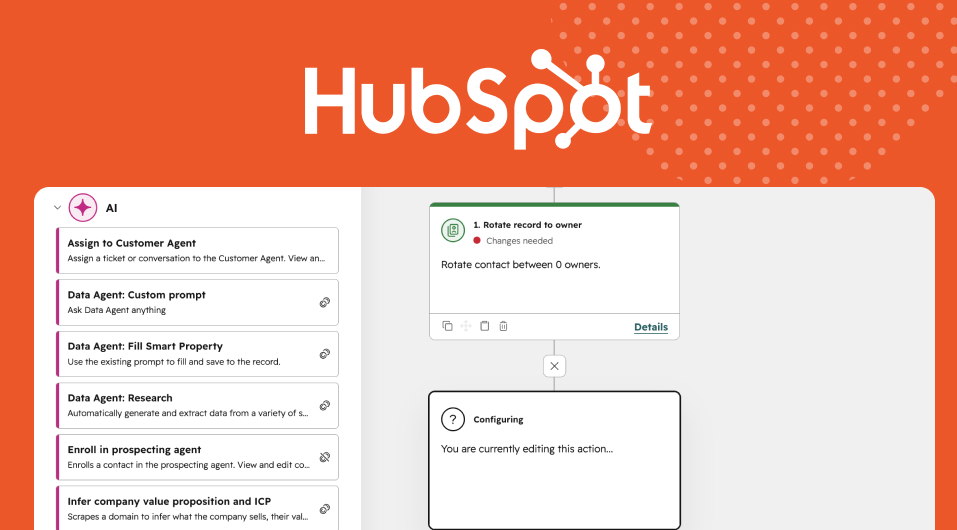
Breeze is HubSpot's comprehensive AI suite, including Copilot (in-app assistant), Customer Agent, and Prospecting Agent. As of April 2026, Customer Agent and Prospecting Agent use outcome-based pricing: $0.50 per resolved conversation and $1.00 per qualified lead. This aligns cost with value and can take real work off marketers' hands.
Extensive Integrations and Academy
HubSpot's app marketplace lists over 2,200 apps and Breeze Agents, covering most common business tools. HubSpot Academy offers free, certified training that is widely regarded as the gold standard in the space.
Limitations and Trade-Offs
HubSpot Review 2026: Is the All-in-One Platform Worth It? - Limitations and Trade-Offs.
Pricing Escalation
HubSpot's pricing is the highest in its category once you move past Starter. Marketing Hub Professional starts at $890/month with a mandatory $3,000 onboarding fee and a 12-month commitment. Enterprise starts at $3,600/month with a $7,000 onboarding fee. Contact tiers add further cost: marketing contacts are billed in 1,000-contact increments, and going one contact over auto-bumps your tier.
Automation Depth
While the workflow builder is solid and easier to learn than many enterprise alternatives, it lacks some advanced features. There is no native ability to A/B test entire automation paths (unlike ActiveCampaign). Predictive sending is Pro+, and predictive lead scoring is Enterprise-only. Re-enrolment behavior with custom-property triggers can be quirky.
Support and Service
User reviews on Trustpilot often highlight negative experiences with customer service, describing it as frustrating. While many users find the Academy and community sufficient, those needing responsive support may be disappointed.
Complexity for Small Teams
HubSpot can feel bulky and overwhelming. Many users report not touching 90% of what they pay for. The mandatory onboarding fee and annual commitment make it a hard sell for small businesses that may be better served by lighter tools.
Pricing Signals: What You'll Actually Pay
HubSpot Review 2026: Is the All-in-One Platform Worth It? - Pricing Signals: What You'll Actually Pay.
HubSpot's headline prices undersell the real cost. Three multipliers drive your bill: core seats (per editing user), marketing-contact tier overages, and optional add-ons (dedicated IP at $300/month, transactional email, AEO module at $50/month, Breeze credits).
Here are realistic scenarios based on current data:
- Solo founder, 1K contacts, 1 seat: Starter ~$15/month.
- Small team, 5K contacts, 3 seats: Starter ~$245/month (3 seats × $15 + ~$200 in contact overages).
- Mid-market, 10K contacts, 5 seats: Professional ~$2,280/month.
- Enterprise, 100K contacts: ~$5,850/month plus $7,000 onboarding.
Key nuances: Marketing contacts are only those you actively market to; unlimited non-marketing contacts sit in the free CRM. Starter is per-seat, not per-list. Annual billing saves 10–15% versus monthly. Professional and Enterprise default to annual commitments, and mid-year cancellation doesn't stop billing.
Setup and Onboarding
Setup is now heavily AI-managed. HubSpot's onboarding assistant extracts information about you and your company—industry, role, team size, website domain, tooling—and pre-populates the account. In hands-on testing, a new free Smart CRM account took about three minutes to set up, with no credit card and no manual property setup. The assistant configures sensible defaults that you can refine later.
Paid tiers include mandatory onboarding: $3,000 for Professional and $7,000 for Enterprise. This fee is non-refundable whether you complete the program or not.
Use Cases: Where HubSpot Shines
- B2B service companies with $1M+ revenue: HubSpot earns its keep through closed-loop attribution and unified data.
- Marketing-led growth teams: The combination of email, landing pages, forms, and reporting allows running full campaigns from audience discovery to impact measurement.
- Sales teams needing CRM depth: Sequences, deal tracking, and pipeline management are robust.
- Customer service teams: Service Hub provides ticketing and knowledge base features, though support reviews are mixed.
Decision Criteria: Is HubSpot Right for You?

HubSpot | Software & Tools for your Business - Homepage.
Choose HubSpot if:
- You are a B2B company with complex sales cycles and need revenue attribution.
- You value a polished, all-in-one platform and can afford Professional or Enterprise.
- You have a dedicated marketing ops person to manage the system.
- You want to leverage AI agents for prospecting and customer conversations.
Look elsewhere if:
- You are a small business with a tight budget; ActiveCampaign offers roughly 90% of the automation at a fraction of the cost.
- You primarily need a CRM and not a full marketing suite.
- You require advanced automation features like split-testing entire paths.
- You need responsive, human customer support.
For omnichannel messaging and chat-focused needs, consider comparing HubSpot with specialized tools like SaleSmartly vs HubSpot vs ChatMaxima or SaleSmartly vs HubSpot vs DelightChat. If you're evaluating broader team collaboration platforms, see our Top 10 AI Team Collaboration & Work Management Platforms 2026.
Related reading
- SaleSmartly vs ChatMaxima vs SleekFlow: Which AI Chat Platform Wins? - Compare SaleSmartly, ChatMaxima, and SleekFlow on AI agents, omnichannel reach, multilingual support, pricing, and cross-border fit. Find your best match.
Sources and further reading
- Is Hubspot good as a CRM? - Reddit - Jul 1, 2021 ... Hubspot is a great CRM, it combines sales, marketing and teams into a centralized place and organises things for us that were once all over the ...
FAQ
Is HubSpot good as a CRM?
Yes, HubSpot's CRM is robust and user-friendly, especially for B2B teams. It combines sales, marketing, and service data in one place. However, the free tier is limited for advanced needs, and paid tiers are expensive.
How much does HubSpot cost in 2026?
Marketing Hub Professional starts at $890/month with a $3,000 onboarding fee. Enterprise starts at $3,600/month with a $7,000 onboarding fee. Contact overages and add-ons can significantly increase costs. Starter is $15/seat/month.
Is HubSpot easy to set up?
The free Smart CRM can be set up in minutes with AI assistance. Paid tiers require mandatory onboarding, which adds cost and time.
What are HubSpot's main drawbacks?
High pricing beyond Starter, mandatory onboarding fees, annual commitments, limited automation depth compared to some competitors, and mixed customer service reviews.
Does HubSpot have AI features?
Yes, Breeze AI includes Copilot, Customer Agent, and Prospecting Agent. Outcome-based pricing for agents is $0.50 per resolved conversation and $1.00 per qualified lead.
Conclusion
HubSpot remains a powerful, best-in-class platform for B2B companies that can afford it and will use its full suite. The free CRM is an excellent starting point, but scaling to Professional or Enterprise brings significant costs and commitments. If you need deep automation on a budget, alternatives like ActiveCampaign may serve you better. For teams prioritizing unified data, revenue attribution, and AI-driven efficiencies, HubSpot is a strong contender—provided you go in with clear eyes about the total cost of ownership.
For further reading, see the Trustpilot reviews and Venture Harbour's 8-year review.