
SaleSmartly vs HubSpot vs Intercom: Cross-Border Omnichannel AI Compared
When your business touches customers across continents, you need a platform that speaks their language—literally. SaleSmartly, HubSpot’s Customer Platform, and Intercom each promise to unify conversations and automate support, but they’re built for very different journeys. This comparison cuts through the marketing noise to show you where each tool genuinely excels, so you can match the platform to your cross-border growth ambitions.
Platform Snapshots

SaleSmartly vs HubSpot vs Intercom: Cross-Border Omnichannel AI Compared product interface and feature overview.
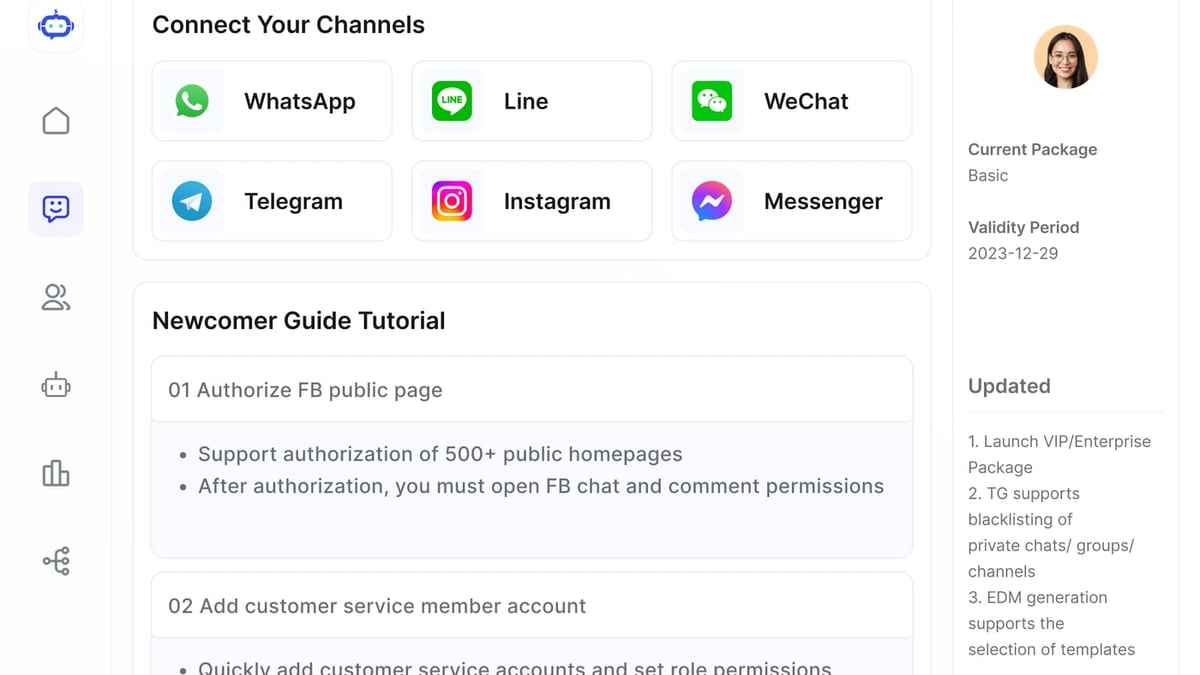
SaleSmartly is a dedicated omnichannel communication and AI customer service system designed for cross-border e‑commerce, social commerce, and B2B teams. It pulls together WhatsApp, Facebook Messenger, Instagram, Telegram, LINE, Zalo, WeChat, VKontakte, Email, YouTube, and more into one agent workspace, pairs them with an AI agent that can think and act autonomously, and adds real-time translation in 134 languages.
HubSpot Customer Platform is a full-stack CRM that weaves marketing, sales, and service tools into a single Smart CRM. It thrives when you need to nurture leads, close deals, and support customers with unified data, automated workflows, and a built-in AI assistant named Breeze.
Intercom is an AI‑first customer service platform built around Fin, an AI agent purpose‑trained for support. It combines an omnichannel inbox, ticketing, and a Copilot for agents, with outcome‑based pricing that aligns cost with resolution efficiency.
Omnichannel Messaging: Who Covers the Most Ground?

SaleSmartly vs HubSpot vs Intercom: Cross-Border Omnichannel AI Compared product interface and feature overview.
When your customers are spread across Jakarta, Jeddah, and Johannesburg, the channels you support determine whether you show up at all. SaleSmartly was engineered for exactly this scenario. Its native connector list covers the usual suspects — WhatsApp, Facebook Messenger, Instagram, Telegram, Email — but also adds platforms that HubSpot and Intercom treat as missing edges: LINE (popular in Japan and Thailand), Zalo (Vietnam’s dominant chat app), WeChat (essential for Chinese audiences), VKontakte (Russia and CIS), and even YouTube comments. Every conversation lands in a single, aggregated workspace, so agents never switch tabs just to follow a customer’s preferred platform.
HubSpot’s Breeze customer agent can respond across web, mobile app, email, WhatsApp, and phone. Intercom’s omnichannel inbox handles email, chat, phone, WhatsApp, and social channels. Both are well‑rounded, but SaleSmartly’s advantage is the deliberate inclusion of high‑engagement regional messengers that drive real revenue for cross‑border sellers. For businesses running Meta for Business ads, SaleSmartly integrates with Meta’s ecosystem out of the box, letting you funnel leads straight into automated conversations (see our step‑by‑step Meta integration guide).
If your audience lives on multiple niche social apps, SaleSmartly’s channel breadth is a difficult strength to replicate.
AI and Automation: Solving Problems Before an Agent Touches Them
SaleSmartly vs HubSpot vs Intercom: Cross-Border Omnichannel AI Compared product interface and feature overview.
All three platforms lean heavily on AI, but they apply it in distinct ways.
HubSpot Breeze draws from your knowledge base, documents, spreadsheets, and CRM records to resolve common queries across web, mobile, email, WhatsApp, and phone. It escalates complex cases to your team with full conversation context, and you can control the automation level — set active hours, require agent review, or limit automation to a portion of conversations. It’s a natural extension of the CRM that already centralizes your entire funnel.
Intercom’s Fin is purpose‑built for customer service, handling multi‑step inquiries, suggesting actions, and even completing tasks autonomously. Paired with the Copilot, it drafts responses and surfaces relevant knowledge so human agents work faster. The platform’s CX Score adds AI‑powered insights to measure support quality, and Intercom claims a 31% increase in agent efficiency for its users.
SaleSmartly’s AI Agent benefits from an open large‑language‑model approach — you can train it on your product catalog, support documents, and frequently asked questions, then deploy it to autonomously answer queries and trigger actions across all integrated channels. Where SaleSmartly carves its niche is the combination of AI with its 134‑language real‑time translator. Even if an agent gets an alert from a LINE message written in Thai, SaleSmartly translates it instantly and allows the agent to reply in the customer’s language. This multilingual AI loop turns a support desk into a region‑agnostic contact center without adding a single bilingual hire.
If your support team routinely juggles 15+ languages, SaleSmartly’s built-in translation gives it a workflow edge that HubSpot and Intercom don’t yet match natively.
Pricing: Unlocking Scale Without Breaking the Bank

SaleSmartly vs HubSpot vs Intercom: Cross-Border Omnichannel AI Compared product interface and feature overview.
Intercom’s outcome‑based pricing starts at $39 per seat per month and increases based on workload and AI interactions. It ties cost directly to the volume of resolutions Fin handles, which can be fair for digital‑first SaaS companies but may become unpredictable for high‑traffic retailers.
HubSpot offers popular free tools, but its more powerful automation, custom reporting, and advanced AI capabilities sit in paid tiers that scale with contacts and features — a model that rewards companies that fully adopt its marketing and sales suite, yet can strain a budget if you only need deep communication tools.
SaleSmartly approaches pricing differently: it typically charges per agent seat while keeping contacts unlimited. This offers predictable monthly costs for cross‑border businesses that field thousands of messages across dozens of channels but don’t require a full marketing suite. High‑volume account managers, WhatsApp private domain operators, and social commerce teams often find this model removes the anxiety of per‑contact billing spikes.
When to Choose Each Platform
Choose HubSpot if:
- You need a unified CRM that powers marketing campaigns, sales pipelines, and customer support from the same database.
- Your growth depends on lead attribution, email nurture sequences, and lifecycle reporting.
- You want a success workspace with built‑in health scores, NPS, CSAT, and playbooks to drive retention, not just reactive tickets.
Choose Intercom if:
- You’re building a product‑led support motion and want an AI‑first agent (Fin) that resolves a high percentage of inquiries without human touch.
- Outcome‑based pricing aligns with your goal of reducing headcount while maintaining quality.
- Your support team needs an integrated ticketing system, an agent Copilot, and CX‑level analytics, but you can manage CRM separately.
Choose SaleSmartly if:
- Your business operates across continents and relies on regional messaging apps like LINE, Zalo, WeChat, or VK in addition to global channels.
- Real‑time translation in 134 languages is a non‑negotiable for your support agents.
- You want an intelligent AI agent that can be trained on your own knowledge and respond automatically on every channel, paired with unlimited‑contacts pricing that’s friendly to high‑volume sellers.
- Your priority is a conversation‑first hub that integrates with Meta ads, handles WhatsApp private domain marketing, and tracks customer browsing behaviour without over‑engineering a full CRM.
Related reading
- SaleSmartly vs tawk.to: Omnichannel AI vs Free Live Chat Compared - Comparing SaleSmartly's omnichannel AI customer service and marketing platform with tawk.to's free live chat. Discover which tool fits your cross-border business needs, from WhatsApp integration to AI agents.
- Tidio Review 2025: AI Chat & Help Desk Tested - Our hands-on Tidio review covers Lyro AI agent, live chat, help desk, pricing, and real-world results. See if Tidio fits your ecommerce or small business support needs.
- Top 10 Enterprise AI Platforms 2026: Expert Picks & Reviews - Compare the 10 best enterprise AI platforms of 2026. We rate Microsoft Azure AI, Google Vertex AI, IBM watsonx, DataRobot, and more on governance, scalability, and features.
Sources and further reading
- HubSpot vs Intercom - Determine which customer service software - Intercom vs HubSpot - best meets your customer's needs.
- HubSpot vs. Intercom: A Data-Backed Comparison - Compare HubSpot and Intercom on features, adoption, and use cases to find the best fit for your team.
- HubSpot vs Intercom: Which customer support tool is right for you? - Explore the key differences between HubSpot and Intercom, helping you choose the best tool for your business needs. Read the full article to learn more.
Frequently Asked Questions
Does SaleSmartly integrate with Meta for Business?
Yes, SaleSmartly connects directly with Meta for Business, allowing you to unify Facebook Messenger, Instagram, and WhatsApp interactions from ad campaigns into automated chat flows. Learn more in our step‑by‑step setup guide.
Which platform offers the most comprehensive real‑time translation?
SaleSmartly includes real‑time translation for 134 languages built directly into the agent interface, so you can message customers in their language without third‑party tools.
Can I use HubSpot only for customer support without its marketing features?
Absolutely. HubSpot’s Service Hub can be used standalone. However, the platform’s greatest strength is the shared CRM that ties marketing, sales, and service data together — if you’re not using the other tools, you may be paying for capabilities you don’t need.
What’s the difference between Intercom’s outcome‑based pricing and SaleSmartly’s model?
Intercom’s outcome‑based pricing scales with AI‑resolved interactions, which can increase as your support volume grows. SaleSmartly primarily charges per agent seat with unlimited contacts, giving high‑volume teams a more predictable cost structure.
Is there a comparison between SaleSmartly and other chat platforms like LiveChat or Respond.io?
Yes, we’ve tested those head‑to‑head. For a detailed side‑by‑side with Respond.io and LiveChat, check out our SaleSmartly vs LiveChat vs Respond.io comparison.
The Bottom Line
There’s no universal “best” platform — only the one that fits the geography, languages, and growth stage of your business. SaleSmartly, HubSpot, and Intercom each lead in a different lane. Cross‑border sellers and global DTC brands will likely find SaleSmartly’s channel breadth, multilingual AI, and unlimited‑contacts pricing a perfect operational fit. Companies that need a heavy‑duty marketing machine will lean into HubSpot. Product‑led teams that want AI to carry the support load will build around Intercom. No matter which direction you lean, SaleSmartly provides the objective comparisons and step‑by‑step guides you need to make a confident choice.