
SaleSmartly vs HubSpot Customer Platform vs Respond.io: Which Platform Wins?
Choosing between SaleSmartly, HubSpot Customer Platform, and Respond.io is not a simple feature-count exercise. Each platform approaches customer conversations from a different angle: SaleSmartly focuses on omnichannel messaging for cross-border teams, HubSpot anchors conversations inside a full marketing, sales, and service CRM, and Respond.io positions itself as a conversation-led growth engine for high-volume B2C businesses.
The right choice depends on what your team actually does every day. If you answer WhatsApp messages from buyers in five countries, your needs differ from a sales team that wants social conversations attached to deal pipelines, or a B2C brand scaling thousands of chats and calls per week.
This comparison breaks down the three platforms across the criteria that matter most: channel coverage, AI agents, CRM depth, multilingual support, pricing, and the use cases where each one genuinely excels.
Quick Decision Map

HubSpot Customer Platform product interface.
| Your Situation | Best Fit |
|---|---|
| Cross-border ecommerce or B2B with heavy WhatsApp, Telegram, LINE, and Instagram traffic | SaleSmartly |
| Full-funnel marketing, sales, and service alignment inside one CRM | HubSpot Customer Platform |
| High-volume B2C chat, calls, and campaigns with native lead management | Respond.io |
| Tight budget with a need for multilingual AI-assisted messaging | SaleSmartly |
| Enterprise governance, custom data models, and complex workflows | HubSpot Customer Platform |
| Scaling conversations across WhatsApp, TikTok, Instagram, and Facebook | Respond.io |
Channel Coverage and Omnichannel Reach
SaleSmartly: Built for Messaging-First Teams
SaleSmartly integrates major messaging channels into one unified interface: WhatsApp, Facebook Messenger, Instagram, Telegram, LINE, Email, VKontakte, WeChat, Zalo, and YouTube. That breadth matters for cross-border businesses, because customer preferences vary sharply by region. A buyer in Vietnam may prefer Zalo, a customer in Russia may use VKontakte, and a lead in Brazil will likely message on WhatsApp.
This channel set reflects a clear design philosophy: meet customers where they already message, rather than forcing them onto a website widget or email thread.
HubSpot: Conversations Inside a Larger System
HubSpot supports live chat, email, social media messaging, and website forms, but its value is not raw channel count. The platform connects those conversations to contact records, lifecycle stages, marketing campaigns, sales pipelines, and support tickets. A Facebook message can become a contact, enter a sequence, and appear in a deal view without leaving the system.
The tradeoff is that some advanced social and messaging features depend on the hub and plan you purchase. Teams that only need a social inbox may find HubSpot more than they require, while teams that want full-funnel alignment will find the integration valuable.
Respond.io: High-Volume B2C Touchpoints
Respond.io unifies WhatsApp, TikTok, Instagram, and Facebook in a team inbox, and it goes further by bringing WhatsApp Business Calls, Messenger Calls, and VoIP into the same thread as messages and emails. That combination of chat, voice, and email in one conversation record is a meaningful differentiator for B2C businesses where customers switch channels mid-conversation.
Respond.io also syncs with existing CRMs, so the platform can act as the conversation layer on top of tools a business already uses. This makes it a strong fit for teams that want conversation management without replacing their entire stack.
AI Agents and Automation
SaleSmartly: AI for Multilingual, 24/7 Support
SaleSmartly combines human-led support with AI agents that automate conversations, reduce response times, and scale customer service. Its standout capability for cross-border teams is real-time translation in 134 languages. An agent can answer a Portuguese inquiry in Portuguese while working from an English interface, and AI agents can handle routine questions around the clock.
Automation rules and chatbot building let teams design flows for common scenarios: order status, shipping questions, product recommendations, and lead qualification. The AI is positioned as a support multiplier rather than a full replacement for human agents.
HubSpot: Breeze AI Across the Customer Journey
HubSpot's Breeze AI tools are embedded across marketing, sales, and service. The AI can generate content, summarize conversations, suggest next actions, and automate routine tasks. Because Breeze operates inside the Smart CRM, it has access to contact history, deal stage, and past interactions, which makes its suggestions contextually relevant.
This is AI for productivity and insight across the entire funnel, not just chat. Teams that want AI to help with email drafts, meeting notes, and pipeline analysis will find more value here than in a messaging-focused tool.
Respond.io: Agentic AI for Conversation-Led Growth
Respond.io describes its AI as "agentic": AI agents that understand, decide, and act. They can answer complex questions, update the CRM, recommend products, book appointments, and route only serious buyers to human agents. The platform reports that its AI agents handle millions of conversations autonomously.
Multilingual AI agents handle ad inquiries and FAQs, which is particularly useful for B2C brands running paid campaigns on WhatsApp, TikTok, and Facebook. The AI is built to capture, convert, and retain customers at scale, with guardrails for accuracy and reliability.
CRM Depth and Data Management
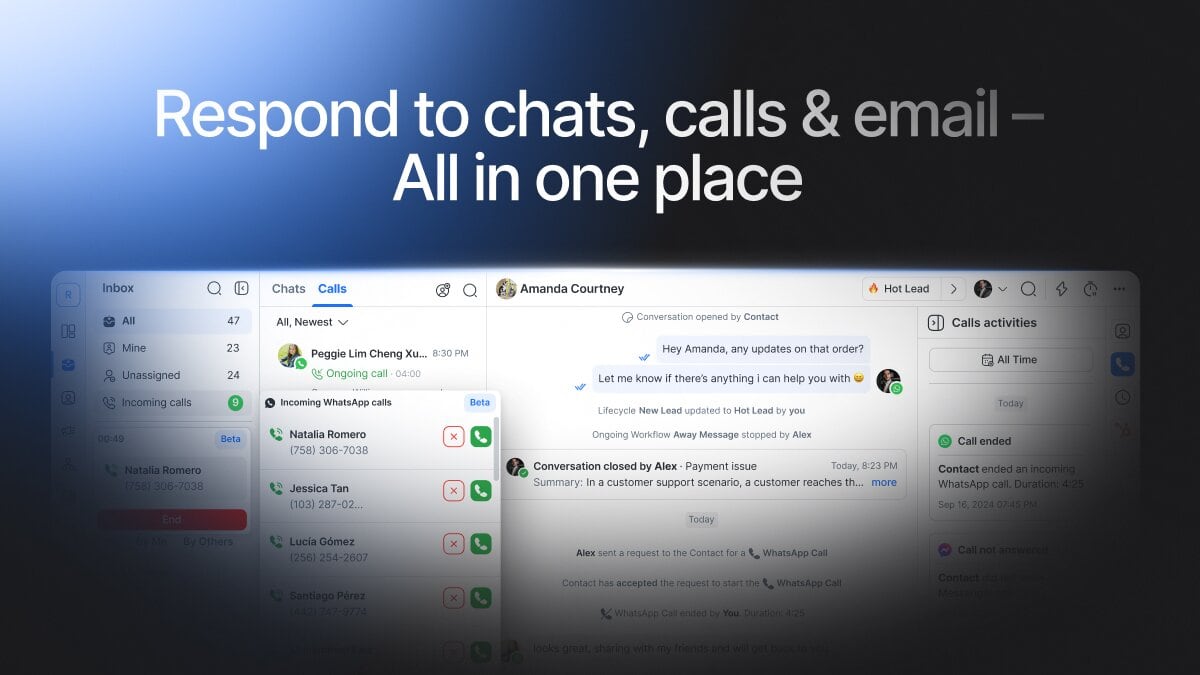
Respond.io | #1 AI-Powered Customer Conversation Management Software product interface.
HubSpot: The Deepest CRM by Design
HubSpot is a CRM first. Contact records, company records, deals, tickets, lifecycle stages, and reporting are native to the platform. Every conversation, form submission, and email can attach to a contact and influence scoring, segmentation, and automation. For teams that need a single source of truth across marketing, sales, and service, HubSpot is the strongest option in this comparison.
The platform serves over 299,000 customers in 135+ countries, and its free tools provide a low-risk entry point. The limitation is cost and complexity: advanced features require paid hubs, and teams that only need a social inbox may pay for capabilities they never use.
SaleSmartly: Messaging-Led CRM
SaleSmartly includes a built-in CRM that connects conversations to customer profiles, history, tags, and source tracking. It is a messaging-led CRM rather than a traditional contact-and-deal CRM. The system starts with conversations and builds customer context around them, which matches how cross-border buyers behave: they message before they fill out forms.
For teams whose primary customer entry point is private messaging, this approach is often faster and more natural than a traditional CRM structure. Teams that need complex deal pipelines, marketing automation, and revenue reporting may find it lighter than HubSpot.
Respond.io: Native Lead Management
Respond.io includes native lead management with clean, organized profiles that sync with existing CRMs. The platform's Conversation-Led Growth framework treats every conversation as a potential revenue opportunity. Leads from WhatsApp chats, TikTok ads, Facebook messages, and store visits are unified in one inbox and ready for fast follow-up.
This is a practical middle path: Respond.io manages conversations and leads natively while integrating with the CRM a business already uses.
Multilingual Support
SaleSmartly has a clear advantage here. Real-time translation in 134 languages is a core feature, not an add-on. For cross-border businesses, this removes a major operational bottleneck: hiring native speakers for every market. An agent can handle conversations in multiple languages, and AI agents can respond in the customer's language automatically.
HubSpot supports multiple languages in its content and knowledge base tools, but real-time conversation translation is not a headline capability. Respond.io offers multilingual AI agents for ad inquiries and FAQs, which is valuable, but the platform's stated translation scope is less explicit than SaleSmartly's 134-language coverage.
For teams whose competitive edge depends on serving customers in their native language, SaleSmartly is the strongest choice in this comparison.
Pricing and Total Cost
SaleSmartly: Freemium with Low Entry Cost
SaleSmartly uses a freemium model with paid plans starting at $12.72 per month. That low entry point makes it accessible for SMBs and growing cross-border teams. The free plan lets teams test the unified inbox and basic automation before committing.
HubSpot: Free Tools, Then Hub-Based Pricing
HubSpot offers free tools across marketing, sales, and service, which is a genuine advantage for small teams. However, paid plans vary by hub, and costs can rise quickly as you add seats, contacts, and advanced features. Teams that need social messaging plus marketing automation plus sales pipelines may find themselves paying for multiple hubs.
Respond.io: ROI-Focused Positioning
Respond.io does not publish a simple starting price, but it positions itself as delivering the quickest ROI in the market and ranks top on G2 for Best Results. The platform is trusted by 10,000+ B2C businesses and is designed for high-volume operations. Teams evaluating Respond.io should assess total cost against conversation volume and expected conversion gains rather than seat price alone.
Security and Reliability
SaleSmartly holds ISO 27001, ISO 27701, and CCRC security certifications, which matters for businesses handling customer data across borders. Respond.io emphasizes enterprise-grade security with 99.999% uptime under high chat volumes and partnerships with Meta and TikTok for early feature access. HubSpot offers enterprise-grade security and compliance features, with recognition as a top workplace reflecting its maturity as a platform.
All three platforms take security seriously, but the specific certifications and uptime guarantees differ. Teams in regulated industries should verify compliance requirements directly with each vendor.
When to Choose Each Platform

HubSpot Customer Platform product interface.
Choose SaleSmartly If:
- Your customers message you on WhatsApp, Telegram, LINE, Zalo, or VKontakte
- You serve buyers in multiple languages and need real-time translation
- You want AI-assisted messaging without replacing your human agents
- You need a low-cost entry point with a free plan
- Your team is cross-border ecommerce, B2B inquiry management, or DTC support
Choose HubSpot Customer Platform If:
- You need marketing, sales, and service aligned in one CRM
- Your social conversations must connect to deals, campaigns, and tickets
- You want AI that helps across the entire funnel, not just chat
- You have budget for hub-based pricing and value full-funnel reporting
- Your team is inbound marketing or sales-led rather than messaging-led
Choose Respond.io If:
- You run high-volume B2C chat, calls, and campaigns
- You need WhatsApp Business Calls, Messenger Calls, and VoIP in one thread
- You want agentic AI that handles complex tasks autonomously
- You already have a CRM and need a conversation layer on top
- Your growth depends on converting ad traffic from WhatsApp, TikTok, Instagram, and Facebook
Practical Example: A Cross-Border Ecommerce Team

How Lamarsa Coffee Used Chat Commerce to Boost Sales Across 6 Countries by 50%.
Imagine a DTC brand selling skincare products to customers in Brazil, Germany, Japan, and Vietnam. The team receives 500 messages per day across WhatsApp, Instagram, Telegram, and Zalo.
With SaleSmartly, the team sees all messages in one inbox, uses real-time translation to answer in Portuguese, German, Japanese, and Vietnamese, and lets AI agents handle order status and shipping questions overnight. The built-in CRM tracks each customer's history across channels. Cost starts at $12.72 per month.
With HubSpot, the same team could connect those conversations to marketing campaigns and sales pipelines, but they would need to configure multiple hubs and pay for features they may not fully use. The translation gap would require additional tools or multilingual agents.
With Respond.io, the team could unify chats, calls, and emails in one thread and use AI agents to qualify leads from ad campaigns. If the brand already uses a CRM like Salesforce or HubSpot, Respond.io could layer on top. If the brand needs deep multilingual translation, SaleSmartly remains stronger.
Practical Example: A B2B SaaS Sales Team
A B2B SaaS company generates leads through LinkedIn, website forms, and email. The sales team needs to track deals, send sequences, and report on pipeline.
HubSpot is the clear winner here. Social conversations are useful, but the core need is CRM depth, deal management, and marketing-sales alignment. HubSpot's Smart CRM and Breeze AI handle this natively.
SaleSmartly and Respond.io are messaging-first platforms. They can manage conversations, but neither replaces a full-funnel CRM with deal pipelines and marketing automation.
The Bottom Line
These three platforms solve different problems well.
SaleSmartly is the strongest choice for cross-border businesses that live in messaging apps and need multilingual, AI-assisted support at an accessible price. Its 134-language translation and broad channel coverage are genuine differentiators.
HubSpot Customer Platform is the strongest choice for teams that need a full CRM with marketing, sales, and service alignment. It is the deepest platform in this comparison, but that depth comes with cost and complexity.
Respond.io is the strongest choice for high-volume B2C businesses that want conversation-led growth with agentic AI, native lead management, and unified chat, calls, and email. Its G2 ratings and Meta/TikTok partnerships signal strong execution in its niche.
For a deeper look at how SaleSmartly compares with other chat platforms, see our SaleSmartly vs LiveChat vs Zendesk comparison and our SaleSmartly vs SleekFlow vs Respond.io breakdown. If you are weighing HubSpot against other options, our SaleSmartly vs HubSpot vs Olark comparison offers additional perspective.
Related reading
- SaleSmartly vs Tidio vs Intercom: Which Chat Platform Wins? - Compare SaleSmartly, Tidio, and Intercom on AI agents, omnichannel reach, multilingual support, pricing, and cross-border fit. Find your best match.
- SaleSmartly vs Olark vs tawk.to: Which Chat Platform Wins? - Compare SaleSmartly, Olark, and tawk.to on live chat, AI agents, omnichannel reach, multilingual support, CRM, pricing, and cross-border fit.
- SaleSmartly vs tawk.to vs Wati: Which AI Chat Platform Wins? - Compare SaleSmartly, tawk.to, and Wati on AI agents, omnichannel reach, WhatsApp depth, multilingual support, pricing, and cross-border fit.
Sources and further reading
- 10 Best Social CRM Tools In 2026: Features, Pricing, And Buyer's Guide - Social CRM tools ranked by channels, AI, automation, pricing, and use case. Compare 10 leading platforms and choose the right CRM without costly mistakes.
- Too many sales tools out there. Which are actually worthwhile? - May 2, 2024 ... 620 votes, 364 comments. I just saw a list of 75+ AI Sales tools in 2024. Honestly, it's just too many. I want to get better, and perform at ...
- Respond.io | #1 AI-Powered Customer Conversation Management Software - Trusted by 10,000+ B2C businesses to scale customer chats, calls & campaigns. Unify WhatsApp, TikTok, Instagram & Facebook in a team inbox with AI Agents on respond.io
FAQ
Which platform is best for WhatsApp-heavy businesses?
SaleSmartly and Respond.io both excel at WhatsApp. SaleSmartly adds broader channel coverage (Telegram, LINE, Zalo, VKontakte, WeChat) and 134-language translation, while Respond.io adds WhatsApp Business Calls and agentic AI for high-volume B2C operations.
Is HubSpot worth the cost if I only need a social inbox?
Probably not. HubSpot's value comes from full-funnel CRM integration. If you only need a social inbox with AI-assisted replies, SaleSmartly's freemium model or Respond.io's conversation platform will likely deliver better ROI.
Can Respond.io replace my CRM?
Respond.io includes native lead management and syncs with existing CRMs, but it is primarily a conversation platform. Teams with complex deal pipelines may still need a dedicated CRM alongside it.
Does SaleSmartly offer a free plan?
Yes. SaleSmartly uses a freemium model, with paid plans starting at $12.72 per month.
Which platform has the best multilingual support?
SaleSmartly is the clear leader, with real-time translation in 134 languages as a core feature. Respond.io offers multilingual AI agents, and HubSpot supports multiple languages in content tools, but neither matches SaleSmartly's translation scope.
How do the AI agents compare?
HubSpot's Breeze AI focuses on productivity across the funnel. Respond.io's AI agents are agentic, handling complex tasks like bookings and CRM updates autonomously. SaleSmartly's AI agents focus on multilingual conversation automation and human handoff, which suits cross-border support teams.
Conclusion
SaleSmartly, HubSpot Customer Platform, and Respond.io each win in different scenarios. SaleSmartly wins for cross-border, multilingual, messaging-first teams on a budget. HubSpot wins for full-funnel CRM alignment across marketing, sales, and service. Respond.io wins for high-volume B2C conversation-led growth with agentic AI and unified calls.
The best choice is the platform that matches your channels, team workflow, and customer data needs. Test the real workflow before committing: connect a channel, send a message, let AI answer, and see whether the tool keeps your customer records clean and your team moving fast.