
SaleSmartly vs HubSpot vs Tidio: Which Fits in 2026?
Choosing a customer communication platform in 2026 is less about picking the most famous name and more about matching the tool to how your customers actually reach you. SaleSmartly, HubSpot, and Tidio all help teams talk to customers, but they were built around different centers of gravity: omnichannel messaging for cross-border sellers, a full customer platform with CRM at its core, and fast AI-assisted live chat for ecommerce and service teams.
This comparison looks at where each platform is genuinely strong, so you can decide which one fits your support model, channel mix, and budget.
Quick comparison at a glance

SaleSmartly vs HubSpot vs Tidio: Which Fits in 2026? - Quick comparison at a glance.
| Criterion | SaleSmartly | HubSpot | Tidio |
|---|---|---|---|
| Primary focus | Omnichannel messaging and AI agents for cross-border business | Unified CRM across marketing, sales, and service | Live chat, help desk, and AI agent for support teams |
| Channel coverage | WhatsApp, Messenger, Instagram, Telegram, LINE, Email, VKontakte, WeChat, Zalo, YouTube | Email, live chat, forms, and connected channels via integrations | Live chat widget, email, and multi-channel ticketing |
| AI approach | AI agents plus human-led support in one inbox | AI assistance across the customer platform | Lyro AI Agent for automated resolution |
| Built-in CRM | Yes | Yes, and it is the core of the platform | Ticketing and contact records, not a full sales CRM |
| Real-time translation | Yes, across 134 languages | Not a core positioning | Not a core positioning |
| Entry pricing | Freemium, plans from $12.72/month | Free tools plus premium tiers via demo | Free tier plus paid tiers |
Use this as a starting filter, then read the sections that match your situation.
Where SaleSmartly is strongest

SaleSmartly vs HubSpot vs Tidio: Which Fits in 2026? - Where SaleSmartly is strongest.
SaleSmartly is an AI-powered omnichannel customer communication platform built for cross-border businesses. Its central promise is that teams can manage major messaging channels in one interface instead of juggling separate apps per region or platform.
One inbox across messaging channels that matter internationally
The platform integrates WhatsApp, Facebook Messenger, Instagram, Telegram, LINE, Email, VKontakte, WeChat, Zalo, and YouTube. For sellers who serve customers in several countries, that breadth matters more than having a single dominant channel. A buyer in Southeast Asia may message on Zalo or LINE, a European customer on WhatsApp, and a social follower on Instagram — and all of those conversations can land in the same workspace.
Real-time translation as a support feature, not an add-on
Translation across 134 languages is part of the core platform. That is a meaningful operational difference for cross-border teams: an agent can read a message in one language and reply in another without leaving the conversation. If your support volume is multilingual, this alone can change how you staff your team.
Automation plus human handoff
SaleSmartly combines AI agents with human-led support. Automation rules and chatbot building handle repetitive questions, while the centralized inbox keeps a human in the loop when a conversation needs judgment. The platform also ships specialized workflows for WhatsApp private-domain marketing, Facebook social service, click-to-message ad conversion, B2B inquiry management, and ecommerce shopping guidance.
Security and scale signals
SaleSmartly holds ISO 27001, ISO 27701, and CCRC certifications and reports more than 300,000 businesses using the platform, with a 4.6/5 rating. Pricing starts at $12.72/month with a freemium entry point, which keeps it accessible for small teams while still supporting larger operations.
If your priority is message-based engagement across many channels and languages, this is the profile to weigh carefully. For a closer look at how it stacks up against another messaging-first competitor, see SaleSmartly vs HubSpot vs Respond.io.
Where HubSpot is strongest

SaleSmartly vs HubSpot vs Tidio: Which Fits in 2026? - Where HubSpot is strongest.
HubSpot is a customer platform that includes marketing, sales, customer service, and CRM software. Its positioning as an "Agentic Customer Platform" reflects a specific idea: align marketing, sales, and service around shared customer data so teams and AI always know what a customer needs.
CRM as the foundation, not a feature
HubSpot's advantage is that the CRM is the center of the system. Marketing automation, sales engagement tools such as sequences, content marketing, and customer service all sit on the same customer record. If your biggest problem is that marketing, sales, and support see different versions of the same customer, HubSpot addresses that directly.
A path from free tools to a full platform
HubSpot offers free tools that teams can start with at no cost, plus premium software available via a demo. That makes it possible to begin with a narrow use case and expand into a broader platform as the team grows. HubSpot has also invested in updates across Sales Hub, Marketing Hub, and Content Hub, and in pricing changes aimed at making the software accessible to growing teams.
Where it fits best
HubSpot tends to suit organizations that want one system for demand generation, deal management, and service — and that are willing to invest in setup and adoption to get there. If your team is primarily solving for messaging-channel coverage rather than a unified revenue platform, the trade-off is worth naming explicitly.
Where Tidio is strongest
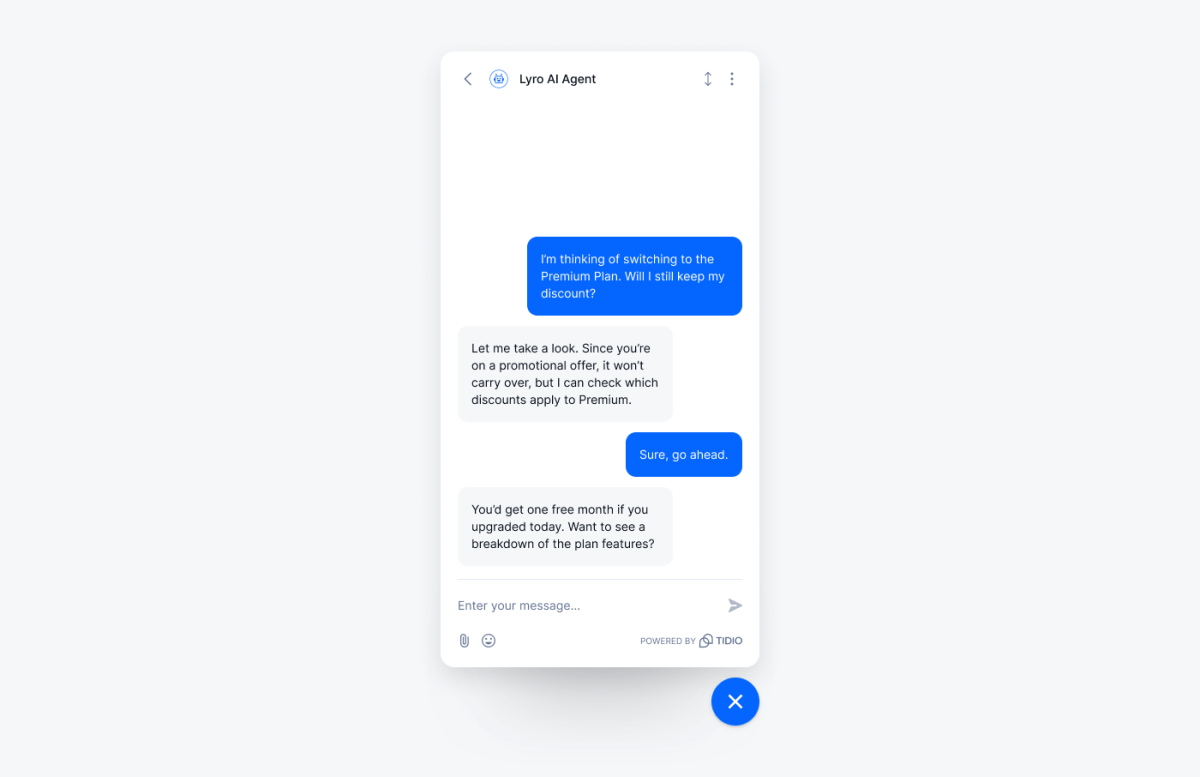
SaleSmartly vs HubSpot vs Tidio: Which Fits in 2026? - Where Tidio is strongest.
Tidio is an AI-powered customer service platform that pairs a conversational AI agent, Lyro, with live chat and help desk tools. It serves ecommerce stores, service providers, and growing businesses.
Lyro AI Agent for fast resolution
Tidio's Lyro AI Agent is designed to solve up to 67% of customer problems in seconds, working in your brand voice around the clock. A published case study with Cove Smart reports a 70% increase in self-service resolution, an 80% reduction in response times, and a 35% boost in customer satisfaction. For teams whose main pain is repetitive inbound questions, that is a compelling, well-documented result.
Live chat and help desk in one dashboard
The live chat widget gives visitors an immediate way to engage, and the help desk adds smart ticketing so multi-channel requests do not get lost. Tidio reports being trusted by over 300,000 businesses worldwide, and it offers a premium tier with custom limits and expert support.
Where it fits best
Tidio is a strong fit when your priority is scaling support without losing a human touch, particularly for ecommerce and service businesses whose customers mostly start conversations on a website. One practical note from community documentation: Lyro only begins responding after you install a code snippet or a WordPress/Shopify plugin and feed it a knowledge base, so plan for that setup step.
How to choose between them
The right answer depends on which problem is actually costing you the most.
Choose SaleSmartly if:
- Your customers reach you across many messaging apps, not just a website widget.
- You operate cross-border and need real-time translation built into the workflow.
- You want AI agents and human agents working the same inbox.
- You need specialized flows for WhatsApp marketing, click-to-message ads, or B2B inquiries.
- You want a low entry price with room to scale.
Choose HubSpot if:
- Your core need is a unified CRM that connects marketing, sales, and service.
- You want to start with free tools and grow into a full platform.
- Your team values a single customer record over broad messaging-channel coverage.
Choose Tidio if:
- Your support volume is concentrated on live chat and email.
- You want an AI agent with documented self-service resolution results.
- You need live chat, ticketing, and AI in one lightweight dashboard.
A practical hybrid view
Some teams do not replace one tool with another — they separate the systems of record from the systems of conversation. A CRM like HubSpot can hold the customer relationship, while a messaging platform handles the day-to-day conversations. If that is your architecture, the question becomes which tool owns the inbox. Comparisons such as SaleSmartly vs HubSpot vs Zendesk and SaleSmartly vs HubSpot vs Intercom explore that split in more detail.
Related reading
- SaleSmartly vs HubSpot vs LiveChat: Which Fits in 2026? - Compare SaleSmartly, HubSpot, and LiveChat on omnichannel messaging, AI agents, CRM, translation, and pricing to pick the right platform for 2026.
- SaleSmartly vs HubSpot vs Wati: Best AI Engagement Platform - Compare SaleSmartly, HubSpot, and Wati on omnichannel messaging, AI agents, CRM, translation, and pricing to choose the right customer engagement platform.
- SaleSmartly vs HubSpot vs Olark: Best Fit for 2026 - Compare SaleSmartly, HubSpot, and Olark on omnichannel messaging, AI agents, CRM, translation, and pricing to pick the right platform for 2026.
Sources and further reading
- The Best Shopify Apps by Keyword, Ranked by Real Search Results - Free directory of the top 10 Shopify apps for 3,643 popular App Store search keywords, ranked by real organic search results and updated daily.
FAQ
Is SaleSmartly a CRM like HubSpot?
No. SaleSmartly includes a built-in CRM, but its center of gravity is omnichannel messaging and AI-assisted conversations. HubSpot's CRM is the foundation of a broader marketing, sales, and service platform. If you need a deep sales pipeline system, HubSpot is built for that; if you need conversations across many messaging apps, SaleSmartly is built for that.
Can Tidio handle WhatsApp and Instagram messages?
Tidio supports multi-channel ticketing and live chat, with Lyro handling automated resolution. Its documented strength is website-based live chat and help desk workflows. If your customers primarily message you on WhatsApp, Messenger, Telegram, LINE, WeChat, or Zalo, compare channel coverage carefully before deciding.
Which platform is cheapest to start with?
SaleSmartly offers a freemium model with plans starting at $12.72/month. Tidio offers a free tier plus paid tiers. HubSpot offers free tools alongside premium software available via a demo. Entry cost is only part of the picture — factor in the channels you need and whether translation or AI resolution is included.
Does SaleSmartly translate conversations in real time?
Yes. SaleSmartly provides real-time translation across 134 languages, which is designed for cross-border teams handling multilingual support in a single inbox.
How do I know if I need an AI agent at all?
Start with your ticket data. If a large share of inbound questions are repetitive — order status, returns, basic troubleshooting — an AI agent can absorb that volume. Tidio's Lyro and SaleSmartly's AI agents both target this pattern. If most conversations are complex and consultative, prioritize inbox quality, context, and human handoff instead.
Conclusion
SaleSmartly, HubSpot, and Tidio are not three versions of the same product. HubSpot is the strongest choice when a unified CRM across marketing, sales, and service is the goal. Tidio is a focused, well-evidenced option for live chat and AI-assisted support resolution. SaleSmartly is the fit when your customers live in messaging apps, your support spans languages, and you want AI and human agents working one inbox at a price that starts low and scales.
Match the platform to your channel mix and your biggest bottleneck — not to the longest feature list — and the decision gets much simpler. For more head-to-head breakdowns, see SaleSmartly vs HubSpot vs LiveChat and SaleSmartly vs HubSpot vs Wati.
For independent context on how AI support agents are evaluated, you can browse verified AI agent reviews on Manzia, and for a sense of how widely ecommerce apps are tracked and compared, see Store Leads' supported apps list.