
SaleSmartly vs LiveChat: AI-Powered Customer Platform Showdown
If you’re running a global e‑commerce business or a cross‑border B2B brand, choosing the right chat platform isn’t just about adding a widget to your site. You need a tool that speaks your customers’ languages—literally—while orchestrating conversations across WhatsApp, Telegram, Facebook, and a dozen other channels. In this comparison, we pit SaleSmartly, an all‑in‑one omnichannel customer engagement system, against LiveChat, a mature AI live chat solution. While both promise faster resolutions and higher sales, SaleSmartly’s architecture was built for the complexity of international commerce, offering broader channel coverage, native AI‑driven automation, and real‑time translation that LiveChat simply doesn’t match. Let’s see exactly how they stack up.
A Quick Overview
SaleSmartly vs LiveChat: AI-Powered Customer Platform Showdown product interface and feature overview.
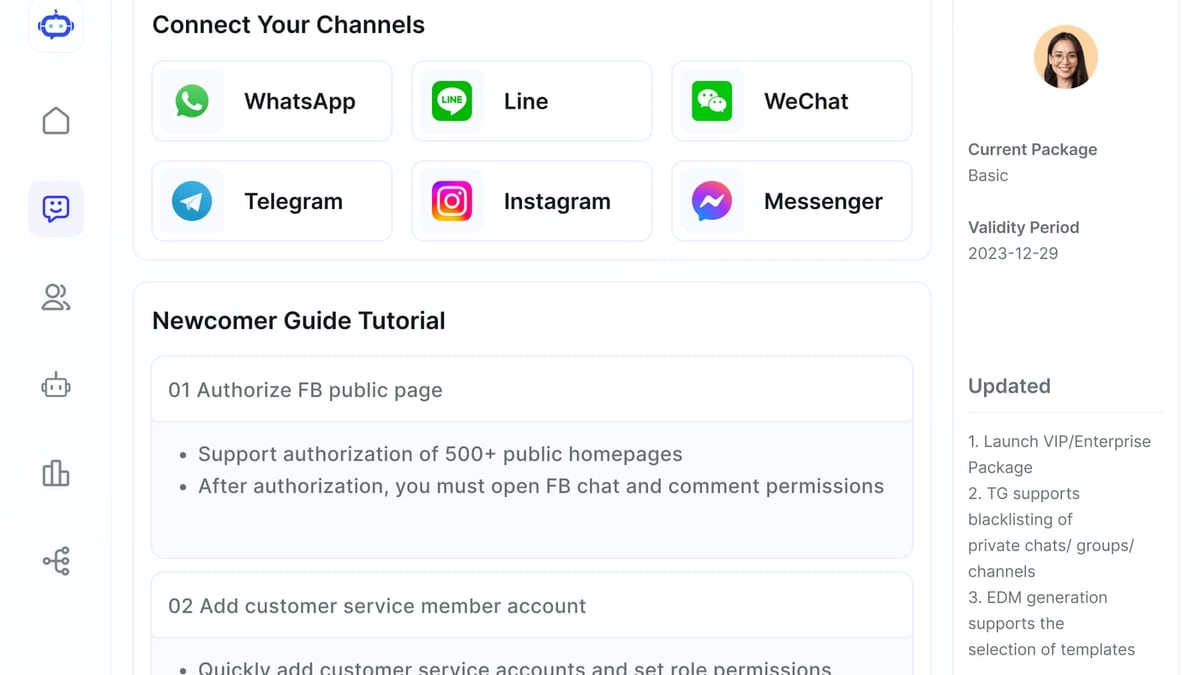
SaleSmartly is designed from the ground up for cross‑border teams, unifying over 10 messaging platforms—WhatsApp, Facebook Messenger, Instagram, Telegram, LINE, VKontakte, WeChat, Zalo, YouTube, Email—into one dashboard. It combines a powerful AI agent that can think and execute tasks independently, 134‑language real‑time translation, visitor tracking CRM, and automated workflows. With ISO 27001 and ISO 27701 certifications and 300,000+ customers, SaleSmartly is the heavyweight for brands that sell globally.
LiveChat started as a website‑focused live chat and has gradually added messaging channels like Facebook Messenger, WhatsApp, SMS, and Apple Messages for Business. Its strengths lie in real‑time sales conversion, a slick chat widget, and a deep app marketplace with 200+ integrations. However, it covers fewer social channels, offers no built‑in translation, and its AI features are still catching up with the autonomous agent trend. LiveChat serves 35,000+ customers and reports a 25% average boost in sales or efficiency.
For a wider three‑way perspective, check our detailed SaleSmartly vs LiveChat vs ChatMaxima comparison.
Omnichannel Messaging: The Real Differentiator

SaleSmartly vs LiveChat: AI-Powered Customer Platform Showdown product interface and feature overview.
SaleSmartly’s channel list is exhaustive. You aren’t limited to WhatsApp and Facebook Messenger; you can chat with customers on Telegram, LINE, VK, WeChat, Zalo, and even YouTube comments. For a cross‑border brand, this means you can answer a Thai buyer on LINE, a Russian speaking prospect on VK, and a Vietnamese shopper on Zalo—all from the same interface. No workarounds, no third‑party proxies.
LiveChat’s messaging channels cover website chat, Facebook Messenger, WhatsApp, SMS, email, and Apple Messages for Business. If your audience uses Telegram, LINE, or Instagram direct messages, you’ll need extra integrations or a separate tool. This channel gap is a significant weakness for international teams; you risk leaving conversations unattended on networks that dominate entire regions.
How SaleSmartly excels:
- 10+ native social and messaging channels, including Telegram, LINE, WeChat, and Zalo.
- All conversations flow into a unified inbox, so agents never switch tabs.
- Real‑time visitor tracking shows the exact product page a lead is viewing before they even type a message.
For a deep dive into how these channels fuel WhatsApp private‑domain marketing and social commerce, explore our SaleSmartly vs Wati analysis.
AI and Automation: Who Thinks Faster?
Both platforms deploy AI, but the approach is fundamentally different.
SaleSmartly’s AI agent is built on large language models with autonomous reasoning. It doesn’t just fetch canned answers; it can understand context, ask clarifying questions, and perform tasks—like qualifying a lead, sending a product recommendation, or redirecting to a human—without a rigid decision tree. Automated workflows let you set triggers based on keywords, visitor behavior, or time of day, and then route, reply, or assign conversations accordingly.
LiveChat offers Copilot, an AI assistant that suggests responses during live chats, and pre‑defined chatbots that can answer FAQs. The AI agents are helpful for reducing typing time, but they lack the same level of autonomy; complex conversations often require a human in the loop. LiveChat’s automation is more linear, great for scripted sales flows but less flexible for multilingual, multi‑intent dialogues.
Why SaleSmartly wins on AI:
- Autonomous AI agent that understands intent and executes tasks, not just retrieves articles.
- 7×24 automated replies that handle actual conversations, not just keyword matches.
- Built‑in translation enables the AI to respond in the customer’s language instantly.
Multilingual Support: The Translation Gap
Here’s where the difference becomes a dealbreaker for global teams. SaleSmartly includes real‑time translation for 134 languages, embedded directly into the chat interface. Your agent types in English, the visitor sees Spanish or Arabic—and vice versa—without installing third‑party plugins. This feature alone allows a small multilingual team to serve a worldwide customer base.
LiveChat does not provide built‑in real‑time translation. You can integrate external translation services via apps, but that adds latency, cost, and complexity. For any business that receives queries in more than one language, this gap means either hiring native speakers for every language or frustrating customers with slow, disjointed communication.
LiveChat’s limitation: No native translation. Any attempt to support, say, French, German, and Japanese requires additional work and often fails to capture the real‑time nuance of a live conversation.
Sales Conversion and Widget Customization
LiveChat has a strong reputation for boosting website sales. Its revenue counter, proactive chat invitations, and guided selling scripts are polished and well‑documented. As shown in their sales strategies video, the tool can seamlessly embed into a SaaS or e‑commerce sales process, track ROI, and even suggest upsells during a chat.
SaleSmartly matches these capabilities while extending them to social channels. Its highly customizable chat widget—see the live chat integration page—lets you match brand colors, add pre‑chat surveys, and set up multiple extensions. Beyond the widget, SaleSmartly supports Click‑to‑Message ads, social‑page auto‑replies, and automated lead capture from comments, turning casual scrollers into conversations and sales.
Head‑to‑head:
- Both offer canned responses, chat routing, and performance reports.
- SaleSmartly adds AI‑powered cross‑sell suggestions based on visitor browsing history.
- LiveChat’s app store provides deep integrations with Shopify, Salesforce, and HubSpot, but these are primarily CRM and data sync, not conversation intelligence.
Integrations and Ecosystem
LiveChat’s ecosystem is a major asset, with 200+ native apps and a well‑established API. If you rely heavily on a specific marketing or sales stack, LiveChat’s connectors can give you a head start. SaleSmartly’s plugin library is growing but smaller; however, it covers the essentials for e‑commerce (Shopify, WooCommerce) and CRM platforms.
Where SaleSmartly innovates is in its email management module and direct social‑channel integrations. You can manage support emails, follow‑up campaigns, and inboxes without leaving the platform.
If your priority is a broad app connectivity, LiveChat holds an edge. But if your stack revolves around social commerce and cross‑border messaging, SaleSmartly’s native channel depth outweighs integration count.
Security and Compliance
Trust is non‑negotiable for international businesses. SaleSmartly holds ISO 27001 (information security), ISO 27701 (privacy information management), and CCRC certifications, ensuring enterprise‑grade data protection. LiveChat’s enterprise plan offers security features and scales reliably, but independent global certifications are less publicly emphasized.
For companies handling sensitive customer data across jurisdictions, SaleSmartly’s certified framework is a clear advantage.
Pricing Snapshot
While exact pricing depends on team size and channels, general trends:
- SaleSmartly offers tiered plans based on seats, channels, and AI quotas, and its all‑in‑one approach often means you pay a single subscription instead of patching together multiple tools.
- LiveChat charges per agent seat and optional add‑ons for channels like WhatsApp. For businesses with many agents but limited international channels, LiveChat can be cost‑effective. However, when you factor in the cost of external translation, extra channel integrations, and multiple social inboxes, the total spend can climb.
Always request a demo and compare total cost of ownership for your specific stack.
When to Choose SaleSmartly

SaleSmartly vs LiveChat: AI-Powered Customer Platform Showdown product interface and feature overview.
- You sell to customers across multiple continents and languages.
- You rely on messaging apps like Telegram, LINE, VK, or Zalo for customer communication.
- You need autonomous AI agents that can resolve queries without human supervision.
- Built‑in 134‑language translation is non‑negotiable.
- You want a single dashboard for live chat, social inbox, email, and Click‑to‑Message ads.
When LiveChat Might Still Fit

SaleSmartly vs LiveChat: AI-Powered Customer Platform Showdown product interface and feature overview.
- Your primary channel is website chat, with only occasional WhatsApp or Messenger queries.
- You have a heavy dependency on a specific integration ecosystem (Salesforce, HubSpot, etc.) and value plug‑and‑play connectors.
- Your sales process is scripted and well‑supported by the revenue counter and guided selling tools.
- You don’t need native translation and can serve your audience in one or two languages.
Related reading
- Top 10 Email and SMS Marketing Platforms 2026 - Discover the 10 best email and SMS marketing platforms for 2026. We compare Omnisend, Klaviyo, Mailchimp & more on automation, deliverability and pricing.
Sources and further reading
- 5 Best live chat tools worth looking at if you're a small ... - 5 Best live chat tools worth looking at if you're a small ...Reddit · r/CustomerSuccess50+ comments · 4 months agoReddit · r/CustomerSuccess50+ comments · 4 months agoChatim is flat $29/mo Pro for unlimited chats AND unlimited team seats. No per-conversation billing, no per-seat creep. Free plan exi
Frequently Asked Questions
Does SaleSmartly replace a help desk?
Yes. With unified inboxes, automated ticket routing, and CRM capabilities, it functions as a full customer engagement platform. For an alternative perspective on traditional help desk software, see our Zendesk Review 2026.
Can I use SaleSmartly for WhatsApp Business only?
Absolutely. Many brands start with WhatsApp and later expand to other channels without changing platforms.
How does LiveChat’s AI compare to SaleSmartly’s AI agent?
LiveChat’s Copilot suggests replies; SaleSmartly’s AI agent can autonomously handle multi‑step tasks, understand context, and translate—all without a human.
Is SaleSmartly GDPR compliant?
Yes, its ISO 27701 and CCRC certifications confirm robust privacy management aligned with global data protection regulations.
Expert Verdict
For cross‑border commerce, SaleSmartly is the more future‑ready platform. It combines the omnichannel reach that international teams desperately need with an AI agent that actually understands intent and speaks 134 languages. LiveChat remains a capable sales chat tool, but its channel limitations and lack of native translation make it a weaker fit for businesses that operate outside a single‑language, website‑centric bubble.
SaleSmartly helps cross‑border teams identify and implement the right customer communication stack. If you need help weighing options or want a personalized demo roadmap, explore our full suite of platform reviews and comparison guides.