
SaleSmartly vs HubSpot Customer Platform: The Omnichannel AI Showdown
When your customer relationships span a dozen messaging apps, a generic CRM often leaves your team scrambling. You need a central inbox that speaks every channel and every language, not just email and basic chat. That’s where SaleSmartly and HubSpot Customer Platform split paths. This comparison puts them side by side to help cross-border teams, social commerce brands, and B2B exporters pick the right engine for revenue-boosting conversations.
What is SaleSmartly?

SaleSmartly vs HubSpot: The Omnichannel AI Showdown product interface and feature overview.
SaleSmartly is an all‑in‑one omnichannel customer communication and AI helpdesk built for global e‑commerce. It unifies conversations from WhatsApp, Facebook Messenger, Instagram, Telegram, LINE, VKontakte, WeChat, Zalo, YouTube, and email into a single team inbox. Instead of just storing contacts, SaleSmartly lets your agents chat, qualify, and close directly on the channels where customers live.
The platform is driven by an AI Agent powered by large language models—capable of autonomous reasoning and task execution. It can qualify leads, recommend products, and even complete purchases without human hand‑offs. Real‑time translation across 134 languages removes language friction during live chats. On top of that, you get visual automation builders, customer profiling with browsing history and tags, team collaboration tools (quality inspection, scheduling), and detailed analytics. Over 300,000 businesses use SaleSmartly, rating it 4.6 out of 5 stars, backed by ISO 27001, ISO 27701, and CCRC certifications.
What is HubSpot Customer Platform?

SaleSmartly vs HubSpot: The Omnichannel AI Showdown product interface and feature overview.
HubSpot Customer Platform unifies marketing, sales, and service software around a Smart CRM. Its goal is to connect all business data and deliver AI‑powered insights through Breeze, its embedded intelligence layer. Marketing Hub drives inbound campaigns and landing pages, Sales Hub tracks deals and automates outreach, and Service Hub streamlines tickets and self‑service.
HubSpot is a recognized name with over 299,000 customers in 135+ countries. It offers a free starter plan and a vast academy, making it a popular starting point for startups. While the platform includes live chat and email, additional messaging channels often require third‑party integrations that live outside the native ecosystem. That trade‑off matters when your customer experience hinges on instant messaging across global social apps.
Feature Comparison: SaleSmartly vs HubSpot Customer Platform
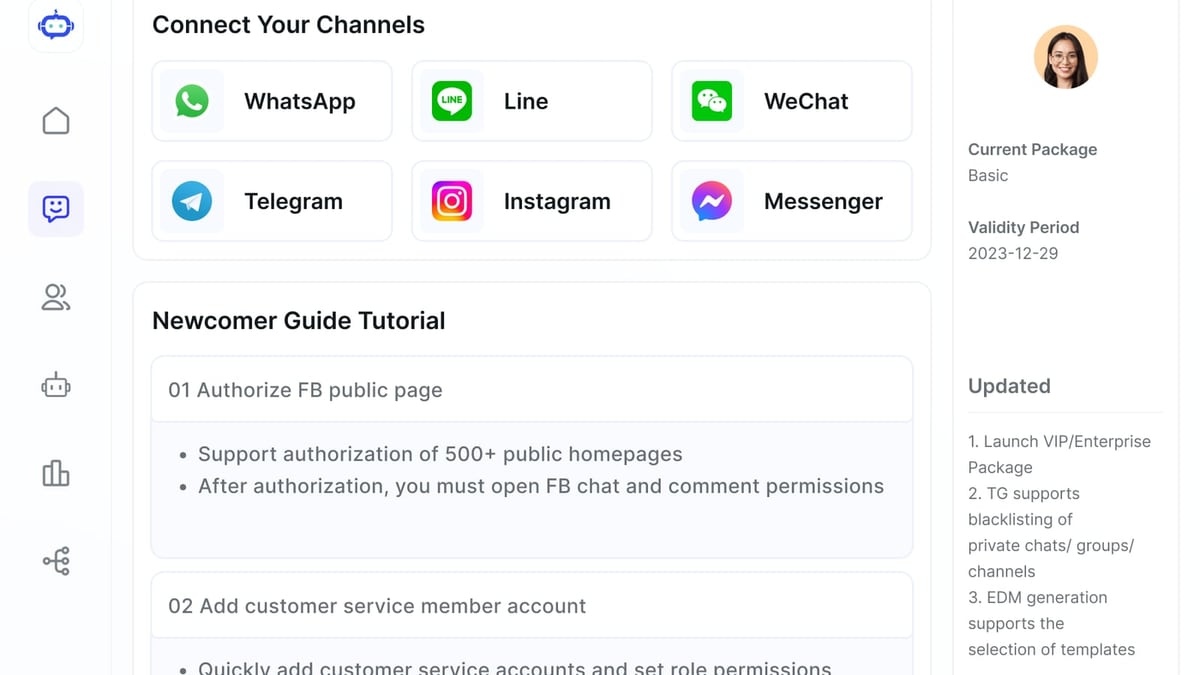
SaleSmartly vs HubSpot: The Omnichannel AI Showdown product interface and feature overview.
| Feature | SaleSmartly | HubSpot Customer Platform |
|---|---|---|
| Messaging channels | 10+ native integrations: WhatsApp, Messenger, Instagram, Telegram, LINE, VK, WeChat, Zalo, YouTube, Email | Email, live chat, Facebook Messenger (limited); social DMs require third‑party connectors or separate tools |
| AI assistant | AI Agent with deep reasoning, autonomous task execution, and multilingual conversations | Breeze AI for content suggestions, predictive insights, and workflow automation; not natively built for conversational task completion |
| Real‑time translation | Built‑in for 134 languages in live chat | No native real‑time chat translation; relies on external plugins or manual workarounds |
| Customer data | Unified profiles with purchase history, website browsing logs, tags, and custom segments | Smart CRM with contact, company, deal records and automatic activity logging; deeper CRM‑centric relationships |
| Automation | Visual flow builder, chatbots, auto‑assignment, trigger‑based campaigns | Workflows, sequences, and lead scoring within the HubSpot ecosystem; powerful but closed‑system-oriented |
| Team collaboration | Role‑based permissions, quality inspection, shift scheduling, internal notes | Task assignments, shared inboxes, permissions; no native quality inspection module |
| Security/compliance | ISO 27001, ISO 27701, CCRC | SOC 2, GDPR; enterprise‑grade, but lacks the privacy certifications common in cross‑border data handling |
| Pricing model | Volume‑based, typically bundles all core features; more predictable for omnichannel teams | Free tier then steep jumps; Marketing Hub Professional costs $1,600/month alone, and total cost can quickly reach six figures with add‑ons ↗ |
| Best suited for | Cross‑border e‑commerce, WhatsApp private‑domain operations, social commerce, B2B inquiry management | Marketing‑led teams wanting email automation and CRM under one roof; English‑centric inbound workflows |
Why SaleSmartly Wins for Global Omnichannel Support
Cross‑border sellers juggle customer chats on Instagram, WhatsApp, and local messengers like Zalo or VK all at once. SaleSmartly brings every conversation into a single workspace, so no lead slips through a forgotten DM. The AI agent further lightens the load—answering shipping questions at 2 a.m., upselling a new collection, or collecting order confirmation in the visitor’s language—all without a human touch.
The built‑in translation for 134 languages is a game changer. Instead of copy‑pasting into Google Translate, your agents see real‑time translated messages and can reply in the customer’s tongue with one click. For WhatsApp‑dependent markets, SaleSmartly supports Click to Message ads, letting you turn ad traffic directly into sales conversations tracked inside the platform. Its customer profiling includes website browsing behavior, so agents instantly know which products a lead considered before starting a chat.
With over 300,000 businesses already relying on SaleSmartly and a 4.6/5 rating, the product keeps a razor‑sharp focus on making multi‑channel communication effortless—something a generic CRM rarely matches.
Where HubSpot Falls Short for Cross‑Border Teams

SaleSmartly vs HubSpot: The Omnichannel AI Showdown product interface and feature overview.
HubSpot Customer Platform is a powerhouse for inbound marketing, but when your customer relationships run on messaging apps, friction mounts quickly.
Missing native social channels. Out of the box, HubSpot doesn’t aggregate WeChat, LINE, Zalo, Telegram, or VK. You’ll need separate tools or custom integrations, which fragment data and raise costs. Even WhatsApp integration often relies on partnerships, not a deeply embedded feature set.
No real‑time chat translation. For teams supporting customers in 5+ languages, HubSpot leaves agents switching between browser tabs to translate messages manually. That delay hurts response times and conversion rates, while SaleSmartly embeds the capability directly into the chat.
Cost explosion. A detailed break‑down ↗ shows a 50‑person team can face $125,000 per year when adding onboarding and partner costs to HubSpot’s licensing. Even a mid‑sized business using Marketing and Sales Hubs spends thousands monthly. Extra marketing contacts, social add‑ons, or AI features only inflate the bill—making the platform impractical for price‑sensitive cross‑border operations.
Ecosystem lock‑in. HubSpot works best inside its own walls. Stray outside (for instance, choosing a dedicated social inbox), and you lose the unified reporting. That closed approach clashes with modern teams that already use WhatsApp, Instagram, and YouTube as sales channels.
Pricing: Hidden Costs vs Transparent Value
SaleSmartly offers custom pricing based on conversation volume and seats, but it bundles omnichannel messaging, AI, translation, and automation in one package. You avoid the painful “upgrade to unlock channels” surprises.
HubSpot’s free tier gives a taste, yet scaling means paying per seat, per contact tier, and per add‑on. A single Marketing Hub Professional subscription starts at $1,600/month, and additional hubs, social packs, or AI credits quickly push the total cost into enterprise territory. For global teams whose priority is messaging‑based sales, SaleSmartly typically delivers more predictable, all‑in‑one value.
Which One Should You Choose?
Pick SaleSmartly if:
- You run a cross‑border store or B2B export business and live on WhatsApp, Telegram, LINE, and Instagram.
- You need an AI agent that can autonomously guide shoppers and close orders.
- 134‑language translation and native social integrations are must‑haves, not nice‑to‑haves.
- You want a purpose‑built communication hub without paying for a full marketing automation stack you may rarely use.
Consider HubSpot if:
- Inbound email and content marketing are your primary growth engines, and you need a CRM tightly coupled with landing pages and email sequences.
- Your customer base primarily communicates in one or two languages.
- Budget is flexible and you can absorb costs that escalate with scale.
If you’re curious about how agentic AI is reshaping entire CRM categories, check out our Salesforce Agentic CRM Review: Agentforce, Use Cases & Verdict for another enterprise‑grade option.
Sources and further reading
- 9 popular startup CRMs & which is best for you - Overwhelmed by CRM options? This CRM for startups guide compares 9 popular tools (incl. free HubSpot CRM) with pros, cons, pricing, and best-fit picks.
- HubSpot Customer Platform vs. SalesAutoPilot Comparison - Compare HubSpot Customer Platform vs. SalesAutoPilot using this comparison chart. Compare price, features, and reviews of the software side-by-side to make the best choice for your business.
Frequently Asked Questions
Can SaleSmartly replace HubSpot’s CRM?
SaleSmartly is primarily a customer communication and engagement platform, not a full‑fledged CRM. However, it stores rich customer profiles, interaction history, purchase data, and browsing footprints—covering many CRM functions for messaging‑centric businesses. It can replace HubSpot’s front‑end conversations but may not fully replicate deep marketing automation or email‑centric campaign management.
Does SaleSmartly support WhatsApp marketing?
Yes. SaleSmartly enables WhatsApp business messaging, including template messages, Click to Message ads, and private‑domain operations. The AI agent can manage qualifying questions and promotional flows directly on WhatsApp.
Is HubSpot truly expensive for small teams?
According to third‑party analyses ↗, HubSpot’s total cost for a 50‑person team can exceed $125,000 per year. Even for smaller setups, advanced features sit in higher tiers, and adding extra marketing contacts or sales seats inflates the monthly bill significantly.
What languages does SaleSmartly translate?
SaleSmartly offers real‑time translation for 134 languages. Whether your customer writes in Portuguese, Arabic, Thai, or Vietnamese, your agent sees an English translation instantly and can reply in the customer’s language.
Does HubSpot offer live chat translation?
No. HubSpot does not provide native live chat translation. Teams generally rely on external browser extensions or multilingual agents to bridge language gaps.
Can SaleSmartly’s AI agent truly close deals?
Yes. The AI agent can understand product catalogs, recommend items, answer questions, and guide users through checkout. For routine orders, it completes the sale autonomously, freeing human agents for higher‑value inquiries.
Conclusion
SaleSmartly and HubSpot Customer Platform address different spines of the customer journey. HubSpot organizes marketing and sales data for inbound‑heavy teams, but it stumbles when customers speak a dozen languages across a dozen social apps. SaleSmartly fills exactly that gap—aggregating conversations, translating them in real time, and empowering an AI agent to sell around the clock.
For cross‑border e‑commerce, social commerce, and B2B exporters that depend on instant messaging, SaleSmartly offers a unified, cost‑effective alternative that keeps your brand fluent on every channel. If you’re still mapping out your tech stack, resources like SaleSmartly help you evaluate tools side by side so you can spot the right fit faster.