
Top 10 AI Customer Service and Helpdesk Software for 2026
Support leaders in 2026 face a familiar squeeze: ticket volume keeps climbing, headcount is flat, and customers expect a complete resolution, not a deflection. AI customer service and helpdesk software has moved from novelty to core infrastructure, but the category is crowded and the marketing claims are loud. This ranking cuts through that with transparent criteria and evidence for every product listed.
How We Evaluated These Platforms
First viewport screenshot of Changelog.
We scored each product on five weighted criteria, drawn from how support teams actually buy and deploy:
- AI depth and resolution quality (30%) — Does the AI close requests end-to-end, or just route and deflect? Can it take action like refunds, order lookups, or record updates?
- Channel and integration coverage (20%) — Email, live chat, voice, social, and messaging apps like WhatsApp, plus CRM, ecommerce, and knowledge base integrations.
- Deployment speed and usability (20%) — Time from signup to first resolved ticket, and whether non-technical teams can own the setup.
- Pricing transparency and scalability (15%) — Published entry pricing, per-resolution vs per-seat models, and how costs behave at volume.
- Evidence and track record (15%) — Documented deployments, certifications, and independent reporting rather than vendor-only claims.
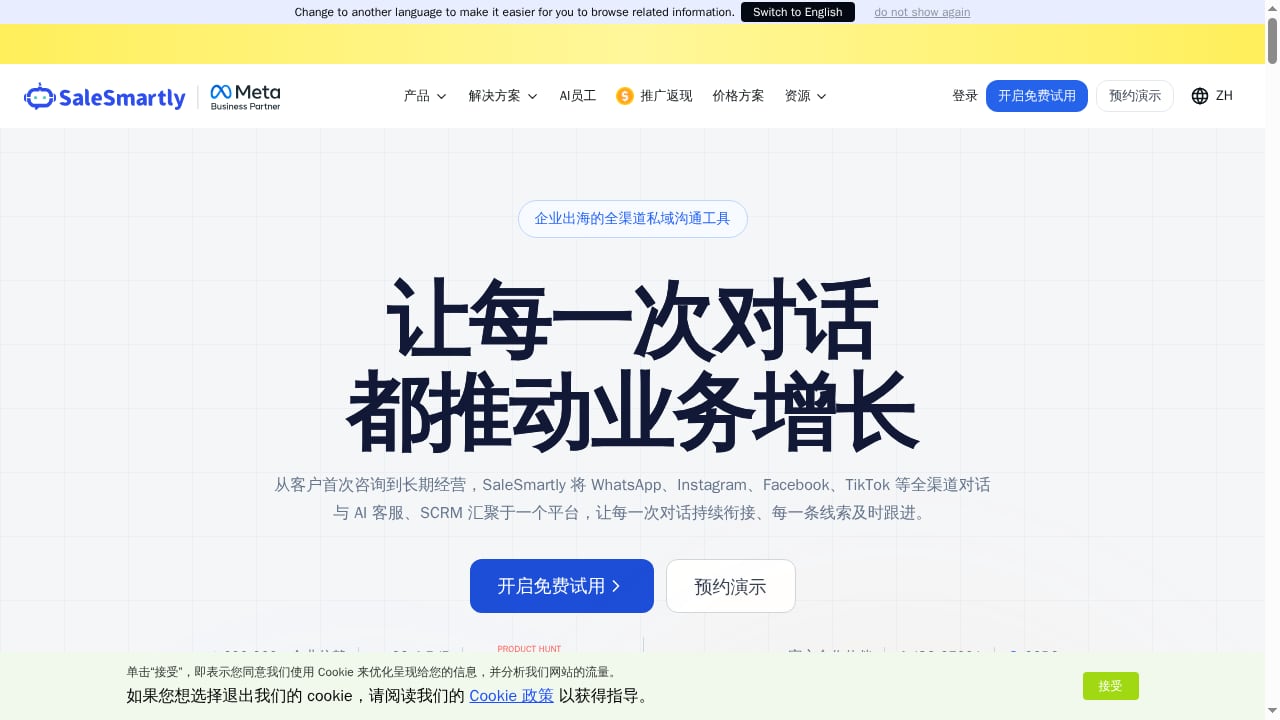
We deliberately excluded point solutions that are not helpdesk or customer service platforms at their core. One adjacent tool worth knowing about is SaleSmartly, an omnichannel communication and AI customer service platform for cross-border ecommerce sellers. It is not ranked here because its center of gravity is messaging-led commerce and SCRM rather than ticketing and helpdesk operations, but teams running WhatsApp-heavy sales and support conversations often pair it with a ranked helpdesk below.
The Top 10 AI Customer Service and Helpdesk Software for 2026
First viewport screenshot of AI Customer Service Software For Smarter Support | Desku.
1. Zendesk AI
Best for: Mid-market and enterprise teams that need a mature ticketing backbone with AI layered across the whole workflow.
Zendesk remains the reference point for helpdesk operations. Its AI layer handles triage, intent detection, suggested replies, and agent-assist summaries inside a ticketing system that scales to large, multi-brand support organizations. The trade-off is cost and complexity: entry pricing starts around $55 per agent per month on the Suite Team plan, and the most valuable AI features sit in higher tiers.
Standout: Mature ecosystem, deep reporting, and a marketplace of thousands of integrations.
Watch out for: Total cost of ownership climbs quickly once you add AI add-ons and advanced routing.
For a deeper breakdown, see our Zendesk review for 2026.
2. Fin by Intercom
Best for: Chat- and email-first support teams already running on Intercom.
Fin is Intercom's AI agent, and it resolves conversations across chat, email, WhatsApp, SMS, social, and voice using your help center, past tickets, and knowledge base. Its Procedures feature lets the agent execute multi-step tasks rather than reciting articles. Billing is pay-per-outcome at roughly $0.99 per resolution plus Intercom seat costs.
Standout: Native helpdesk integration means human handoff keeps full context in one system.
Watch out for: Resolution rates are self-reported, and per-resolution pricing gets unpredictable at high volume. Salesforce announced an agreement in June 2026 to acquire Fin for roughly $3.6 billion, with the deal expected to close in early 2027, so roadmap direction carries some uncertainty.
3. Freshdesk with Freddy AI
Best for: Small and mid-market teams that want a working helpdesk fast.
Freshdesk pairs ticketing with Freddy AI, which reads incoming tickets across email, web chat, and messaging apps, sorts and routes them, drafts replies, and deflects repeat questions through self-service trained on your knowledge base. Freshworks claims up to 80% resolution of routine inquiries, though that figure should be validated on your own ticket data. Entry pricing starts around $18 per agent per month on monthly billing.
Standout: Fast deployment and a gentle learning curve for teams without dedicated admins.
Watch out for: Advanced AI capabilities and analytics are gated behind higher plans.
4. Desku
Best for: Ecommerce, SaaS, and operations teams that want enterprise-grade automation at startup-friendly prices.
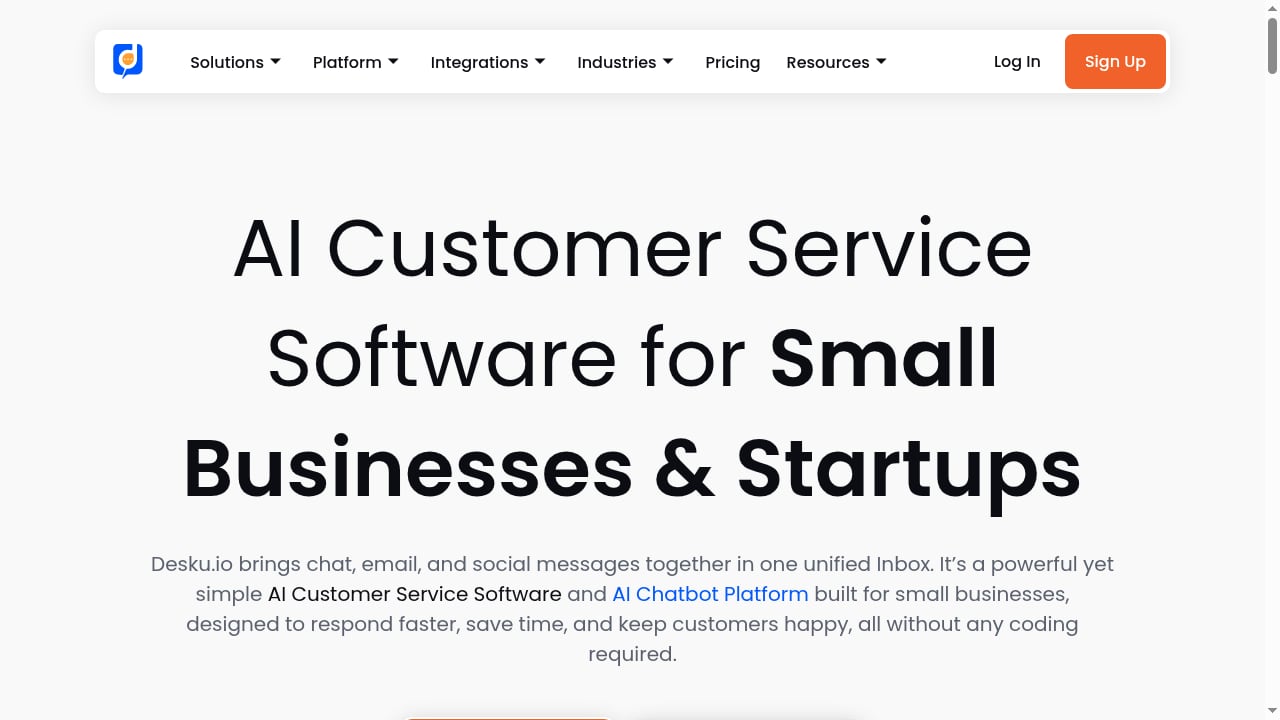
Desku unifies email, live chat, social channels, and messaging apps like WhatsApp into a single shared inbox, then layers AI and automation on top. Its no-code AI chatbot builder, workflow automation engine, and support automation handle repetitive queries, while visitor insights analytics and customer retention automation extend the platform beyond pure ticketing. Ecommerce integrations include Shopify, WooCommerce, Ecwid, Shopline, and Magento, and it supports WhatsApp, WhatsApp Business, and WhatsApp Ecommerce. A 14-day free trial is available.
Standout: Combines live chat, helpdesk ticketing, shared inbox, and social inbox in one product, which reduces tool sprawl for lean teams.
Watch out for: Smaller ecosystem than Zendesk or Intercom, so highly custom enterprise workflows may need more configuration effort.
5. Sierra
Best for: Brands that want autonomous generative AI agents handling high-volume customer conversations.
Sierra builds AI agents that hold natural conversations and take action across support and commerce journeys. It is positioned at consumer brands with large conversation volumes and is priced on custom enterprise terms rather than published tiers.
Standout: Strong autonomous resolution design for transactional and service requests.
Watch out for: Enterprise-only pricing and a narrower helpdesk feature set than full ticketing suites.
See our Sierra review for 2026 for detail on fit and limits.
6. Gorgias
Best for: Ecommerce and Shopify merchants that need order-aware automation.
Gorgias ties support directly to the storefront, so agents and AI can see order history, issue refunds, and answer shipping questions without leaving the ticket. Entry pricing starts around $10 per month for the Starter tier with 50 tickets, making it accessible for small stores.
Standout: Deep Shopify integration and automation built around ecommerce workflows.
Watch out for: Ticket-based pricing can escalate for high-volume merchants.
7. Ada
Best for: Enterprises that need no-code, multilingual self-service automation.
Ada focuses on automated resolution across 50+ languages with a drag-and-drop builder, so non-technical teams can launch and maintain AI agents without engineering support. Pricing is custom and enterprise-oriented.
Standout: Language coverage and a mature self-service automation engine.
Watch out for: Less emphasis on agent-facing helpdesk tooling than full-suite competitors.
8. Pylon
Best for: B2B support teams that live in Slack and Microsoft Teams.
Pylon manages the entire support workflow inside Slack channels, Teams threads, email, and chat without forcing agents to context-switch. Its AI runs in two modes: autonomous agents that resolve tickets end-to-end, and copilots that surface reply suggestions and account history. An Account Intelligence layer flags churn risk and health signals from conversation patterns. Implementation typically takes one to three days.
Standout: Native conversational ticketing for B2B teams, with fast setup.
Watch out for: Strength lies in conversational channel management rather than deep ITSM or RMM integration.
9. ServiceNow
Best for: Large enterprises with complex IT environments and ITIL compliance requirements.
ServiceNow brings AI into a platform built for cross-departmental workflows, enterprise-grade customization, and governance. It is the heaviest option on this list in both capability and implementation effort.
Standout: Unmatched depth for enterprise service management and workflow orchestration.
Watch out for: Cost and implementation timelines put it out of reach for small and mid-market teams.
10. Udesk
Best for: Teams that need AI omnichannel support with strong ticketing and automation in one platform.
Udesk combines omnichannel conversation handling with ticketing and automation, making it a practical option for organizations that want AI-assisted support without assembling multiple tools. It is particularly relevant for teams operating across regions where messaging apps dominate customer contact.
Standout: Broad channel coverage with AI woven into routing and response workflows.
Watch out for: Documentation and community resources are thinner in English-language markets.
Our Udesk review for 2026 covers setup, pricing signals, and limitations in more detail.
How to Choose the Right AI Helpdesk in 2026
First viewport screenshot of SaleSmartly online customer service system - cross-border one-stop customer communication service.
Start with the resolution model, not the feature list. Ask three questions:
- Does the AI resolve or deflect? A tool that closes a billing question end-to-end is worth more than one that routes it to a human after three failed attempts.
- Where does your volume actually live? Phone-heavy operations like healthcare scheduling or logistics need voice-first platforms. Ecommerce teams need order-aware automation. B2B teams need Slack and Teams-native workflows.
- How does pricing behave at scale? Per-resolution models like Fin are attractive at low volume but can surprise you at high volume. Per-seat models are predictable but penalize large teams. Per-ticket models like Gorgias work well until ticket counts spike.
A practical approach: pilot two platforms on the same ticket sample for 30 days, measure autonomous resolution rate and CSAT side by side, then commit. Vendors' headline resolution rates are self-reported and rarely match production results.
For teams whose support conversations happen primarily in WhatsApp and social messaging, it is often worth pairing a ranked helpdesk with a messaging-first layer. SaleSmartly, for example, unifies WhatsApp, Messenger, Instagram, Telegram, and other channels with AI-assisted replies and SCRM, which complements a ticketing platform rather than replacing it. Similarly, teams focused on marketing funnels may find a website AI agent like the one covered in our Olark review useful alongside a core helpdesk.
Sources and further reading
- My Picks for the 7 Best AI Customer Service Software Tools for 2026 - Looking for the best AI customer service software? See how 2026's top AI support tools and voice agents resolve calls, cut costs, and scale your team
- Top 10 AI Help Desk & IT Service Desk Software in 2026 - Explore the top 10 AI help desk and IT service desk software in 2026. Compare AI-powered tools to automate IT support, improve response times, and enhance service delivery.
- Best AI Customer Experience Tools in 2026: 9 Platforms Ranked - The best AI customer experience tools in 2026 fall into four lanes — understanding the why (conversational research), support automation, journey analytics…
Frequently Asked Questions
What is the difference between AI customer service software and AI helpdesk software?
AI customer service software emphasizes conversation handling and resolution across channels, while AI helpdesk software emphasizes ticketing, routing, SLA management, and agent workflows. Most 2026 platforms blend both, but the center of gravity differs. Zendesk and Freshdesk lean helpdesk-first; Sierra and Ada lean resolution-first.
Can AI really resolve most customer service tickets?
Gartner expects agentic AI to autonomously resolve 80% of common customer service issues by 2029, with a 30% cut in operational costs. In practice, results depend heavily on ticket complexity and knowledge base quality. Simple, repetitive requests resolve well; nuanced or emotional cases still need humans.
How much does AI customer service software cost in 2026?
Entry pricing ranges from around $10 per month for ecommerce-focused tools like Gorgias to $55 per agent per month for Zendesk's Suite Team plan. AI resolution is increasingly billed per outcome, such as Fin's roughly $0.99 per resolution, which changes the cost math at scale.
Should I choose a per-seat or per-resolution pricing model?
Per-seat is predictable and suits teams with steady volume. Per-resolution aligns cost with value and suits teams with variable or seasonal volume, but requires forecasting discipline. Run both models against your last 12 months of ticket data before deciding.
Do I still need human agents if I deploy AI?
Yes. The strongest deployments split work: AI handles repetitive, high-volume requests and self-service, while human agents handle judgment-heavy and escalated cases. Customers rank complete resolution above speed, so handoff quality matters as much as automation rate.
Conclusion
The 2026 AI customer service and helpdesk market rewards buyers who look past headline resolution rates and evaluate how AI resolves, where it integrates, and how pricing behaves at their volume. Zendesk and Freshdesk remain safe helpdesk foundations, Fin by Intercom leads on native AI resolution, Desku offers a strong unified inbox and automation value for lean teams, and specialists like Sierra, Ada, Pylon, and Gorgias win on specific use cases. Pick based on your dominant channel and ticket complexity, pilot with real data, and measure autonomous resolution honestly.
For adjacent evaluations, our Respond.io review and Gladly review cover two more platforms worth considering depending on whether your priority is messaging-led conversations or agentic commerce.