
Olark Review 2026: An AI Agent That Works Your Funnel 24/7
Olark has been a live chat product since 2009, used by more than 12,000 businesses. In 2026, the company's headline offer is no longer a cheap chat widget. It is an AI website agent — marketed as "more than a chatbot" — that answers visitor questions, qualifies leads, and decides when to hand a conversation to a human. This review looks at what is actually on sale, what it costs, where it fits, and where it does not.
What Olark is selling in 2026
First viewport screenshot of Customers | Olark.
Olark now leads with an AI website agent powered by an engine it calls Aiden. The pitch is aimed at marketers who are handling several jobs at once: the agent answers questions from your live site and documentation, qualifies visitors, and escalates to a human at the right moment.
Two things separate this from a conventional chatbot:
- Answers come from your current site, not stale training data. Olark states the agent learns from your live site and latest documentation, so a pricing change made this morning is reflected in the answer it gives.
- Engagement is behavior-triggered. The agent uses signals such as referral source, pages viewed, and repeat visits to decide when to appear — for example, a returning visitor who has opened your pricing page three times.
The classic live chat product still exists. Olark's pricing page notes a live-chat-only plan for teams that want humans without AI. That dual structure matters, because most published reviews still describe the older, cheaper tool.
Pricing signals: the number most reviews get wrong
First viewport screenshot of Live Chat Help Center | Olark.
This is the single most important thing to verify before you evaluate Olark.
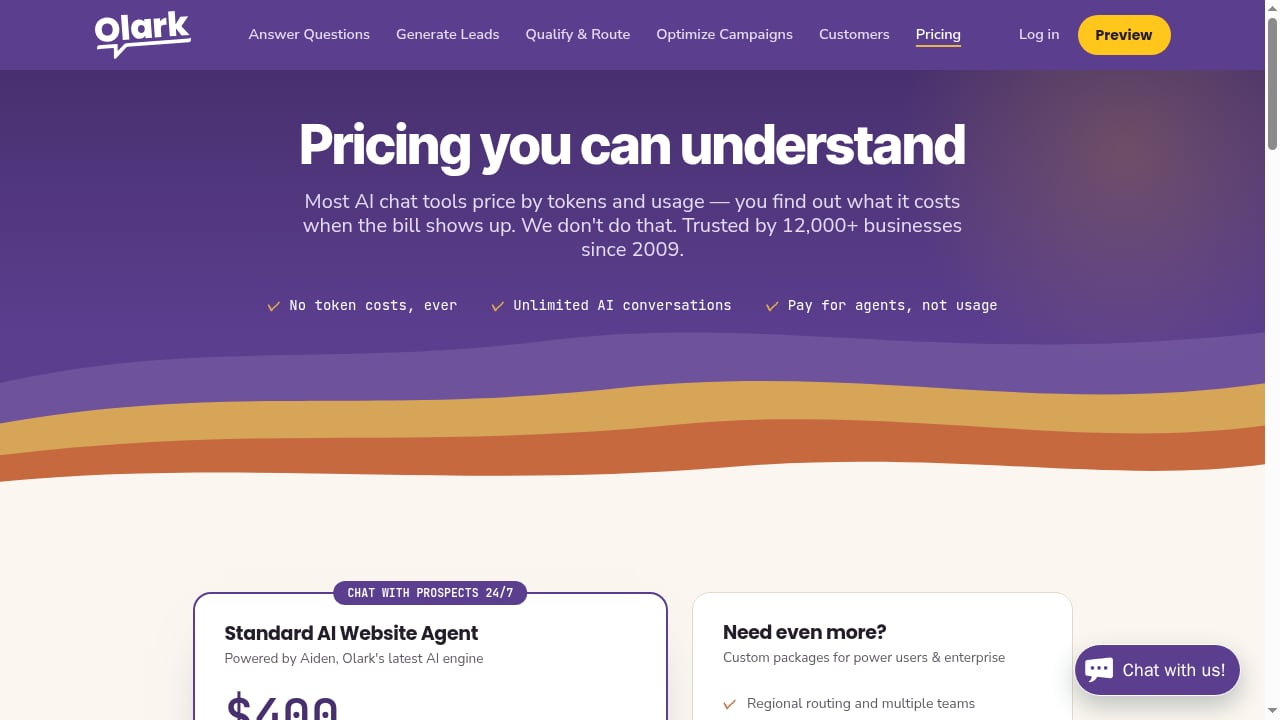
Aggregator sites still list Olark entry pricing in the $17–$29 per month range. Those figures describe the legacy live chat product. Olark's own pricing page in 2026 leads with the Standard AI Website Agent at $400 per month billed annually — roughly $4,800 per year — which includes unlimited AI conversations, automatic knowledge updates, lead capture and qualification, proactive engagement, account management, and one human agent seat. Additional human seats are listed at $29 each per month. A custom enterprise tier covers regional routing, SSO, custom SLAs, and legal review.
The legacy live-chat-only plan remains available at $29 per agent per month.
The pricing philosophy is worth noting. Olark argues against token or usage-based pricing on the grounds that it penalizes success: the more your agent helps, the more you pay, so teams start rationing their own automation. Olark's answer is a flat fee with unlimited AI conversations and no overages, where cost rises only when you add human seats. The critique is fair even if the entry price is high for a small team.
If budget predictability is your main criterion, it is worth comparing flat-fee models against platforms that charge per resolution or per contact. Our Top 10 AI Customer Service Software Products 2026 breaks down how those models differ in practice.
Setup: what "trained in under a minute" actually means
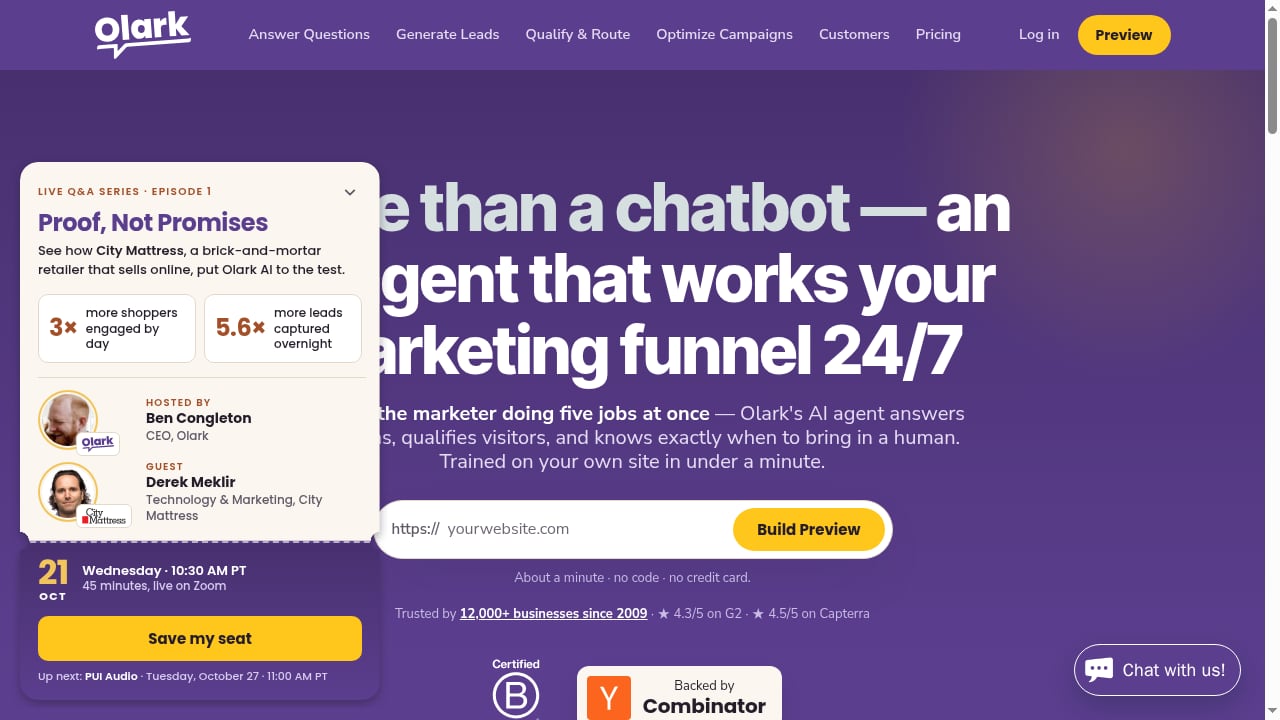
First viewport screenshot of Olark — More than a chatbot. An AI agent that works your marketing funnel 24/7.
Olark's setup claim is specific: about a minute, no code, no credit card to start. In practice, the flow looks like this:
- Install the widget on your site.
- Point the agent at your site and documentation so it learns from your real content rather than a generic model.
- Adjust behavior in plain English instead of building logic trees.
- Connect your stack — HubSpot, Salesforce, ActiveCampaign, and webhooks are among the listed integrations — so leads and transcripts land where your team already works.
The design decision behind this is deliberate. Olark's team has said publicly that they abandoned the logic-tree builder model because customers built flows they could never maintain. For a marketer without engineering support, that is a genuine advantage over visual flow builders that require ongoing upkeep.
The honest limitation: "trained in a minute" describes the first pass, not the finished product. Any AI agent needs review of its answers, escalation rules, and edge cases before you trust it with revenue conversations.
Strengths
Simplicity is the product. Olark's historical strength — easy setup, easy admin, minimal learning curve — carries into the AI tier. Reviewers have consistently rated ease of use and ease of setup near the top of the category.
Behavior-based engagement. Visitor monitoring and proactive triggers were always strong relative to price. In the AI tier, those signals feed an agent that can open a conversation before the visitor asks, or address the objection they are already forming.
Human handoff is a first-class feature. Olark markets "one side of human with every bot" — visitors who ask for a person get one, and support comes from the people who built the product. In a category where forced bot loops frustrate buyers, that positioning is a real differentiator.
Predictable billing. Unlimited AI conversations with no overage charges removes the mid-month bill spike risk that per-contact and per-token models carry.
Integration coverage. HubSpot, Salesforce, ActiveCampaign, and webhooks cover the common marketing and CRM paths.
Limitations
The review corpus describes a different product. Olark holds roughly 4.3/5 on G2 (about 224 reviews) and 4.5/5 on Capterra (471 reviews), but the reviewers overwhelmingly describe the low-cost live chat widget, and Capterra's own breakdown shows about 80% small business reviewers. There is very little independent commentary on the current AI agent, which means most third-party evidence does not apply to what you would actually be buying.
The price jump is steep. Moving from a $29-per-agent chat tool to a $4,800-per-year AI agent is a different purchasing decision, not a tier upgrade. Small teams should test whether the qualification and after-hours capture justify the delta.
Customization has historically been thin. The most common criticism in the review corpus is that the interface looks dated and customization is limited compared with competitors — including the inability to build a custom chatbot in the legacy product. Verify how much branding and behavior control the AI tier now allows.
Add-on costs have been a complaint. Olark's historical PowerUps structure — co-browsing, branding removal — carried meaningful recurring fees on top of seat pricing. Confirm what is included in the AI plan before signing.
No meaningful independent forum discussion. Trustpilot and Reddit offer little usable sentiment on the new product, so early evaluation depends heavily on vendor materials and your own trial.
Who Olark fits — and who it does not
First viewport screenshot of Pricing | Olark.
Olark is a strong fit if:
- You are a marketing team without dedicated support engineers, and you want an AI agent live in days rather than weeks.
- Your funnel loses leads after hours or during high-traffic periods, and you want qualification plus human escalation rather than a pure deflection bot.
- You value flat, predictable AI pricing over per-resolution billing.
- You already run HubSpot, Salesforce, or ActiveCampaign and want conversations to flow into those systems.
Olark is a weaker fit if:
- You need deep helpdesk and ticketing. Olark has never tried to cover a full support surface; if structured ticketing is core, look at platforms built around it.
- You need heavy visual flow customization or a no-code chatbot designer with branching logic.
- You are a very small team for whom $4,800 per year is disproportionate to current chat volume. The legacy $29-per-agent live chat plan may be the better starting point.
- You need omnichannel coverage beyond website chat — messaging apps, social channels, and email in one inbox.
For teams weighing free or low-cost live chat against a paid AI agent, our tawk.to review covers the free-tier trade-offs, and our Top 10 AI-First Customer Service Platforms 2026 compares agentic platforms on resolution depth and fit by industry.
How to decide: a short evaluation checklist
- Confirm the current price on Olark's own pricing page. Ignore aggregator figures until you have.
- Run the agent against your real site and read its answers for accuracy on pricing, policies, and edge cases.
- Test the escalation path. Ask for a human and measure how quickly one appears.
- Check your integration requirements against the supported list before committing.
- Model the human seat cost. The AI tier includes one seat; additional seats are $29 per month each.
- Compare against one alternative with a different pricing model so you are choosing between philosophies, not just features.
Related reading
- Manago AI Review 2026: CDP, AI Campaigns & Real Limits - Hands-on Manago AI review for 2026: CDP, one-prompt campaigns, omnichannel journeys, pricing signals, setup, pros, cons, and who should buy it.
- Bird Review 2026: Developer-First Omnichannel Messaging - Hands-on Bird review for 2026: channels, MCP/CLI/SDK setup, pricing signals, strengths, limits, and who should choose it over rivals.
Sources and further reading
- Olark Review 2026: Pricing, Features and Verdict - Olark now sells an AI agent at $400 a month, not the $29 chat tool review sites list. A support leader on what changed and who should buy.
- Olark — More than a chatbot. An AI agent that works your marketing funnel 24/7 - Built for the marketer doing five jobs at once — Olark's AI agent answers questions, qualifies visitors, and knows exactly when to bring in a human. Trained on your own site in under a minute.
- 27 Best ManyChat Alternatives in 2026: Chat Marketing + AI Bots - The 24 best ManyChat alternatives in 2026: Chatfuel, Landbot, Tidio, Crisp, LiveChat, Tawk.to, Respond.io, Intercom and more.
FAQ
Is Olark still a cheap live chat tool? Partly. The legacy live-chat-only plan remains at $29 per agent per month, but Olark's main 2026 offer is an AI website agent at $400 per month billed annually.
What is Aiden? Aiden is the name Olark uses for the engine powering its AI website agent.
How long does setup take? Olark advertises training on your site in about a minute with no code. Expect additional time for reviewing answers and configuring escalation before going live.
Does Olark charge per AI conversation? Olark's AI tier includes unlimited AI conversations with no overages; cost rises when you add human seats.
Can visitors still reach a human? Yes. Human handoff is a core part of the product positioning, and the AI plan includes one human agent seat.
Does Olark replace a helpdesk? No. It is a website chat and AI agent product, not a full ticketing suite. Teams needing structured ticketing should pair it with or choose a helpdesk platform.
Conclusion
Olark in 2026 is two products wearing one name: a dependable, inexpensive live chat tool with a long track record, and a new AI website agent priced for teams that treat chat as a revenue channel. The AI agent's strongest ideas — answering from your live site, engaging on visitor behavior, and handing off to humans without friction — map directly to the problems marketers actually have. The weakest part of the evidence base is that almost all public reviews describe the old product, so your trial matters more than the star ratings.
If your funnel leaks after hours and you want an agent running in days, Olark is worth a serious test. If you need deep ticketing, omnichannel messaging, or heavy flow customization, compare it against platforms built for those jobs before you commit.