
Bird Review 2026: A Developer-First Omnichannel Communications Platform
Bird is a communications platform built for developers who need to send and receive messages across Email, SMS, WhatsApp, Apple Messages, and Voice from a single stack. It ships MCP, CLI, and SDK tooling, plus features like Verify, Lookup, Mailbox, eSIM, and Realtime. This review covers what Bird does well, where it strains, how setup actually feels, and which teams should shortlist it.
What Bird Is and Who It's For

Banking solution with secure authentication and regulatory messaging..
Bird positions itself as "Communications for developers." That framing matters. The product assumes you are comfortable with APIs, webhooks, and code-first workflows rather than drag-and-drop campaign builders alone.
Typical fits:
- Product and platform teams embedding transactional email, SMS, or WhatsApp into an app.
- Developers who want MCP, CLI, and SDK access instead of clicking through a dashboard.
- Growth and lifecycle marketers running journey automation and AI-powered send time optimization.
- Support teams that need a unified inbox for conversations across channels.
- AI builders experimenting with Agent Mailboxes for autonomous agents.
If your team has no engineering capacity and wants a purely visual tool, Bird will feel heavier than necessary.
Channels and Core Capabilities

Ecommerce solution showing personalized customer messaging across channels..
Bird's channel coverage is the headline. One platform handles:
- Email for transactional and lifecycle messages.
- SMS for notifications, alerts, and two-way texting.
- WhatsApp for campaigns and conversational support.
- Apple Messages for businesses targeting Apple's ecosystem.
- Voice for calls and verification flows.
On top of channels, Bird layers:
- Verify for passcodes and one-time verification.
- Lookup for validating and enriching phone numbers.
- Mailbox for inbox-style conversation management.
- eSIM for connectivity use cases.
- Realtime for live event and delivery tracking.
Public APIs for preferences and SMS statistics mean you can build consent management and reporting directly into your own product rather than exporting CSVs.
Setup: MCP, CLI, and SDKs
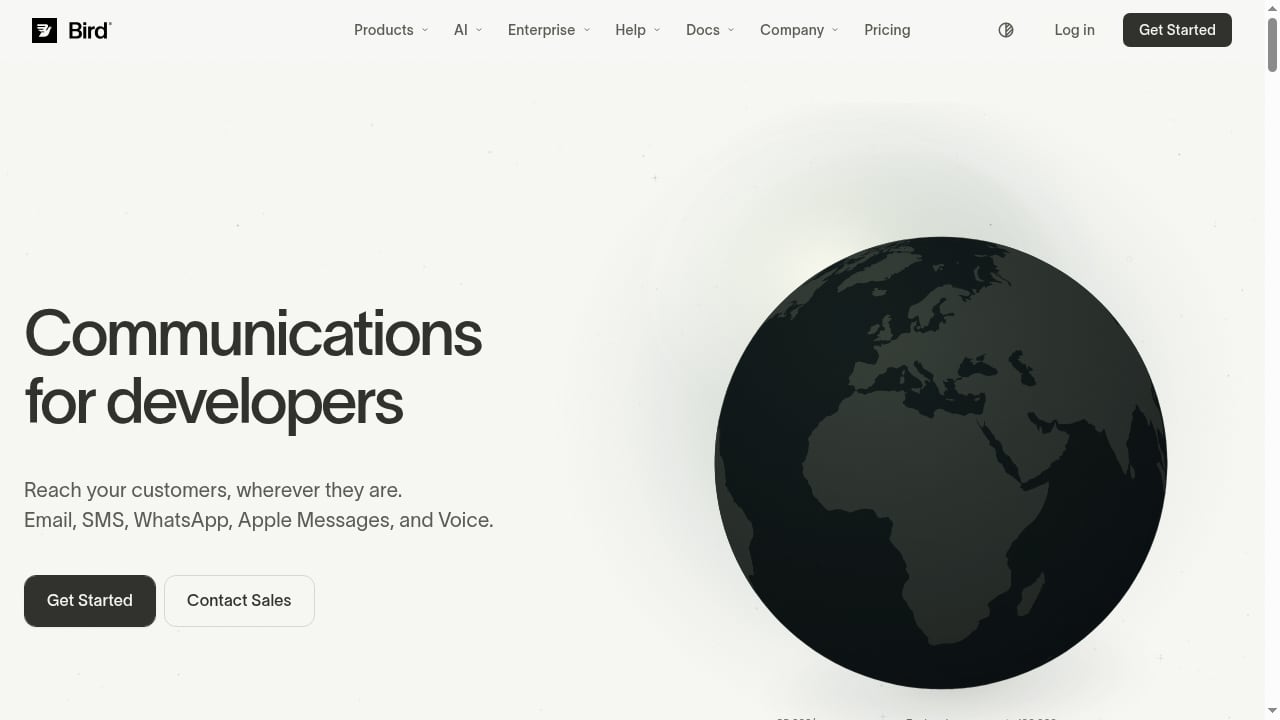
First viewport screenshot of Communications for developers — Bird.
Setup is where Bird differentiates most clearly from marketing-first platforms.
- Pick your integration path. MCP suits AI-assisted and agent-driven workflows; the CLI suits scripting and CI; SDKs suit application code.
- Authenticate and configure channels. You provision sending identities per channel — domains for email, numbers or sender IDs for SMS, business accounts for WhatsApp.
- Wire events. Delivery tracking, inbound messages, and preference changes come through APIs and webhooks, so you can react in your own systems.
- Test in a sandbox. Verify flows and passcodes should be tested before production traffic.
- Automate journeys. Once sending is stable, layer journey automation and send time optimization.
Bird's presence in ChatGPT and Codex plugin directories is a practical signal: the team is investing in AI-assisted development workflows, not just traditional docs.
Strengths
- Genuine multi-channel depth. Email, SMS, WhatsApp, Apple Messages, and Voice in one place reduces vendor sprawl.
- Developer ergonomics. MCP, CLI, and SDKs lower the cost of embedding messaging into products.
- Verification and lookup built in. Verify and Lookup remove the need for a separate OTP vendor in many stacks.
- AI-forward roadmap. Agent Mailboxes and send time optimization show where the platform is heading.
- Unified inbox. Support and marketing conversations can be managed together instead of in silos.
Limitations and Trade-offs
- Engineering dependency. Teams without developers will find the API-first model slower to adopt than a no-code tool.
- Breadth can mean shallowness. Some channels may not match the depth of a single-channel specialist, so evaluate per channel.
- Pricing opacity. Costs typically scale with volume and channel mix, so you must model usage before committing.
- Migration effort. Moving existing SMS or email infrastructure takes planning around sender reputation and templates.
- Learning curve. MCP and CLI are powerful but unfamiliar to teams used to GUI-only platforms.
Pricing Signals
Bird does not publish a simple flat rate. Expect usage-based pricing that varies by channel, destination country, and message type. Verification, lookup, and voice minutes are usually metered separately. The practical approach is to estimate monthly volume per channel, request a quote, and compare against your current vendor's effective cost per message — not list price.
Bird vs Alternatives
If you are comparing platforms, weigh these dimensions:
- Developer tooling: Bird's MCP/CLI/SDK model is stronger than most marketing-first suites.
- Channel breadth: Bird competes with large CPaaS providers on coverage but differentiates with inbox and journey features.
- Support and CRM integration: If you need deep helpdesk or CRM behavior, compare against broader customer service suites in our top 10 AI customer service software products for 2026.
- Omnichannel engagement: For conversational marketing and support across channels, see the top 10 customer communication platforms for 2026.
- Head-to-head comparisons: Teams evaluating bundled engagement tools should also read SaleSmartly vs HubSpot vs Zendesk to understand how support-led platforms differ from developer-led ones.
Decision Criteria: Is Bird Right for You?

Communications for developers.
Choose Bird if:
- You have developers who will own messaging infrastructure.
- You need multiple channels under one API surface.
- Verification, lookup, or voice are part of your product.
- You want AI-assisted workflows via MCP and agent mailboxes.
Look elsewhere if:
- You need a fully no-code setup.
- You only send one channel at low volume.
- You require transparent self-serve pricing before a sales conversation.
Related reading
- Top 10 AI-First Customer Service Platforms 2026 - Ranked top 10 AI-first customer service platforms for 2026, evaluated on resolution depth, agentic actions, channels, pricing, and fit by industry.
- SaleSmartly vs HubSpot vs Tidio: Which Fits in 2026? - Compare SaleSmartly, HubSpot, and Tidio on omnichannel messaging, AI agents, live chat, CRM, translation, and pricing to pick the right platform.
Sources and further reading
- Bird movie review & film summary - It really, really, really could happen.
- Bird review – Andrea Arnold’s untamed Barry Keoghan tale is a curate’s egg - Toads who sweat hallucinogens, lonely pre-teens and a sudden German in a kilt: Arnold’s pick’n’mix latest dives as much as it soars
- Bird (2024) | Rotten Tomatoes - Discover reviews, ratings, and trailers for Bird (2024) on Rotten Tomatoes. Stay updated with critic and audience scores today!
FAQ
Is Bird good for transactional email? Yes. Email is a first-class channel alongside SMS and WhatsApp, and delivery tracking is exposed through APIs.
Does Bird support WhatsApp campaigns? Yes. WhatsApp is supported for both campaigns and conversational messaging, subject to Meta's business policies.
What is Bird Verify used for? Verify handles passcodes and one-time verification codes, typically for login and signup flows.
Can AI agents use Bird? Bird offers Agent Mailboxes and MCP integration, and appears in ChatGPT and Codex plugin directories, which supports agent-driven messaging workflows.
Is Bird hard to set up? It depends on your team. Developers with API experience will move quickly; non-technical teams will need engineering support.
Conclusion
Bird is a credible choice for developer-led teams that want omnichannel messaging — Email, SMS, WhatsApp, Apple Messages, and Voice — with verification, lookup, and AI-ready tooling in one stack. Its MCP, CLI, and SDK approach is a real advantage for product teams, and Agent Mailboxes signal a serious bet on agentic workflows. The trade-offs are engineering dependency, per-channel depth that varies, and pricing that requires a quote. If your team builds in code and needs multi-channel communications, Bird deserves a shortlist spot; if you need no-code simplicity, compare it against support-led platforms first.
For broader context, see Bird's official site and third-party platform comparisons such as Rotten Tomatoes for unrelated media reviews — not applicable here — or industry analysis from The Guardian on technology trends.