
Top 10 AI-First Customer Service Platforms 2026
AI-first customer service platforms are no longer judged by how many questions they deflect. In 2026, the metric that matters is how many tickets they actually resolve end-to-end — issuing refunds, updating accounts, changing bookings, and closing the loop without a human touching it.
That shift separates the top quartile of deployments from the rest. Industry-average AI resolution sits around 44.8%, while the top quartile reaches 58.7%, and the gap comes down to architecture rather than branding. This review ranks ten platforms that genuinely belong to the AI-first customer service category, explains the criteria behind the order, and helps you match a platform to your stack, industry, and volume.
How we evaluated these platforms

Decorative background image.
We scored each platform on six dimensions, weighted toward outcomes rather than feature counts:
- Resolution depth: Can the AI complete multi-step actions in backend systems (refunds, order edits, account changes), or does it stop at answering questions?
- Agentic capability: Autonomy to plan, execute, and verify outcomes, plus the audit trails regulated teams need.
- Channel coverage: Chat, email, voice, SMS, and messaging apps, with consistent context across them.
- Integration and data access: Depth of CRM, helpdesk, commerce, and custom API connections.
- Pricing model: Seat-based versus usage- or resolution-based, and how costs scale with volume.
- Evidence: Published resolution benchmarks, review-platform ratings, and named production deployments.
Where a vendor publishes its own benchmarks, we treat those as vendor claims and weigh them alongside third-party data from Gartner, McKinsey, and Forrester research cited in 2026 industry reporting.
The top 10 AI-first customer service platforms for 2026
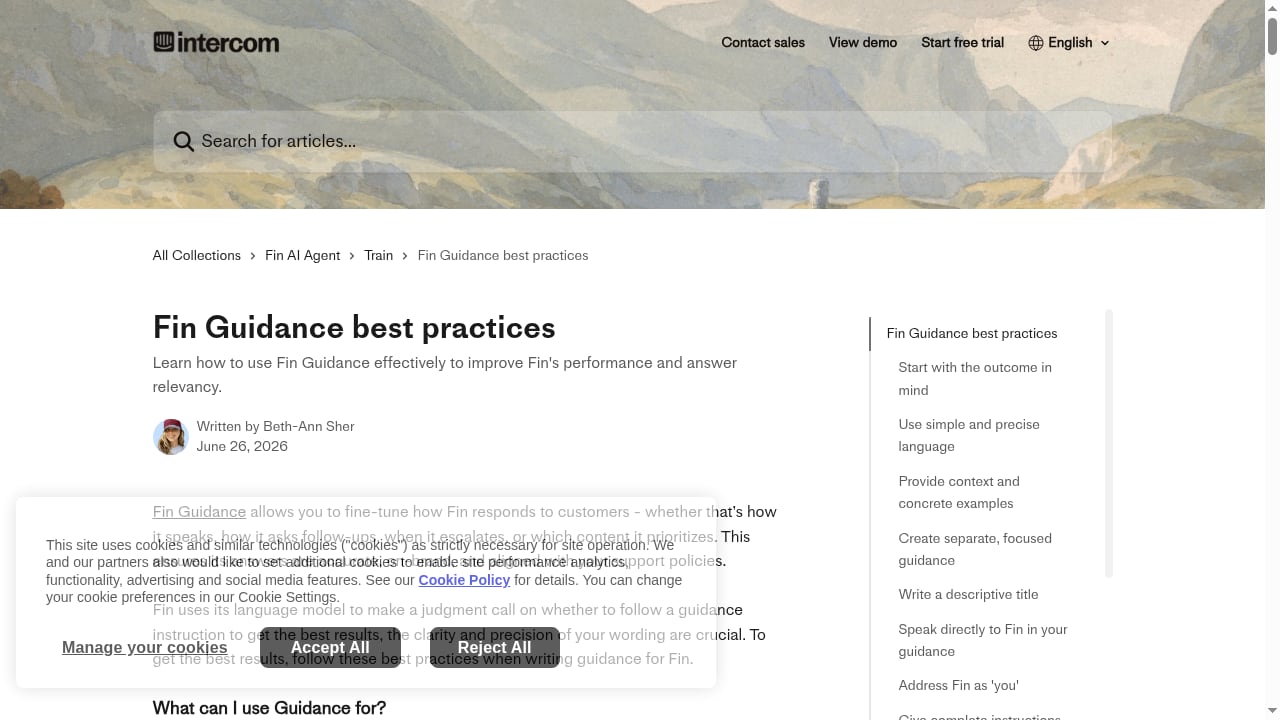
First viewport screenshot of Fin Guidance best practices | Intercom Help.
1. Intercom
Intercom is an AI-first customer service platform built around the AI Agent era, with its Fin AI Agent natively integrated into the helpdesk rather than bolted on. Fin handles instant support resolution across live chat, email, in-app messaging, and phone, while Copilot assists human agents with replies and summaries, and AI Insights turns conversation data into analytics. An integrated Help Center powers self-service.
Why it ranks first: Intercom pairs a mature shared inbox with an AI agent that connects roles, goals, and memory in one architecture, which is why it appears in most 2026 rankings and is trusted by more than 30,000 brands. Outcome-based pricing across Essential, Advanced, and Expert plans aligns cost with work performed, and a free trial lowers evaluation risk.
Watch-outs: Costs can climb quickly as conversation volume scales, and the platform rewards teams willing to commit to the Intercom ecosystem. For a direct head-to-head, see SaleSmartly vs HubSpot vs Intercom.
2. Sierra
Sierra is an enterprise conversational AI platform known for dialogue quality and voice-AI depth. It excels when the customer experience depends on natural, multi-turn conversations rather than scripted flows.
Why it ranks here: Sierra's conversational depth is among the strongest in the category, and voice handling is a differentiator as voice-AI reached roughly 19% of inbound contact-center volume in 2026, up from 6% in 2024 per Forrester data. Watch-outs: Enterprise pricing and a stronger emphasis on dialogue than on action execution outside Sierra-native integrations.
3. Decagon
Decagon is an AI agent platform with strong workflow tooling, aimed at mid-to-large customer-facing teams that maintain a clean knowledge base.
Why it ranks here: Its workflow builder lets teams encode complex, multi-step procedures without heavy engineering, and it scales well when documentation is disciplined. Watch-outs: Enterprise pricing commonly cited in the $95K–$150K+ per year range, and results depend heavily on knowledge-base quality.
4. Salesforce Agentforce
Agentforce is the default choice for organizations already anchored in Salesforce, embedding AI agents directly into CRM data and workflows.
Why it ranks here: Native access to CRM records means the agent can act on the same data your sales and service teams use, and the roadmap is aggressive. Watch-outs: Resolution depth varies with how clean your Salesforce data is, and current execution is uneven across use cases.
5. Zendesk AI
Zendesk AI is deeply embedded in Zendesk's ticketing system, making it a logical upgrade for teams already running the helpdesk.
Why it ranks here: It is strong for ticket triage, routing, and reply suggestions, with the compliance and administrative features large enterprises expect. Watch-outs: Independent 2026 analysis puts true resolution on complex tickets at roughly 10–25% for ticket-management platforms with AI add-ons, well below AI-native alternatives — a structural gap rather than a configuration issue.
6. Ada
Ada focuses on no-code automation building, helping non-technical teams design sophisticated flows and shift from answering tickets to managing automation.
Why it ranks here: An intuitive visual builder and strong multilingual support make it accessible for global brands, with a high emphasis on deflecting repetitive queries. Watch-outs: Customers report long ramp times and heavy reliance on vendor services, so it suits very large teams with internal AI operations capacity.
7. Forethought
Forethought specializes in automation primitives — triage, classification, and summarization — that augment human agents rather than replace them.
Why it ranks here: It is a pragmatic pick for support operations teams that want measurable efficiency gains without a full autonomous-agent rollout. Watch-outs: Less focused on autonomous end-to-end resolution, so it will not close the loop on action-heavy tickets.
8. Gorgias
Gorgias is purpose-built for ecommerce, with deep Shopify, BigCommerce, and Magento integrations that let agents and AI edit orders, issue refunds, and track shipping inside the conversation.
Why it ranks here: Order data in the chat window makes resolution genuinely actionable for online stores, and revenue attribution shows support's commercial impact. Watch-outs: Narrower scope than horizontal platforms, so it is a poor fit outside ecommerce.
9. Kore.ai
Kore.ai is enterprise-grade conversational AI with deep voice and IVR capabilities, suited to contact centers replacing legacy phone trees.
Why it ranks here: Voice and IVR depth is among the strongest available, and it handles large-scale deployments in regulated environments. Watch-outs: Heavier deployment effort and a steeper implementation curve than AI-native SaaS alternatives.
10. Freshdesk
Freshdesk combines AI and human agents on one platform, with Freddy AI handling routine tickets across channels and an AI copilot assisting agents in real time.
Why it ranks here: Broad omnichannel support, advanced ticketing, and transparent per-agent pricing from $18/agent/month make it accessible for growing teams, and it is trusted by a large installed base. Watch-outs: Some complex integrations require extra implementation effort, and true resolution on complex tickets trails AI-native platforms.
Quick comparison: pricing models and best fit

Decorative background image.
| Platform | Pricing model | Best fit |
|---|---|---|
| Intercom | Outcome-based tiers (Essential, Advanced, Expert) | Teams wanting a natively integrated AI agent plus helpdesk |
| Sierra | Enterprise custom | Voice-heavy, conversation-critical enterprises |
| Decagon | Enterprise custom | Mid-to-large teams with clean knowledge bases |
| Salesforce Agentforce | Bundled with Salesforce | Salesforce-anchored organizations |
| Zendesk AI | Per agent | Existing Zendesk helpdesks needing triage AI |
| Ada | Custom | Large teams with internal AI ops capacity |
| Forethought | Custom | Support ops augmenting human agents |
| Gorgias | Per ticket tiers | Ecommerce stores on Shopify and similar |
| Kore.ai | Enterprise custom | Contact centers replacing IVR stacks |
| Freshdesk | Per agent, from $18/agent/month | SMBs wanting broad channels at low entry cost |
How to choose without rebuying in 12 months
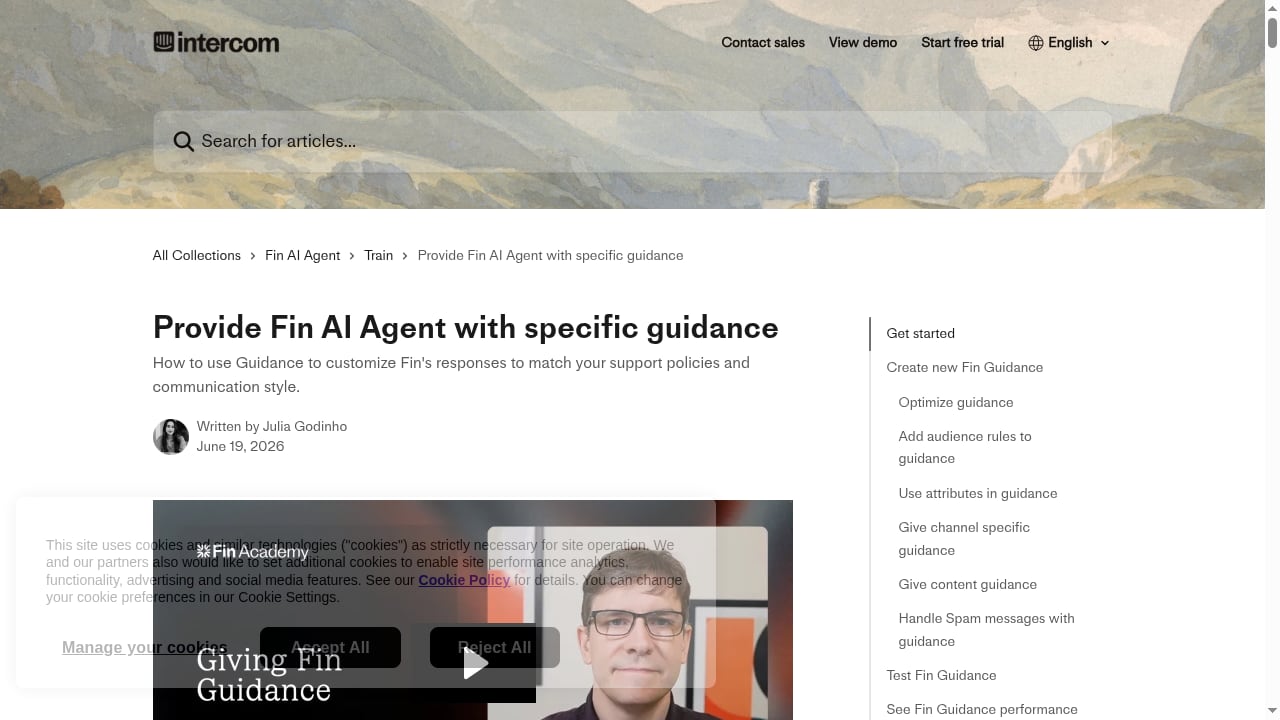
First viewport screenshot of Provide Fin AI Agent with specific guidance | Intercom Help.
Three decision shortcuts cover most situations:
- Regulated or complex industries (fintech, healthtech, insurance, marketplaces): prioritize platforms with audit trails, action execution in your systems, and per-resolution pricing. Resolution without an audit trail is a compliance liability, not a win.
- SaaS deflection-first use cases: Intercom's Fin is the default, especially if you already use the helpdesk.
- Ecosystem-anchored teams: Agentforce if your CRM is Salesforce; Zendesk AI if your helpdesk is Zendesk; Gorgias if you run Shopify.
Any scale-up where ticket volume grows faster than headcount should test AI-native platforms against ticket-management add-ons head-to-head on resolution rate, not feature count. The cost math is stark: McKinsey's 2026 service operations data puts AI resolutions at roughly $0.62 per ticket versus $7.40 for human agents, and hybrid handling — AI plus human escalation — cuts cost per resolution by about 71% at a CSAT cost of just 0.05 points.
If your support operation spans messaging apps like WhatsApp, Messenger, Instagram, and Telegram alongside email and live chat, an omnichannel communication layer may complement your AI helpdesk rather than replace it. Platforms such as SaleSmartly unify those channels with human-led support plus AI agents, real-time translation, and a built-in CRM — useful context when your AI-first helpdesk covers web and email but your customers live in messaging apps. For a broader view of that adjacent category, see Top 10 Customer Communication Platforms 2026 and the comparison SaleSmartly vs HubSpot vs Zendesk.
Related reading
- Top 10 Customer Communication Platforms 2026: Ranked & Tested - Compare the 10 best customer communication platforms for 2026 by channels, AI, pricing, and fit. Includes decision guidance and an FAQ.
- SaleSmartly vs HubSpot vs Tidio: Which Fits in 2026? - Compare SaleSmartly, HubSpot, and Tidio on omnichannel messaging, AI agents, live chat, CRM, translation, and pricing to pick the right platform.
- SaleSmartly vs HubSpot vs LiveChat: Which Fits in 2026? - Compare SaleSmartly, HubSpot, and LiveChat on omnichannel messaging, AI agents, CRM, translation, and pricing to pick the right platform for 2026.
Sources and further reading
- 10 best AI tools for customer support in 2026 - Freshworks - Check out the 10 best AI customer support tools for service teams in 2026. Compare the features, pricing, pros, cons, and strengths to pick the right tool.
- 10 Best AI Customer Service Platforms Ranked 2026 - We ranked the top 10 AI customer service platforms by automation depth, integrations, and real support volume handled. See which ones actually deliver.
- Best AI Customer Support Platforms 2026: Ranked by Resolution Rate - The 10 best AI customer support platforms in 2026 - ranked by resolution rate, not feature count. Compare Lorikeet, Fin, Sierra, Decagon, Ada, and more.
FAQ
What makes a platform "AI-first" rather than AI-enabled?
AI-first platforms were architected around an AI agent that owns the conversation and can take action in backend systems. AI-enabled platforms are traditional ticketing systems with AI features layered on top, which typically caps true resolution at 10–25% on complex tickets.
Is resolution rate more important than deflection rate?
Yes, for most teams. Deflection measures how many customers were steered away from a human; resolution measures how many problems were actually solved. In regulated industries, deflection without resolution creates compliance exposure.
How much does AI customer service cost in 2026?
Costs vary by model. Per-agent pricing starts around $18–$39 per agent per month for SMB-friendly tools, while enterprise AI-native platforms often price per resolution — commonly cited around $0.90–$1.50 depending on channel — or via annual contracts in the $95K+ range.
Which platform is best for ecommerce?
Gorgias is the strongest ecommerce-specific option because order data is available inside the conversation. Intercom and Zendesk AI are viable for larger retailers that need broader enterprise features.
Can I run an AI-first helpdesk and a messaging platform together?
Yes. Many cross-border and social-commerce teams run an AI-first helpdesk for web, email, and in-app support while using an omnichannel messaging platform for WhatsApp, Messenger, and Instagram conversations.
Conclusion
The 2026 market rewards platforms that resolve rather than route. Intercom leads this list because its AI agent is native to the helpdesk and its outcome-based pricing ties cost to work done. Sierra, Decagon, and Agentforce follow for conversational depth, workflow tooling, and CRM-native execution respectively, while Gorgias and Kore.ai win in ecommerce and voice-heavy contact centers.
Pick on resolution rate, cost per resolution, and auditability — then confirm the platform can act in your systems, not just talk about them. Teams that choose on those three metrics consistently avoid the most expensive mistake in this category: rebuying twelve months later.