
CoSupport AI Review 2026: Pricing, Accuracy, and Who It Fits
CoSupport AI is an AI customer support automation platform that resolves repetitive tickets on its own and drafts replies for human agents, trained only on your own knowledge base and past tickets. This review separates what the vendor claims from what buyers can actually verify, then maps the platform to real support teams, budgets, and workflows.
If you are comparing AI support tools, the honest question is not "does it use AI?" but "will it resolve enough tickets to justify the cost and risk?" CoSupport AI's answer is a patented multi-step reasoning architecture, decision logs, and three pricing models. Here is how that holds up.
What CoSupport AI actually does
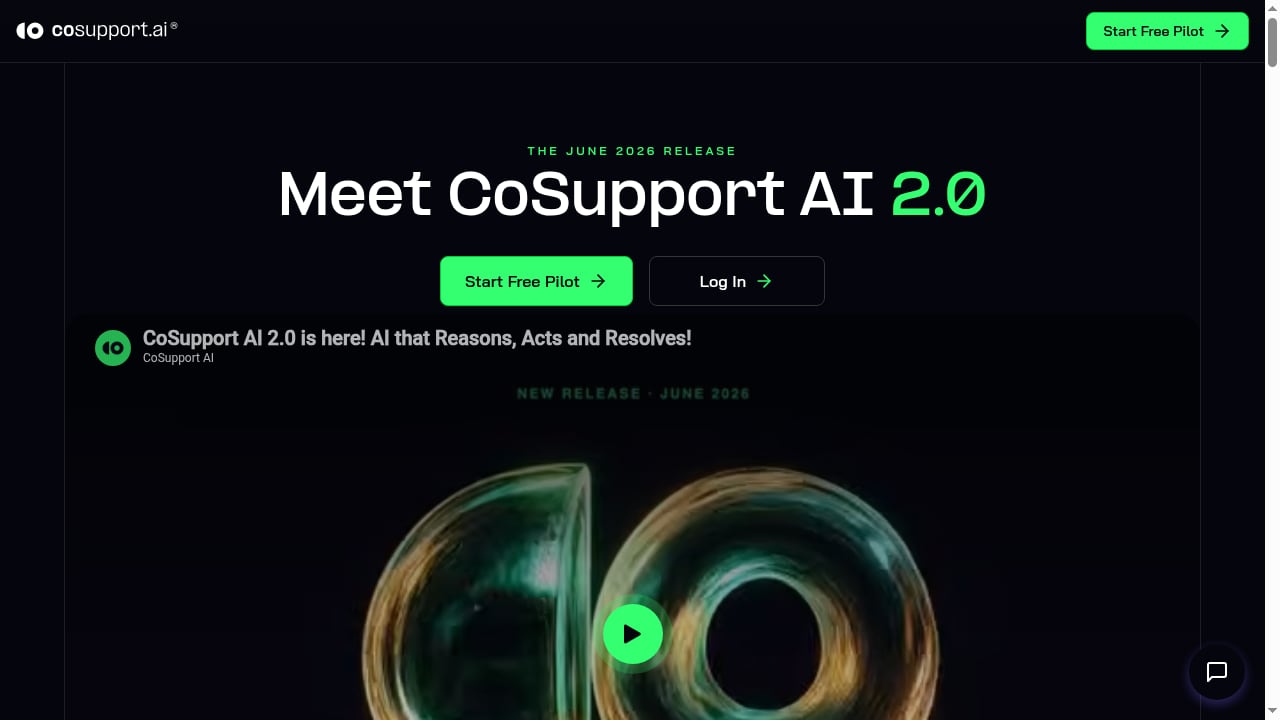
First viewport screenshot of What's new in CoSupport AI 2.0.
CoSupport AI sits between your helpdesk and your customers. It ingests your documentation, macros, and historical tickets, then either answers a customer directly or prepares a draft for an agent to approve.
The core loop is multi-step reasoning: the AI searches your knowledge sources, analyzes what it found, searches again if the answer is incomplete, and validates the result before responding. That re-search-and-validate pattern is the main defense against the failure mode most support leaders fear — a confident but wrong answer.
Two features matter most for evaluation:
- Decision logs. Every AI decision is recorded with the data behind it. This is the difference between "the bot said something weird" and "the bot cited an outdated policy article, here is the fix."
- Agentic API. Autonomous workflows can reach across connected tools and systems, not just answer from a static article. That expands use cases from FAQ deflection to actions like order lookups or account checks, depending on what you connect.
Integrations and deployment
CoSupport AI connects to helpdesks including Zendesk, Freshdesk, and Zoho Desk, plus business tools such as Shopify, Stripe, Notion, and Confluence. A public Product Hunt launch post also lists Intercom, Salesforce, Slack, and Teams, along with ISO 27001 and GDPR/CCPA compliance, a self-hosted LLM option, prompt injection protection, and a 99.9% uptime guarantee.
Setup is described as no-code and fast — the vendor's launch material claims live deployment in about 10 minutes. Treat that as a floor, not a promise: the real timeline depends on how clean your knowledge base is and how many systems the agent must reach.
The numbers: what the vendor claims vs. what to verify
CoSupport AI publishes several outcome figures. They are worth reading carefully because they come from different versions and different customers.
| Claim | What it means for a buyer |
|---|---|
| Average 74% AI resolution rate | A blended figure across clients; your rate will depend on ticket mix and content quality |
| Up to 85% on version 2.0 | A ceiling, not an average — ask for a cohort matching your industry |
| Resolution times as low as 6 minutes | Best-case latency; measure median, not minimum |
| $9,300/month saved by Remedico | A single customer case; request the assumptions behind it |
| $7,000/month saved by an e-commerce marketplace | Same caveat — savings depend on agent cost and volume |
| 300+ brands, patented architecture | Useful credibility signals, but not proof of fit for your stack |
A separate third-party review summary circulating on social media cites a 60% AI resolution rate guarantee with a "you do not pay" framing. That conflicts with the vendor's own 74% average and 85% ceiling claims, which is exactly why you should confirm guarantee terms in writing during a pilot rather than relying on either number.
The practical takeaway: resolution rate is the metric that drives ROI, and it is highly sensitive to your content. A team with messy, duplicated help-center articles will land far below 74%. A team with tight, versioned documentation and a narrow ticket mix can approach the ceiling.
Pricing signals: three models, three risk profiles
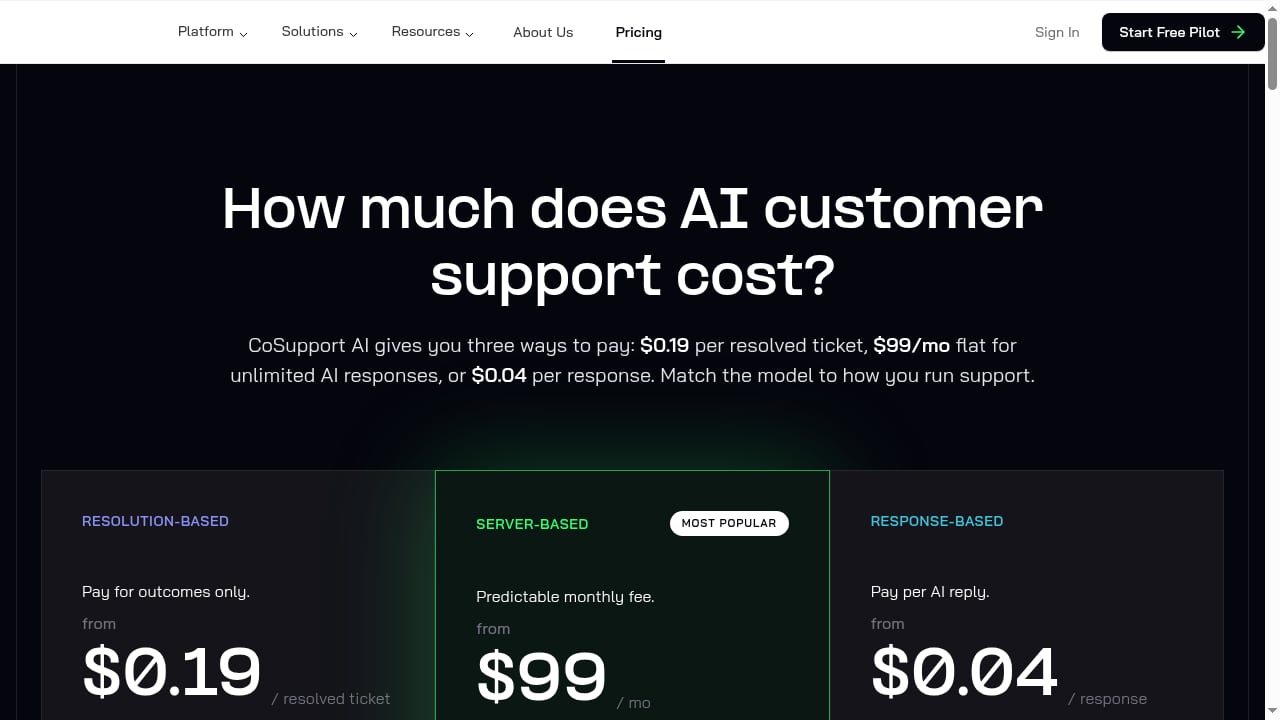
First viewport screenshot of Pricing for AI Customer Support - From $99/mo | CoSupport.
CoSupport AI prices in three ways, and the choice matters more than the sticker price.
- Resolution-based — $0.19 per resolved ticket. You pay only when the AI closes the loop. This aligns cost with value and is the easiest model to defend to finance. The risk is definition: confirm what counts as "resolved" versus "drafted" versus "deflected."
- Server-based — $99/month flat for unlimited AI responses. Predictable and cheap at high volume, but you carry the risk if resolution quality is low. Best for teams that already trust their content and want budget certainty.
- Response-based — $0.04 per AI-generated reply. The lowest unit price, but a "reply" is not a "resolution." If the AI drafts a lot and resolves little, this model gets expensive quietly.
There are no setup fees, a free pilot on real tickets, and a 60-day refund guarantee. Those terms lower the cost of trying the platform, but they do not replace a pilot with agreed success criteria.
A quick cost example
Suppose your team handles 10,000 tickets a month and the AI resolves 60% of them.
- Resolution-based: 6,000 × $0.19 = $1,140/month
- Server-based: $99/month, unlimited responses
- Response-based: if the AI generates 8,000 replies, 8,000 × $0.04 = $320/month
At that volume, server-based is dramatically cheaper — but only if resolution quality holds. At 2,000 tickets a month with 50% resolution, resolution-based costs about $190 while server-based still costs $99, so the math flips depending on scale and confidence. Run your own volume before choosing.
Who CoSupport AI is built for
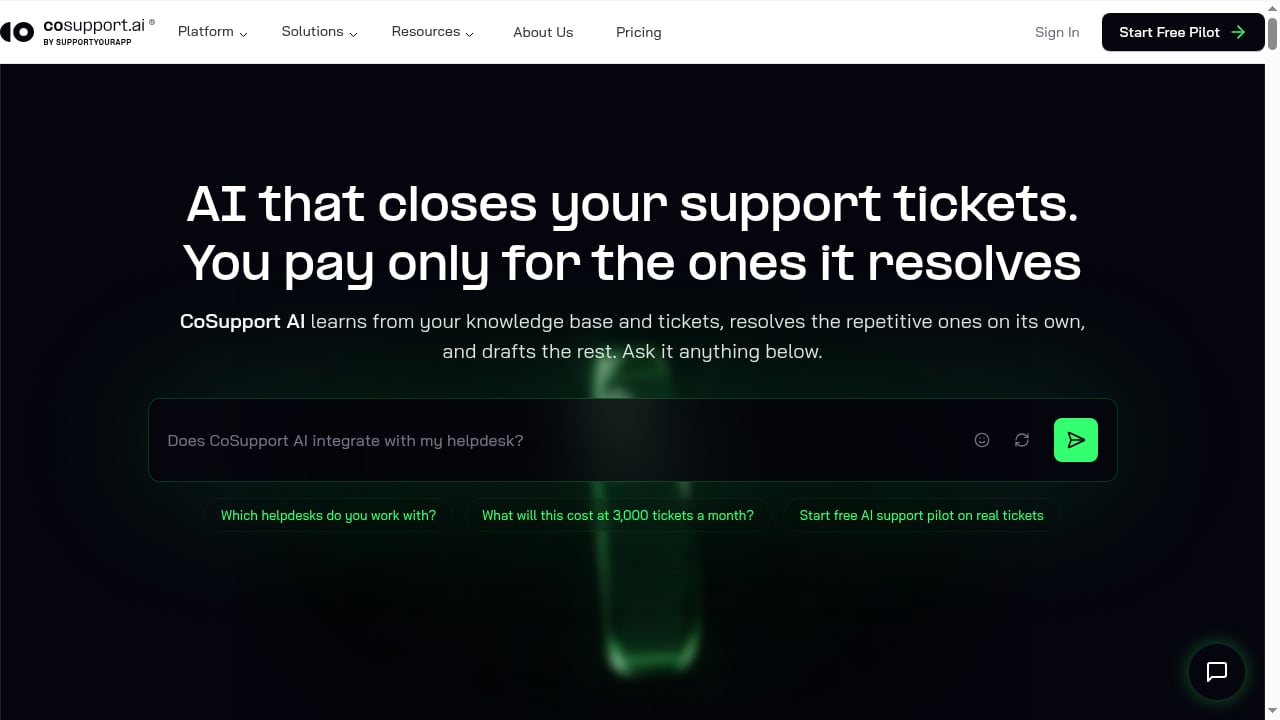
First viewport screenshot of AI Customer Service Platform | Automate Support with CoSupport.
The platform targets support teams at SaaS, e-commerce, finance, education, and BPO companies, plus any organization with high repetitive ticket volume.
Strong fits:
- SaaS support teams with a mature help center and a long tail of how-to and billing questions. Zendesk or Freshdesk plus Notion or Confluence is a natural stack.
- E-commerce and marketplaces where order status, returns, and payment questions dominate. Shopify and Stripe integrations plus the agentic API make order lookups feasible.
- BPO and outsourced support operations that need decision logs to prove quality to clients and audit AI behavior.
- Regulated teams in finance or education that need self-hosted LLM options and documented reasoning before approving automation.
Weaker fits:
- Teams with almost no documentation or historical tickets. The AI trains on your data, so thin data means thin answers.
- Businesses whose tickets are mostly unique, high-stakes, or emotionally complex cases where a draft-only workflow adds little.
- Very small teams with low volume, where a flat $99/month server plan may cost more than the labor it saves.
Setup: what to expect in the first two weeks
A realistic rollout looks like this:
- Connect the helpdesk. Zendesk, Freshdesk, or Zoho Desk first, so the AI can read historical tickets.
- Clean the knowledge base. Remove duplicate and outdated articles. This single step has more impact on resolution rate than any model setting.
- Run the free pilot on real tickets. Start in draft-only mode so agents can review suggestions without customer risk.
- Review decision logs weekly. Look for patterns: which topics fail, which sources are stale, where the AI re-searches and still misses.
- Expand to autonomous resolution only for ticket categories that consistently pass review.
Expect the first week to be calibration, not automation. The teams that succeed treat the pilot as a content-audit project with an AI attached, not a plug-in install.
Limitations and trade-offs to weigh
No review is useful without the downsides.
- Data dependency is the biggest one. Resolution rates are a function of your content quality. The vendor's headline numbers will not transfer automatically.
- Pricing model complexity. Three models with different definitions of "resolved" and "reply" create room for billing surprises. Get definitions in writing.
- Claim inconsistency. The 74% average, 85% ceiling, and third-party 60% guarantee figure do not line up. Ask which applies to your contract.
- Draft mode still costs agent time. If most tickets end up as drafts, you have added a review step, not removed work.
- Integration depth varies. Helpdesk connections are well documented; deeper agentic workflows across tools depend on what you connect and how you govern them.
- Limited independent review volume. Public review coverage is thin compared with established helpdesk brands, so pilot evidence matters more than star ratings.
How CoSupport AI compares to the wider market
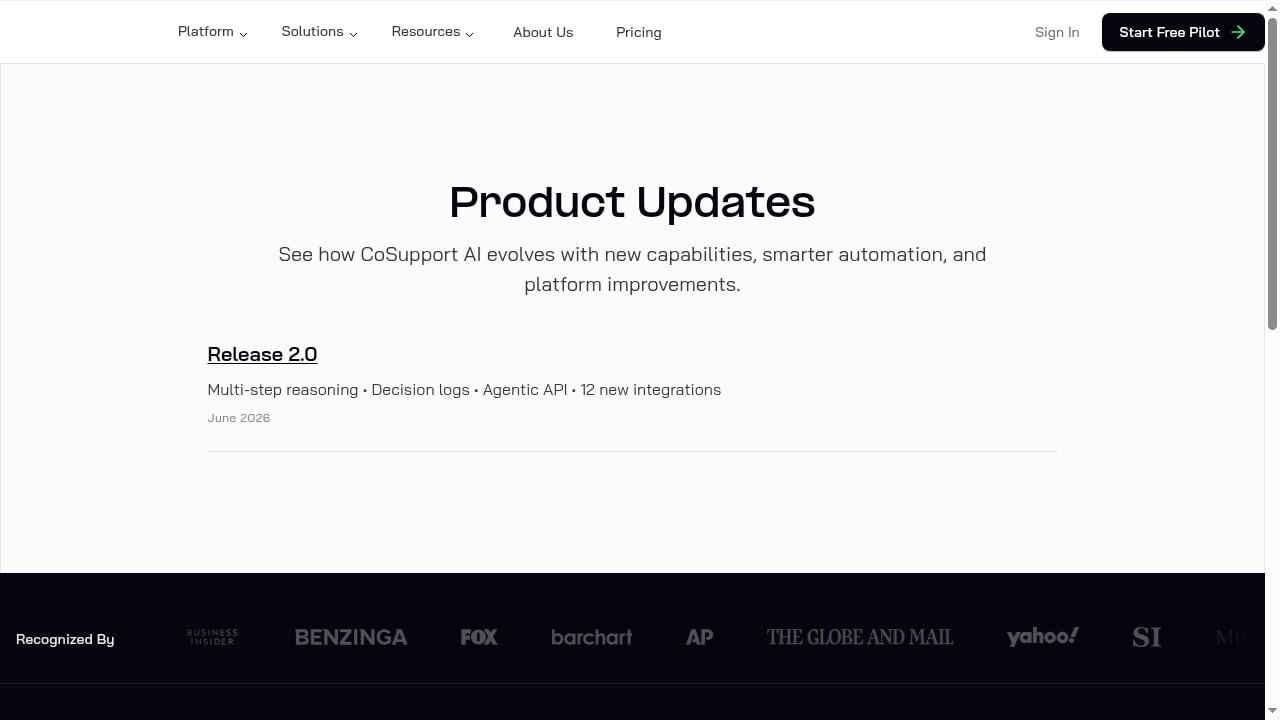
First viewport screenshot of CoSupport AI Product Updates.
CoSupport AI is a specialist: it focuses on resolution and drafting rather than being a full omnichannel inbox. If you need chat, social, and messaging channels in one place alongside AI, a broader platform may fit better — see our comparison of SaleSmartly vs Gorgias for an e-commerce-focused view, or the top 10 AI customer support automation platforms for 2026 for a wider shortlist.
If your priority is a shared inbox with AI assistance for human teams rather than autonomous resolution, our Front review covers that model. And if you are still mapping the category, the live chat and AI chatbot software roundup is a useful starting point.
Decision criteria: a buyer's checklist
Before signing, get clear answers to these:
- What counts as a resolved ticket under the resolution-based plan, and how is it audited?
- What resolution rate is guaranteed, and what happens if you miss it?
- Which data sources does the AI train on, and how often does it refresh?
- Where does data live, and do you need the self-hosted LLM option for compliance?
- How do decision logs export, and can they feed your QA process?
- What is the exit path if resolution quality drops after the pilot?
Score each vendor on these, not on demo polish.
Related reading
- SaleSmartly and PayPal Open Integration: A Guide to Cross-Border Customer Service and Payment Collaboration - Learn how SaleSmartly's omnichannel customer service system and PayPal Open payment platform work together, covering setup steps, real-world scenarios, and FAQs to help cross-border businesses improve conversion and operational efficiency.
- SaleSmartly vs Tidio vs Sprinklr: AI Customer Experience Platform - Compare SaleSmartly, Tidio, and Sprinklr for AI-native customer experience. See channel coverage, AI capabilities, pricing, and which platform fits your business.
Sources and further reading
- Read Customer Service Reviews of cosupport.ai - Trustpilot - Apr 26, 2025 ... CoSupport AI Reviews · We use technology to protect platform integrity, but we don't fact-check reviews · Company details · Contact info.
- CoSupport AI: AI support agents that don’t hallucinate, live in 10 mins | Product Hunt - Tired of bots giving wrong answers? CoSupport AI handles up to 90% of repeat tickets with 99% accuracy. Train it on your content, connect to Zendesk, Intercom, Freshdesk, Salesforce, and more — unlimited replies, no babysitting.
- [Alston Antony on Instagram: "Worth a read 💡
CoSupport AI has a catch. It is in the review, near the top.
CoSupport AI Review 2026: The AI Customer Support Platform That Actually Delivers
CoSupport AI guarantees a 60% AI resolution rate or you do not pay.
Full post is in our bio link. Save this for later.
#CosupportAi #AI #AIReview #ToolReview #AITools #HonestReview #SaaS #ArtificialIntelligence #TechReview #TechTools #AIForBusiness #SaaSTools"](https://www.instagram.com/p/DeWhTNLjVwL/) - 0 likes, 0 comments - zplatform.ai on October 11, 2026: "Worth a read 💡
CoSupport AI has a catch. It is in the review, near the top.
CoSupport AI Review 2026: The AI Customer Support Platform That Actually Delivers
CoSupport AI guarantees a 60% AI resolution rate or you do not pay.
Full post is in our bio link. Save this for later.
#CosupportAi #AI #AIReview #ToolReview #AITools #HonestReview #SaaS #ArtificialIntelligence #TechReview #TechTools #AIForBusiness #SaaSTools".
FAQ
Is CoSupport AI accurate enough to replace human agents? It is designed to resolve repetitive tickets and draft the rest, not replace agents entirely. The vendor reports a 74% average resolution rate and up to 85% on version 2.0, but your result depends on your content and ticket mix. Start with draft mode and expand autonomy gradually.
How much does CoSupport AI cost? There are three models: $0.19 per resolved ticket, $99/month flat for unlimited AI responses on a server-based plan, and $0.04 per AI-generated reply. There are no setup fees, and a free pilot plus a 60-day refund guarantee lower the trial risk.
Which helpdesks does CoSupport AI integrate with? Zendesk, Freshdesk, and Zoho Desk are the core helpdesk integrations, with Shopify, Stripe, Notion, and Confluence for business data. The Product Hunt launch also lists Intercom, Salesforce, Slack, and Teams.
Does CoSupport AI hallucinate? The platform is built to reduce hallucination through multi-step reasoning that searches, analyzes, re-searches, and validates before responding, plus decision logs that show the data behind each answer. No system eliminates the risk entirely, which is why draft mode and log review matter during rollout.
Who should not buy CoSupport AI? Teams with little documentation, very low ticket volume, or mostly unique high-stakes cases will see less value. Those teams may be better served by a shared-inbox tool with lighter AI assistance.
Conclusion
CoSupport AI is a credible specialist in AI ticket resolution, with a defensible architecture, transparent decision logs, and pricing that lets you align cost with outcomes. Its strengths are real: multi-step reasoning, helpdesk integrations, and a pilot-first commercial model. Its weaknesses are equally real: results depend heavily on your content, the three pricing models need careful definition, and public claims do not fully reconcile.
The right move is not to buy on the headline 74% or 85% figures. Run the free pilot on your own tickets, agree on what "resolved" means, and review decision logs weekly. If the numbers hold on your data, CoSupport AI can meaningfully cut repetitive workload. If they do not, the 60-day guarantee gives you a clean exit — provided you documented the success criteria up front.