
eesel AI Review 2026: Autonomous Support Agent Tested
AI customer service tools often promise autonomy but deliver little more than canned replies. eesel AI takes a different angle: it deploys fully autonomous agents inside the helpdesks and chat tools your team already uses, then charges a fixed monthly fee based on ticket volume. This review examines what that actually means in practice, drawing on user feedback, product documentation, and reported customer outcomes to help you decide whether eesel AI fits your support operation.
What eesel AI actually does
eesel AI product interface.
eesel AI is an AI customer service agent platform. Rather than replacing your helpdesk, it connects to tools such as Zendesk, Gorgias, Freshdesk, Slack, email, and website chat. Once connected, its agents can categorize tickets, draft replies from approved macros, answer product and order questions, process returns, and assist internal teams with knowledge lookup.
The positioning is deliberate: eesel AI frames itself as hiring an AI teammate, not buying a chatbot. That distinction matters because the agents are designed to take actions inside existing workflows—reading ticket context, applying rules, and escalating when confidence drops—rather than operating as a separate chat widget.
Core capabilities at a glance
- Autonomous ticket handling: Agents classify, tag, and respond to routine requests without human intervention.
- Macro-based drafting: Replies are generated from approved macros, which keeps tone and policy consistent.
- Order and product answers: Agents can pull order status and product details to resolve common e-commerce questions.
- Returns processing: Return requests can be triaged and actioned according to configured rules.
- Internal knowledge assistance: The same agent logic can answer employee questions in Slack or similar tools.
- Scheduled agents and reports: Recurring tasks and performance reporting are built in.
- Unlimited agents and seats: Pricing is tied to ticket volume (credits), not headcount.
- EU or US data residency: A meaningful option for teams with regional compliance requirements.
- Integrations with ChatGPT, Claude, and Cursor: Useful for teams already building AI workflows around those tools.
Who eesel AI is built for
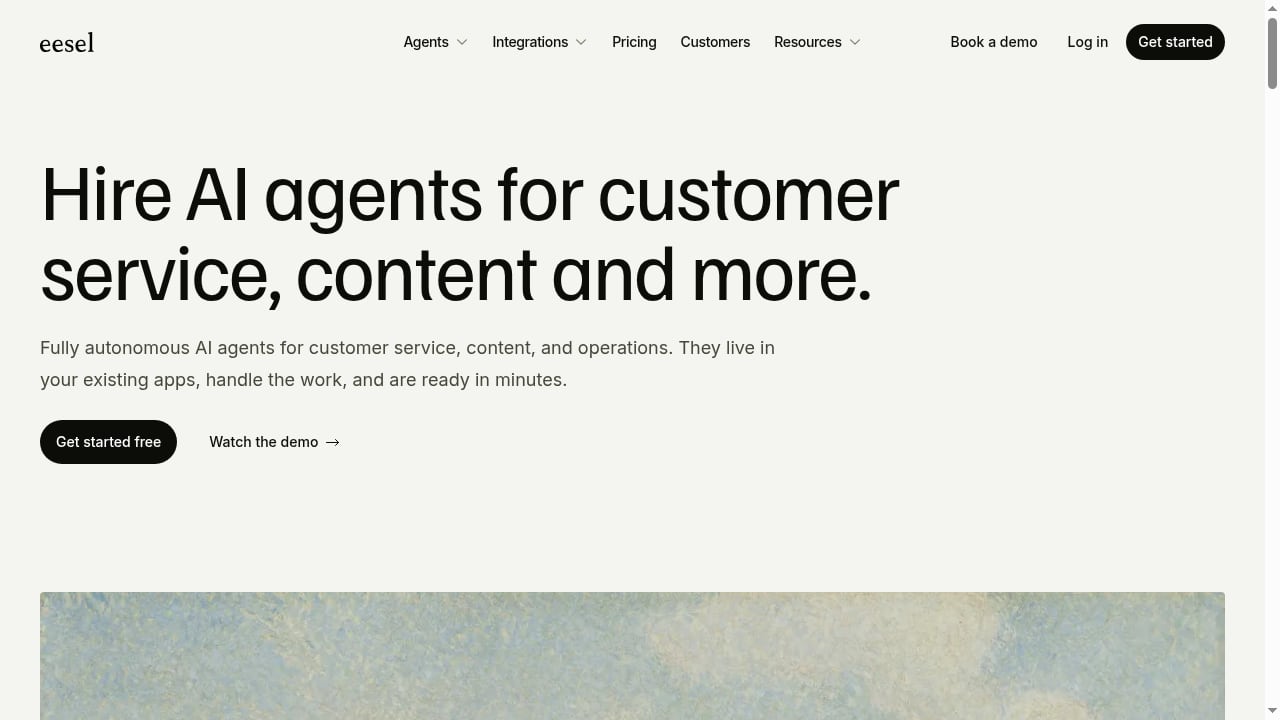
First viewport screenshot of Hire AI agents for customer service, content and more | eesel AI.
eesel AI is not a universal fit. The product context and customer evidence point to three primary audiences.
1. Support teams drowning in repetitive tickets
If a large share of your queue is order status, return requests, password resets, or FAQ-style questions, an autonomous agent can absorb that volume. The reported proof points are instructive: smava and Finanzcheck handle 27,000 tickets per month, a premium audio brand handles more than 10,000 per month, and Adverscale handles 2,400 per month. These are not small operations, which suggests the platform scales beyond pilot projects.
2. E-commerce and SaaS businesses with existing helpdesks
Because eesel AI lives inside Zendesk, Gorgias, and Freshdesk, it suits teams that have already invested in a helpdesk and do not want to migrate. E-commerce teams benefit most from order and return automation; SaaS teams benefit from product question handling and internal knowledge assistance.
3. Internal IT and operations teams
The same agent framework can answer employee questions and route internal requests. Organizations already using Slack as a service desk may find this a lower-friction entry point than deploying a separate ITSM tool.
Strengths: what the evidence supports

eesel AI product interface.
Fast setup is the most consistent theme
User reviews on G2 consistently praise ease of use and quick setup, with reviewers highlighting seamless integration into existing workflows. A Trustpilot page exists but carries very limited review volume, so it should not be treated as strong evidence either way. The practical takeaway: eesel AI appears to deliver on its "ready in minutes" claim for teams with clean helpdesk configurations.
Fixed pricing tied to volume, not seats
The credit-based model—paid plans starting at $299 per month for 500 credits, with a free trial offering 100 credits—is predictable for finance teams. Unlimited agents and seats mean you can expand coverage without renegotiating contracts. For teams comparing per-seat AI pricing, this is a genuine differentiator.
Autonomy that respects existing guardrails
Drafting from approved macros is a smart constraint. It reduces hallucination risk and keeps responses aligned with brand policy. Agents that can process returns and answer order questions go beyond drafting into actual resolution, which is where ROI usually appears.
Data residency flexibility
EU or US data residency options matter for regulated industries and European businesses. Not every AI agent vendor offers this choice at the entry level.
Limitations and open questions
Review volume is thin
The public review footprint is small. G2 has user feedback, but Trustpilot shows only a single review at the time of writing. That does not mean the product is weak—it means independent social proof is limited, and buyers should request references and run a trial rather than rely on aggregate scores.
Credit-based pricing requires forecasting discipline
A fixed monthly fee sounds simple, but credits are consumed by ticket volume. Teams with seasonal spikes—holiday sales, product launches—need to model overage costs carefully. The $299 entry point for 500 credits sets a useful baseline, but the effective cost per ticket depends on how many credits each interaction consumes.
Autonomy still needs supervision
Fully autonomous agents work best when macros, policies, and escalation rules are well defined. Teams with messy helpdesk taxonomies or inconsistent macros will need cleanup work before automation pays off. This is a setup cost, not a product flaw, but it is easy to underestimate.
Integration depth varies by helpdesk
Support for Zendesk, Gorgias, Freshdesk, Slack, email, and website chat is broad, but the depth of action-taking (especially returns processing) may differ by platform. Verify the specific workflows you need during the trial.
Pricing signals and what to watch
| Signal | Detail |
|---|---|
| Free trial | 100 credits |
| Entry paid plan | $299/month for 500 credits |
| Pricing model | Fixed monthly fee based on ticket volume |
| Seats and agents | Unlimited |
| Data residency | EU or US |
The headline number is straightforward, but the real cost question is credits per ticket. Ask during evaluation: how many credits does a typical order-status query consume versus a multi-step return? That ratio determines whether 500 credits is a starter tier or a meaningful monthly allowance.
Setup: what to expect
Setup follows a predictable path:
- Connect your helpdesk. Authorize eesel AI against Zendesk, Gorgias, Freshdesk, or your chosen channel.
- Import or define macros. The agent drafts from approved macros, so existing macro libraries are an advantage.
- Configure skills and escalation rules. Decide which ticket types the agent can resolve autonomously and when it must hand off.
- Set data residency and access controls. Choose EU or US residency and define what the agent can read.
- Run the trial. Use the 100 free credits to test high-volume scenarios, not edge cases.
- Review reports and expand. Scheduled agents and reporting help you scale coverage once resolution quality is proven.
Teams with clean helpdesk hygiene can move quickly. Teams with inconsistent tagging should budget time for cleanup.
How eesel AI compares to alternatives
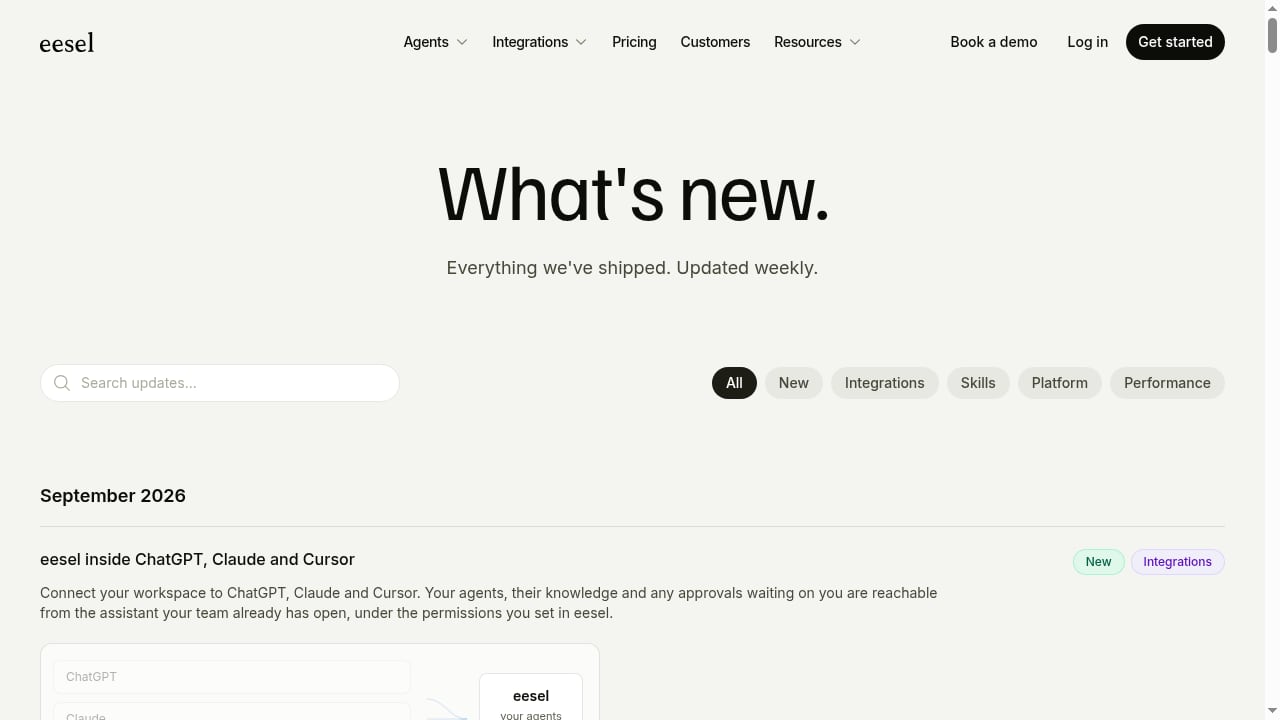
First viewport screenshot of Changelog | eesel AI.
The AI customer service market is crowded. eesel AI's distinguishing traits are helpdesk-native deployment, macro-grounded replies, and volume-based pricing with unlimited seats. If you are evaluating broader options, our roundup of the top AI customer experience and support platforms compares resolution quality, channels, and integrations. For a direct look at human-led versus AI-automated models, see our SaleSmartly vs Ada comparison. And if your priority is e-commerce helpdesk automation specifically, the eDesk review covers a comparable use case.
Decision criteria checklist
- Ticket volume: Do you have enough repetitive volume to justify $299/month? Roughly 500 credits is the entry threshold.
- Helpdesk stack: Are you on Zendesk, Gorgias, Freshdesk, Slack, or a supported channel?
- Macro maturity: Do you have approved macros the agent can draft from?
- Autonomy appetite: Are you comfortable letting an agent process returns, or do you want drafting only?
- Compliance: Do you need EU or US data residency?
- Review risk tolerance: Are you willing to trial with limited public reviews and validate with references?
Related reading
- Top 10 Omnichannel Customer Support & Live Chat Software 2026 - Discover the top 10 omnichannel customer support and live chat software for 2026, evaluated on channel coverage, unified context, AI, pricing, and more.
- SaleSmartly and Mailchimp Synergy: A Guide to Integrating Cross-Border Customer Service and Email Marketing - Learn how SaleSmartly's omnichannel customer service system and Mailchimp's email marketing platform work together, covering integration steps, practical scenarios, and FAQs to help cross-border businesses improve customer communication and conversion efficiency.
- SaleSmartly vs Mixdesk vs ChatBot: A Cross-Border Customer Service Selection Guide - Compare SaleSmartly, Mixdesk, and ChatBot on channel coverage, human-AI collaboration, customer operations, pricing, and use cases to help cross-border teams choose the right live chat system.
Sources and further reading
- Eesel AI Review - Make AI Bot Talk About Your Company ... - YouTube - Welcome to eesel AI review!🚀 Get here eesel AI 👉 https://go.crowdedlab.com/eesel-ai👾👾👾 Subscribe for more videos 👉 https://go.crowdedlab.com/subscrib...
FAQ
Is eesel AI a chatbot?
No. It is an autonomous agent platform that operates inside existing helpdesks and communication tools. It can take actions like categorizing tickets and processing returns, not just answer chat messages.
How much does eesel AI cost?
Paid plans start at $299 per month for 500 credits. There is a free trial with 100 credits. Pricing is based on ticket volume, with unlimited agents and seats.
Which helpdesks does eesel AI integrate with?
Zendesk, Gorgias, Freshdesk, Slack, email, and website chat are supported, along with integrations for ChatGPT, Claude, and Cursor.
Is eesel AI suitable for small teams?
The entry price point may be high for very small teams, but unlimited seats mean the cost does not rise with headcount. Teams with steady repetitive volume are the best fit.
What do users say about eesel AI?
G2 reviewers consistently praise ease of use and quick setup. Public review volume is still limited, so a trial and reference checks are recommended.
Conclusion
eesel AI is a credible option for support, operations, and IT teams that want autonomous agents inside their existing helpdesk rather than another standalone tool. Its strengths—fast setup, macro-grounded replies, unlimited seats, and data residency choice—are well matched to high-volume repetitive support. Its limitations—thin public reviews and credit-based forecasting—are manageable with a disciplined trial. If your queue is full of order questions and routine requests, eesel AI deserves a place on your shortlist. If you need deep customization or extensive independent reviews before committing, test carefully and compare against the broader platform options linked above.