
SaleSmartly vs Mixdesk vs ChatBot: A Cross-Border Customer Service Selection Guide
When cross-border teams choose a live chat system, they often hesitate among three types of products: communication platforms built on omnichannel human customer service with AI as a supplement (such as SaleSmartly), Mixdesk, which focuses on AI customer engagement and lead conversion, and ChatBot, which specializes in website chatbots. All three can "catch" customer messages, but their design priorities differ. This article makes an objective comparison across five dimensions—channel coverage, human-AI collaboration, customer operations, pricing, and use cases—to help you judge which one better fits your business rhythm.
Positioning Differences of the Three Products
First viewport screenshot of mixdesk.com.
First, clarify each product's starting point; only then does the later comparison make sense.
- SaleSmartly: An omnichannel customer communication system centered on human customer service with AI-powered customer service as a supplement. It can connect to channels such as WhatsApp, Facebook Messenger, Instagram, Telegram, LINE, Email, VKontakte, WeChat, Zalo, and YouTube, covering pre-sales, in-sales, and after-sales stages, with built-in SCRM and remarketing capabilities.
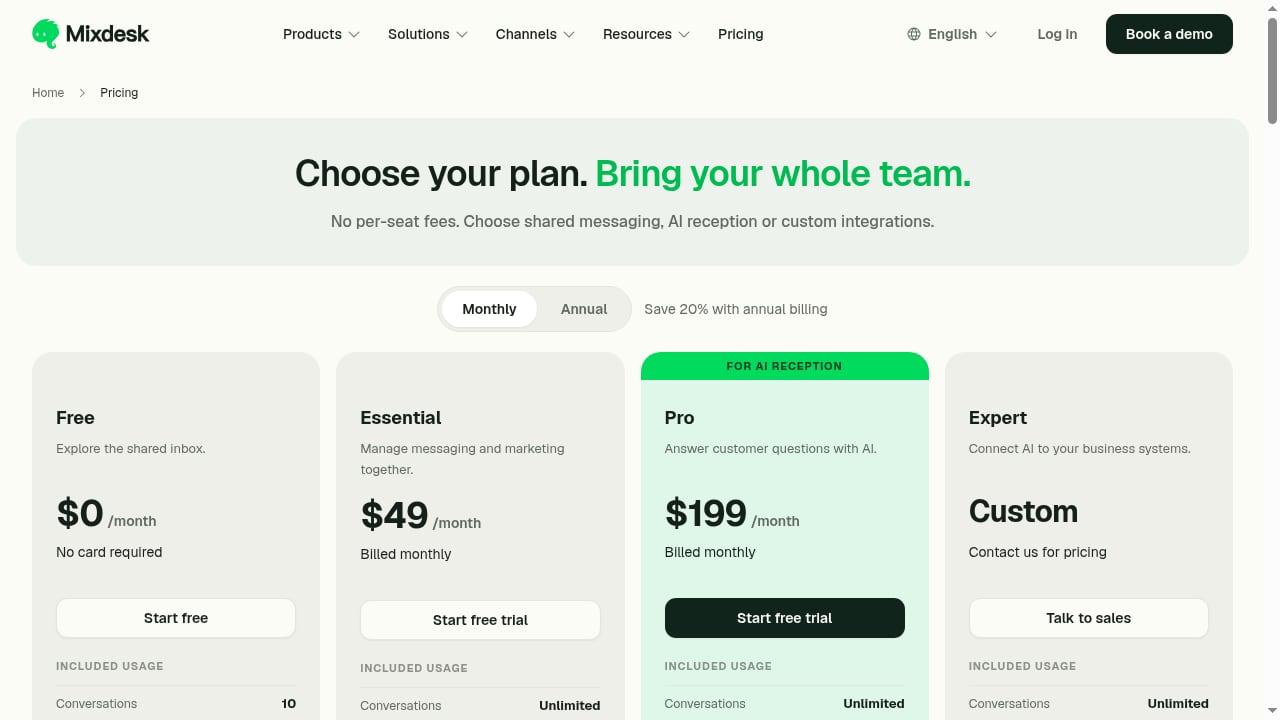
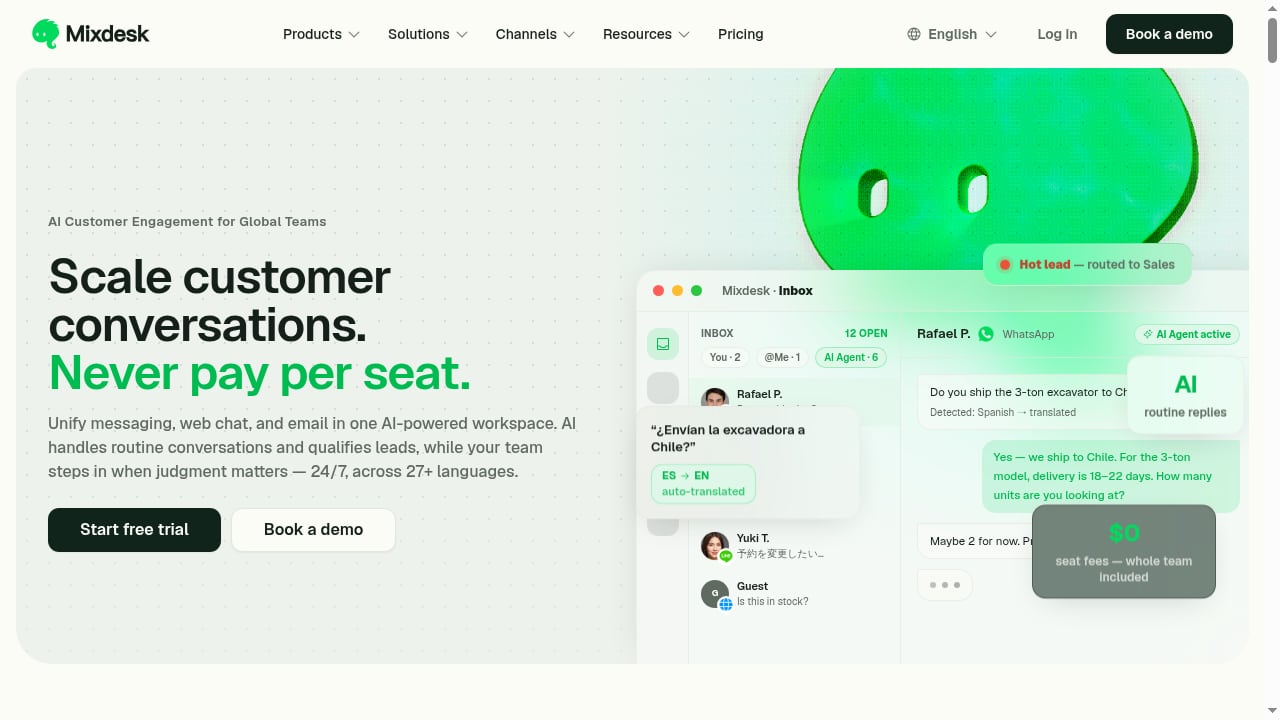
- Mixdesk: An AI customer engagement platform for global teams, emphasizing unified channels, automated replies, and lead qualification, with "no per-seat pricing" as a selling point.
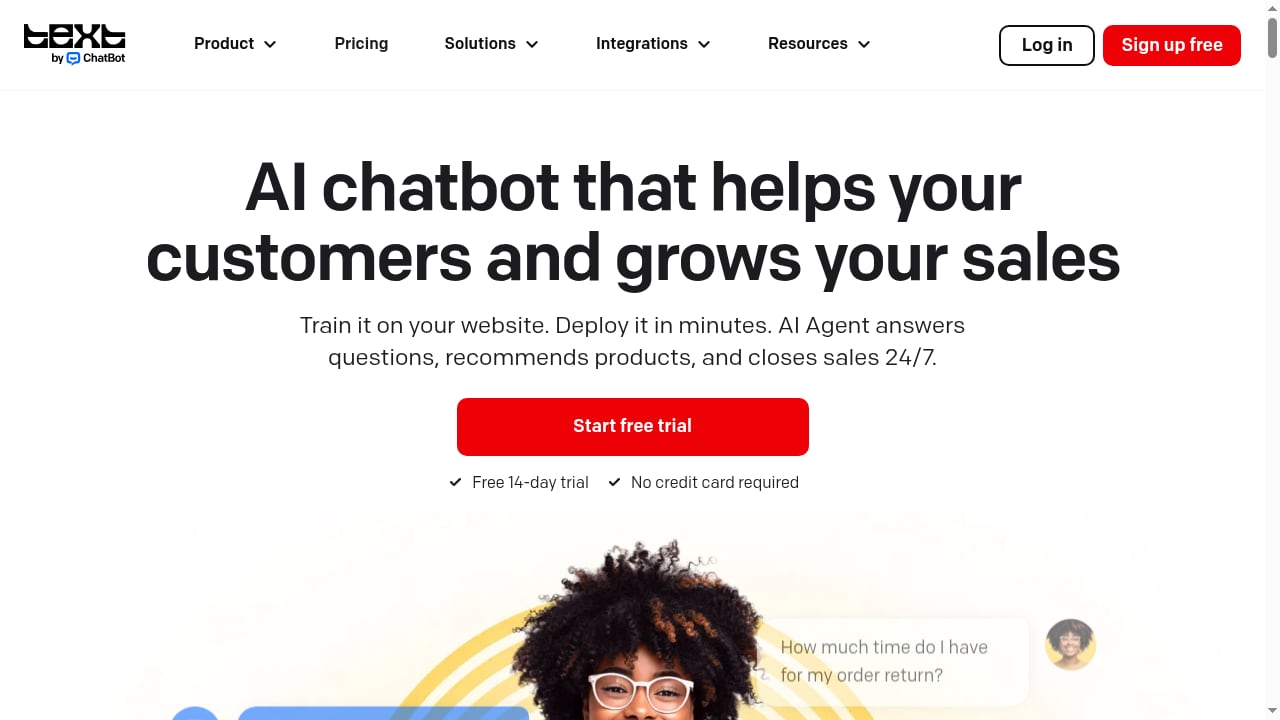
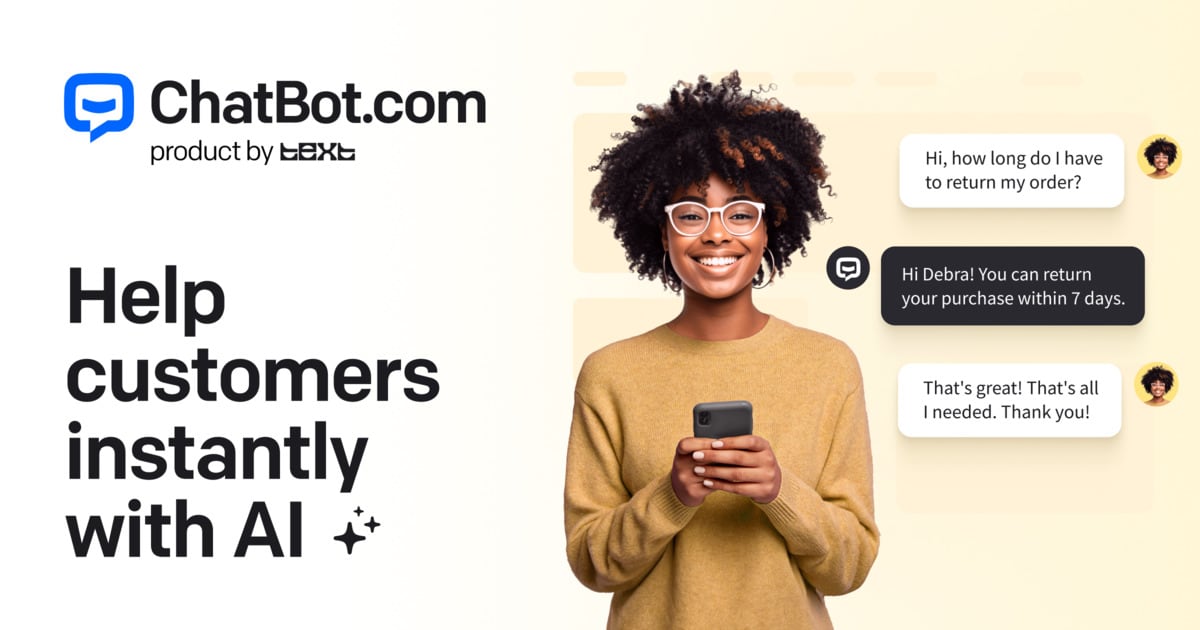
- ChatBot: AI chatbot software for websites that trains a bot on website content to provide 24/7 Q&A, product recommendations, and sales conversion, focusing on fast launch and a free trial.
In one sentence: SaleSmartly is more like a "workbench for human customer service teams," Mixdesk is more like an "AI-driven engagement and lead engine," and ChatBot is more like an "intelligent Q&A window installed on a company's official website."
Channel Coverage: Breadth of Multi-Platform Private-Domain Communication
First viewport screenshot of mixdesk.com.
Cross-border business inquiries are often scattered across multiple social media and instant messaging tools, and channel breadth directly determines the missed-order rate.
- SaleSmartly's advantage lies in the breadth of channel aggregation: WhatsApp multi-account management, Facebook and Instagram chat-based selling, Telegram, LINE, WeChat, Zalo, VKontakte, Email, YouTube, and more can be centralized into one inbox. Combined with conversation records and real-time translation, it suits teams operating in multiple regional markets at the same time.
- Mixdesk also emphasizes "unified channels" and suits global teams that want to consolidate multiple entry points into AI engagement flows. For the specific channel list, refer to its official documentation.
- ChatBot's main battlefield is the website itself. Its strength lies in web-based conversations and product recommendations; off-site social media channels are not its core scenario.
How to judge: If your inquiries mainly come from social media private domains such as WhatsApp, Instagram, and Messenger, and you need multiple accounts in parallel, channel aggregation capability should be the first priority in your evaluation. If traffic is highly concentrated on your official website, a website chatbot can also cover most needs.
How Humans and AI Collaborate
First viewport screenshot of www.chatbot.com.
This is where the three products differ most clearly, and also where it is easiest to stumble during selection.
SaleSmartly: A Collaboration Chain Led by Humans with AI as Support
SaleSmartly's design logic is "AI receives first, key business opportunities are handed to humans." AI employees can handle intelligent reception, intent recognition, and proactive follow-up, and seamlessly hand complex issues or high-value customers to human agents. Real-time translation helps cross-language teams directly handle multilingual conversations. For scenarios that require human decision-making, such as after-sales disputes and custom quotations, this division of labor is closer to real customer service workflows.
Mixdesk: Driving Engagement with AI Automation
Mixdesk places automated replies and lead qualification at its core, suiting teams that want to use AI to handle large volumes of repetitive inquiries and quickly filter out qualified leads. Its "no per-seat pricing" model is attractive to teams with many seats but highly fluctuating inquiry volumes.
ChatBot: A Self-Service Bot on the Website Side
ChatBot trains a bot on website content and can go live in minutes. It excels at answering common questions, recommending products, and driving orders. It is better suited as the "first line of reception" for an official website rather than a customer service hub carrying complex human collaboration.
How to judge: Ask yourself one question—in your business, are human agents the "exception" or the "main force"? If humans remain key to closing deals and after-sales, prioritize whether the collaboration chain is smooth. If most inquiries can be closed by AI, automation depth matters more.
Customer Operations and Remarketing Capabilities
Customer service is not just about answering questions; it also carries lead accumulation and repeat-purchase activation.
- SaleSmartly has built-in SCRM capabilities: enterprise-level customer information accumulation, routing links and live codes, automatic customer assignment, tags and segmentation, 360° customer profiles, and support for precise WhatsApp bulk messaging, multi-channel bulk messaging, and reactivation of silent customers, extending a single inquiry into long-term operations.
- Mixdesk focuses on lead qualification and suits engagement flows aimed at "acquiring qualified leads"; in-depth customer operations require other tools.
- ChatBot focuses on website-side conversation conversion; customer data accumulation and remarketing are not its main positioning.
How to judge: If your growth depends on repeat purchases from existing customers and private-domain operations, SCRM and bulk messaging capabilities should be included in scoring. If at the current stage you only care about converting website inquiries into leads, you can simplify requirements first.
Pricing Models and Team Costs
- Mixdesk clearly uses "no per-seat fees" as a selling point. Teams with many seats and complex scheduling should focus on calculating its total cost.
- ChatBot offers a free trial, suitable for first validating website bot results on a small scale before deciding whether to expand investment.
- SaleSmartly's pricing is tied to its omnichannel aggregation, SCRM, and AI capabilities, suiting teams that view customer service as long-term customer operations infrastructure. For specific plans, it is recommended to estimate based on inquiry volume and seat count against the official website.
How to judge: Do not compare only monthly fee figures. Include "missed-order cost + human efficiency + repeat purchases driven by remarketing" to calculate the true total cost of ownership.
Quick Reference for Use Cases
| Scenario | Better-Fit Choice |
|---|---|
| Multiple regional markets with scattered social media private-domain inquiries, requiring a unified inbox and multi-account management | SaleSmartly |
| Human agents are the main force for closing deals and after-sales, requiring AI assistance rather than replacement | SaleSmartly |
| Want to accumulate customers as operable assets for tag segmentation and remarketing | SaleSmartly |
| Core focus on AI automated replies and lead filtering, with many seats and concern about per-seat billing | Mixdesk |
| Traffic concentrated on the official website, wanting to quickly launch a bot for Q&A and product recommendations | ChatBot |
Practical Example: A Combined Approach for a Cross-Border Brand
ChatBot: The Best AI Chatbot Software for Your Website product interface.
A home goods brand going global receives inquiries on Instagram and WhatsApp and handles product inquiries on its official website. It can assign the official website to ChatBot for first-round Q&A and product recommendations, centralize social media private-domain conversations in SaleSmartly for human follow-up on high-ticket inquiries, and use tag segmentation to reactivate silent customers via WhatsApp bulk messaging. If the team values AI automatic lead filtering more and has a larger seat scale, it can also evaluate Mixdesk as the engagement layer. The key is not "choosing only one," but letting each tool handle the part of the journey it does best.
If you want to see more horizontal comparisons of similar systems, refer to SaleSmartly vs EngageLab vs Front: How to Choose a Cross-Border Customer Service System and SaleSmartly vs Fin: Key Differences in Cross-Border Customer Service Selection. If you plan to connect customer service with business tools, How to Integrate SaleSmartly with Zapier: A Practical Guide to Cross-Border Customer Service Automation provides actionable automation ideas.
FAQ
Can SaleSmartly, Mixdesk, and ChatBot be used at the same time?
Yes. A common combination is using ChatBot on the official website for first-round Q&A, centralizing social media private-domain conversations in SaleSmartly for human-AI collaborative follow-up, and using Mixdesk as the AI engagement and lead filtering layer. Whether to stack them depends on team size and budget.
If I only do business on my official website, do I still need an omnichannel customer service system?
If inquiries almost all come from the official website, a website chatbot like ChatBot can cover most scenarios. But once you start running social media ads and operating WhatsApp or Instagram private domains, the value of channel aggregation and human collaboration quickly becomes apparent.
Is "no per-seat pricing" always cheaper?
Not necessarily. Teams with many seats and highly fluctuating inquiry volumes may benefit significantly, but if you also need SCRM, bulk messaging, multi-account management, and other capabilities, include the cost of filling those gaps in the comparison.
Which capability should cross-border teams validate first?
It is recommended to first run a test with real inquiries: whether multilingual conversations can be handled smoothly, whether AI-to-human handoff is seamless, and whether customer information can be accumulated and reached again. These three determine whether the customer service system can truly support growth.
Conclusion
Each of the three products has a clear home turf: ChatBot is suitable for turning an official website into a 24/7 self-service reception window; Mixdesk suits global teams centered on AI automation and lead filtering that care about per-seat billing; and when you need to centrally manage inquiries from multiple channels such as WhatsApp, Instagram, and Messenger, have humans and AI work together, and accumulate customers as operable assets, SaleSmartly's combination of omnichannel customer service and SCRM better fits the complete chain of cross-border business. During selection, first clarify "the role of humans in the business," then score against the four items of channels, collaboration, operations, and cost—the answer is usually very clear.
Reference sources:
- Shulex: 2026 Cross-Border Ecommerce AI Customer Service System Selection and Comparison
- SaleSmartly Official Website
Related reading
- SaleSmartly and Product Fruits Integration Guide: Cross-Border Customer Service and User Onboarding Collaboration - A detailed explanation of how SaleSmartly's omnichannel customer service system and the Product Fruits user onboarding platform work together, covering setup steps, practical scenarios, and FAQs to help cross-border businesses improve trial conversion and customer retention.