
SaleSmartly vs Ada: Should Cross-Border Customer Service Choose a Human-Led Omnichannel System or an Enterprise-Grade AI Automation Platform?
When cross-border businesses choose a customer service system, they often face a fork in the road: on one side is an omnichannel communication platform centered on human agents with AI as a supplement, and on the other is an enterprise-grade AI customer service agent focused on autonomous resolution rates. SaleSmartly belongs to the former, Ada to the latter. The two are not simply a question of "who is stronger," but rather solve problems at different stages and for different organizational forms. Based on public information, this article compares them across five dimensions—channel coverage, human-AI collaboration, marketing capabilities, deployment barriers, and applicable scenarios—to help you break the selection question down into concrete, judgeable conditions.
Positioning Differences Between the Two Types of Products
SaleSmartly is positioned as a one-stop customer communication system for cross-border businesses: centered on human agents with AI-powered customer service as a supplement, it supports integration with WhatsApp, Facebook Messenger, Instagram, Telegram, LINE, Email, VKontakte, WeChat, Zalo, YouTube, and other channels, covering the entire pre-sales, in-sales, and after-sales process, and comes with marketing capabilities.
Ada is positioned as an enterprise-grade AI customer service agent platform (the ACX platform). It officially claims to autonomously resolve over 80% of customer service inquiries, targeting high-frequency, high-complexity industries such as finance, travel, SaaS, e-commerce, insurance, and gaming, with an emphasis on compliance certifications, multi-model orchestration, and open APIs.
In one sentence: SaleSmartly enables "people" to serve customers more efficiently across multiple channels; Ada enables "AI" to replace people as much as possible in completing the inquiry loop.
Channel Coverage: Breadth of Cross-Border Social Channels vs Depth of Enterprise Channels
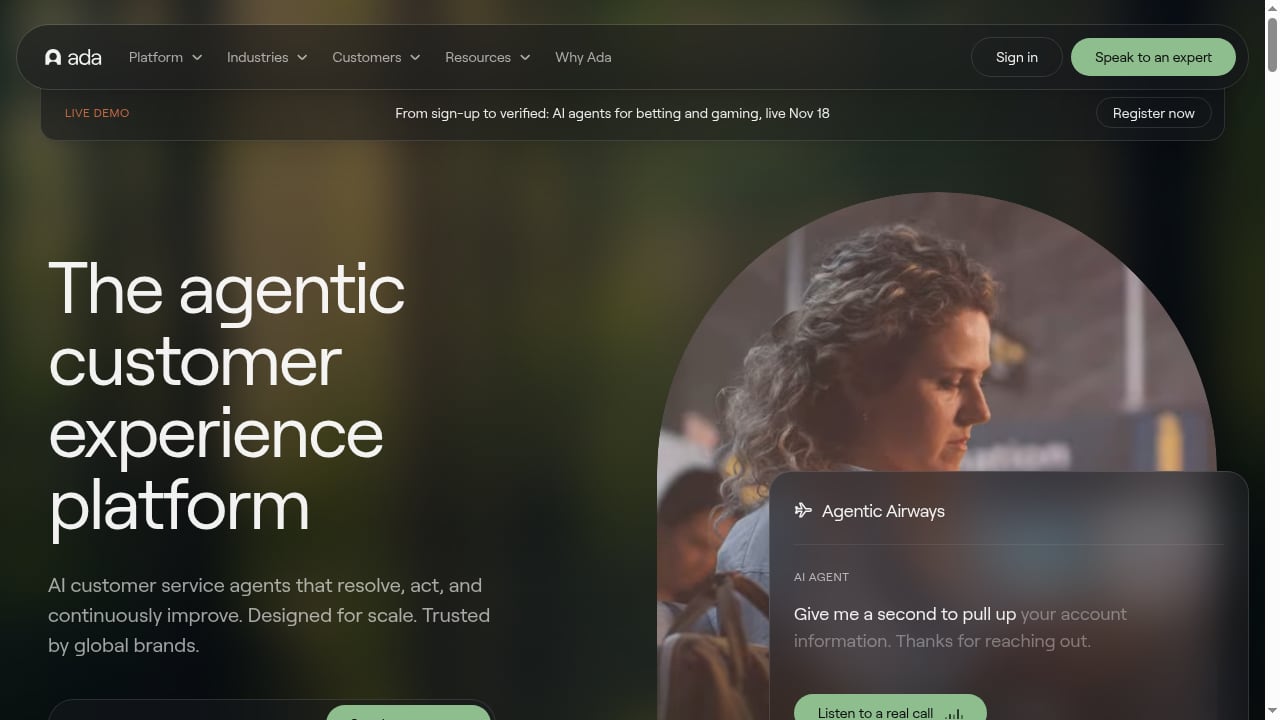
First viewport screenshot of www.ada.cx.
SaleSmartly's Channel Advantages
Customers of cross-border businesses are often scattered across multiple social and instant messaging tools. SaleSmartly explicitly supports WhatsApp, Messenger, Instagram, Telegram, LINE, Email, VK, WeChat, Zalo, YouTube, and other channels. For sellers operating in Southeast Asia, Latin America, the Middle East, and Europe, this ability to "connect all channels in one backend" directly determines whether customer service can manage conversations uniformly and avoid missed replies.
Ada's Channel Capabilities
Ada's Conversation Hub also covers voice, email, chat, Messenger, WhatsApp, SMS, Instagram, in-app, and custom channels, and emphasizes sharing customer context and brand consistency across channels. Its strength lies in replicating the same AI logic across all channels, rather than the number of channels itself.
Judgment Criteria
- If your customers mainly come from social commerce and instant messaging, and you need human agents to respond in real time across multiple channels, SaleSmartly's channel mix is closer to daily operations.
- If you already have mature enterprise systems and want AI to uniformly take over standardized inquiries across voice, email, in-app, and other channels, Ada's cross-channel AI consistency is more valuable.
Human-AI Collaboration: Human-Led with AI as Supplement vs AI Autonomous Resolution as the Core
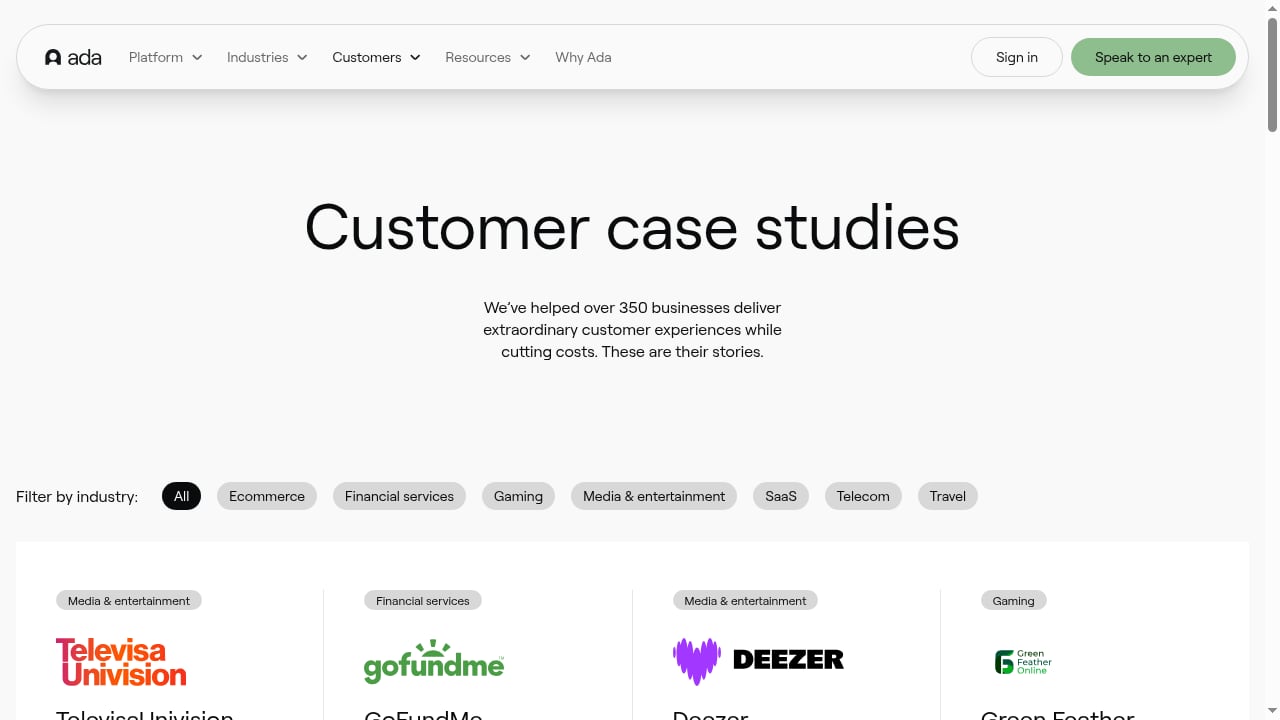
First viewport screenshot of www.ada.cx.
SaleSmartly's Collaboration Logic
SaleSmartly's product description explicitly states "centered on human agents, with AI-powered customer service as a supplement." This means AI plays a supporting role: routing, recommending replies, and handling common questions, while complex or high-value conversations are still taken over by humans. For cross-border businesses with high average order values that require negotiation or emotional reassurance, this model is more controllable.
Ada's Automation Logic
Ada's official data claims it can autonomously resolve over 80% of inquiries, and through Playbooks it enables AI to execute multi-step SOPs such as refunds and eligibility determinations, using code tools to ensure consistent policy enforcement. Its case studies mention that one airline customer reduced wait times to under one minute after deployment, with CSAT improving by over 50%. These figures come from Ada's own customer cases and reflect results under its ideal scenarios; businesses still need to evaluate them against the quality of their own knowledge bases.
Judgment Criteria
- If inquiries are mainly standardized questions such as order lookups, logistics tracking, and return/exchange policies, and your knowledge base and business processes are already digitized, Ada's autonomous resolution path saves more manpower.
- If inquiries involve price negotiation, customization, complaint reassurance, or business rules are not yet fully online, SaleSmartly's human-led model is more reliable, with AI serving as an efficiency tool rather than a replacement.
Marketing and Customer Operations: SaleSmartly's Added Value
SaleSmartly is not just a customer service tool; it also covers pre-sales marketing and after-sales operations, for example using multi-channel outreach for campaign notifications, customer win-back, and remarketing. For cross-border sellers, combining the customer service system with marketing tools reduces data gaps caused by tool fragmentation.
Ada's public materials focus on customer experience and autonomous resolution rates, emphasizing performance centers, coaching mechanisms, and simulation testing, and do not position marketing outreach as a core selling point. If your team needs the customer service system to also take on some marketing functions, this is a difference to factor in.
Deployment Barriers and Organizational Requirements

The agentic customer experience platform.
Ada targets enterprise customers, emphasizing compliance certifications (HIPAA, SOC 2, GDPR, PCI DSS, etc.), open APIs/SDKs, MCP tools, and multi-model orchestration, along with ACX expert services. Such platforms typically require businesses to have a certain level of technical team and process governance capability, and the deployment cycle and investment lean toward medium and large organizations.
SaleSmartly's onboarding is closer to small and medium cross-border teams: after registering and connecting channels, you can start receiving customers, with AI capabilities enabled as needed. For teams without dedicated AI engineers, the learning curve is lower.
If you are evaluating trade-offs among different customer service systems, you can refer to SaleSmartly vs Fin: Key Differences in Cross-Border Customer Service Selection and SaleSmartly vs eesel AI and NiCE CX: A Cross-Border Customer Service Selection Guide for a side-by-side comparison across channels, AI automation, and cost.
Applicable Scenarios at a Glance
| Dimension | SaleSmartly | Ada |
|---|---|---|
| Core positioning | Human-led, AI-assisted omnichannel customer service and marketing system | Enterprise-grade AI customer service agent platform |
| Channel coverage | WhatsApp, Messenger, Instagram, Telegram, LINE, Email, VK, WeChat, Zalo, YouTube, etc. | Voice, email, chat, Messenger, WhatsApp, SMS, Instagram, in-app, custom channels |
| AI role | Assists with routing and common question handling | Autonomously resolves most inquiries and executes multi-step processes |
| Marketing capabilities | Covers pre-sales marketing and after-sales operations | Public materials center on customer experience and automation |
| Deployment barrier | Lower, suitable for small and medium cross-border teams | Higher, leaning toward medium and large enterprises, requiring technical and governance investment |
| Typical scenarios | Social commerce, independent stores, multi-market operations | Large-scale standardized inquiries in high-frequency, high-complexity industries |
How to Decide: Three Questions for a Quick Assessment

The agentic customer experience platform.
- How many of your inquiries are standard questions? If more than 70% are standardizable questions such as orders, logistics, and returns/exchanges, and your knowledge base is complete, you can prioritize evaluating an AI autonomous resolution platform like Ada; if the proportion is lower or rules change frequently, human-led is more reliable.
- Where are your customers mainly located? If they are concentrated on social channels such as WhatsApp, Instagram, LINE, and Zalo, and you need real-time human responses, SaleSmartly's channel integration is more direct.
- Does your team have the capacity to continuously train AI? Ada emphasizes continuous optimization and governance of AI agents, requiring dedicated staff; SaleSmartly's AI-assisted model places lower demands on the team, so you can start using it first and deepen it gradually.
If you want to further understand how AI and human customer service can work together in practice, you can read How to Combine SaleSmartly with OpenAI: A Cross-Border Customer Service AI Implementation Guide and How to Integrate SaleSmartly with Zapier: A Practical Guide to Cross-Border Customer Service Automation to connect your customer service system with business tools.
Frequently Asked Questions
Can SaleSmartly and Ada be used at the same time?
In theory, yes, but you need to evaluate data synchronization and process boundaries. A more common approach is to first determine the primary system: choose SaleSmartly for human-led reception, or Ada for AI autonomous resolution, to avoid two systems handling the same batch of conversations redundantly.
Does Ada's claimed 80% autonomous resolution rate apply to all businesses?
This figure comes from Ada's official page and its customer cases, reflecting results for its typical enterprise customers under the premise of complete knowledge bases and digitized processes. Actual resolution rates depend on your business complexity, knowledge base quality, and degree of process standardization; it is recommended to validate with real conversations during a pilot phase.
Are enterprise-grade AI customer service platforms suitable for small cross-border teams to adopt directly?
If inquiry volume has not yet reached a certain scale, or business processes are not yet online, the return on investment of an enterprise-grade platform may not be ideal. Starting with a human-led omnichannel system to handle inquiries and then gradually introducing AI assistance is a more common path.
Can SaleSmartly's AI capabilities meet cross-border customer service needs?
SaleSmartly is positioned as AI-assisted rather than AI-replacing, suitable for handling common questions, routing, and recommending replies. If your goal is for AI to independently complete multi-step operations such as refunds and order changes, you need to evaluate its configuration depth and your process complexity.
Conclusion
The difference between SaleSmartly and Ada is essentially a choice about the "ratio of human-AI division of labor." SaleSmartly is centered on human agents with AI as a supplement, with channel coverage aligned to the cross-border social ecosystem, accompanying marketing capabilities, and a low deployment barrier—suitable for most small and medium cross-border teams and high-average-order-value businesses that require fine-grained service. Ada is centered on AI autonomous resolution, emphasizing enterprise-grade compliance, multi-model orchestration, and process automation—suitable for medium and large enterprises with large inquiry volumes, a high degree of process standardization, and technical governance capabilities.
When selecting, there is no need to pursue the "most advanced AI"; instead, answer a more practical question: how many of your customer inquiries can you confidently hand over to AI to complete independently? The clearer the answer, the simpler the choice.
References:
Related reading
- SaleSmartly vs EngageLab and Front: How to Choose a Cross-Border Customer Service System - Compares SaleSmartly, EngageLab, and Front across four dimensions—channel coverage, human-AI collaboration, customer operations, and deployment cost—to help cross-border businesses choose an online customer service system that fits their operations.
- SaleSmartly and Product Fruits Integration Guide: Cross-Border Customer Service and User Onboarding in Sync - Explains in detail how SaleSmartly's omnichannel customer service system and the Product Fruits user onboarding platform work together, covering setup steps, practical scenarios, and common questions to help cross-border businesses improve trial conversion and customer retention.