
SaleSmartly vs Kommunicate vs Pylon: A Cross-Border Customer Service Selection Guide
When a cross-border business needs a live chat system, it often hesitates among three types of products: SaleSmartly, known for omnichannel communication and customer operations; Kommunicate, known for AI customer service automation; and Pylon, built for B2B teams. All three can handle customer conversations, but they start from different design premises and suit different teams. This article offers an objective comparison across channel coverage, human-AI collaboration, customer operations, pricing, and use cases, helping you break the selection question down into concrete, judgeable questions.
What Problem Does Each Product Solve?
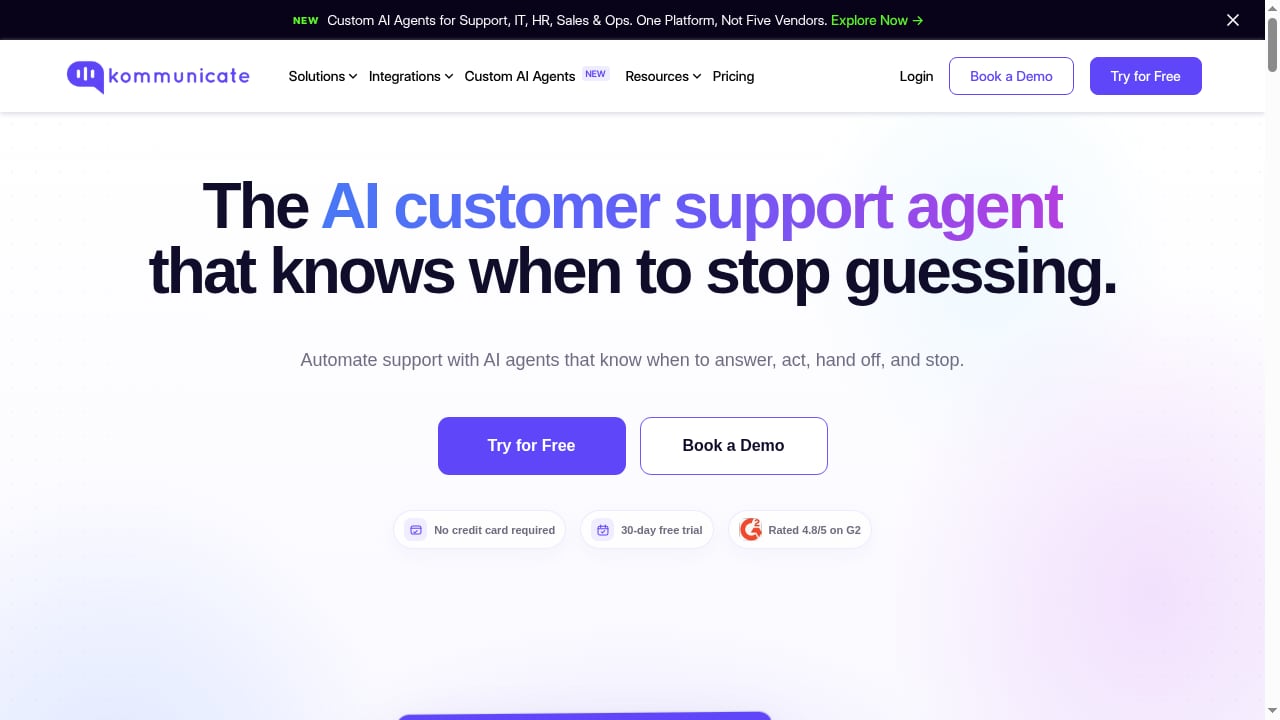
First viewport screenshot of www.kommunicate.io.
SaleSmartly: Cross-Border Omnichannel Customer Communication and Operations
SaleSmartly is an omnichannel customer communication system that centers on human agents with AI-powered customer service as a supplement. It supports channels including WhatsApp, Facebook Messenger, Instagram, Telegram, LINE, Email, VKontakte, WeChat, Zalo, and YouTube, covering the full journey from pre-sales to in-sales to after-sales. Its focus is not just "replying to messages," but consolidating conversations, customer information, and follow-up records scattered across channels, and combining SCRM capabilities for customer segmentation and remarketing.
Kommunicate: AI Customer Service Automation First
Kommunicate positions itself as an AI customer service automation platform, resolving customer issues through AI customer service agents across chat, email, WhatsApp, and voice channels, and emphasizing seamless AI-human collaboration for complex queries. For teams that want to use AI to handle a large volume of repetitive inquiries first and gradually introduce human agents, its path is relatively direct.
Pylon: An Agentic Support Platform for B2B
Pylon is an Agentic customer support platform for B2B teams, enabling humans and AI agents to collaborate on customer work. It unifies entry points such as Slack, Microsoft Teams, email, chat, SMS, WhatsApp, phone, and Discord into a single queue, and enriches each conversation with account and product context (such as ARR, health score, open issues, conversation history, feature requests, and more). Its pricing is based on seats and AI credits: Professional is $89/seat and Advanced is $139/seat (annual billing), with enterprise plans requiring custom quotes.
Channel Coverage Comparison: Who Is Better for Multi-Market Reach

Pylon product interface.
Cross-border businesses rarely rely on just one channel: Southeast Asia commonly uses LINE and Zalo, some European markets rely on VKontakte, and the Middle East and Latin America depend heavily on WhatsApp. Whether channel coverage is complete directly determines whether the support team has to switch back and forth between multiple tools.
- SaleSmartly: Official materials state it supports 14 messaging channels, including WhatsApp, Facebook Messenger, Instagram, Telegram, LINE, Email, VKontakte, WeChat, Zalo, YouTube, and more, making it suitable for teams that need to serve customers across multiple markets from a single backend.
- Kommunicate: Covers major channels such as chat, email, WhatsApp, and voice, sufficient to support automated customer service scenarios centered on website chat and messaging apps.
- Pylon: Entry points cover Slack, Microsoft Teams, email, chat, SMS, WhatsApp, phone, and Discord, leaning more toward the communication tool mix commonly used by B2B product teams.
If your customers mainly come from social media private domains and instant messaging apps, with many channels and mixed languages, SaleSmartly's channel breadth and unified inbox are a better fit; if customers are concentrated on website chat and a few messaging channels, Kommunicate's coverage is sufficient; if customers are used to asking questions in Slack or Teams, Pylon's entry point design feels more natural.
Human-AI Collaboration Comparison
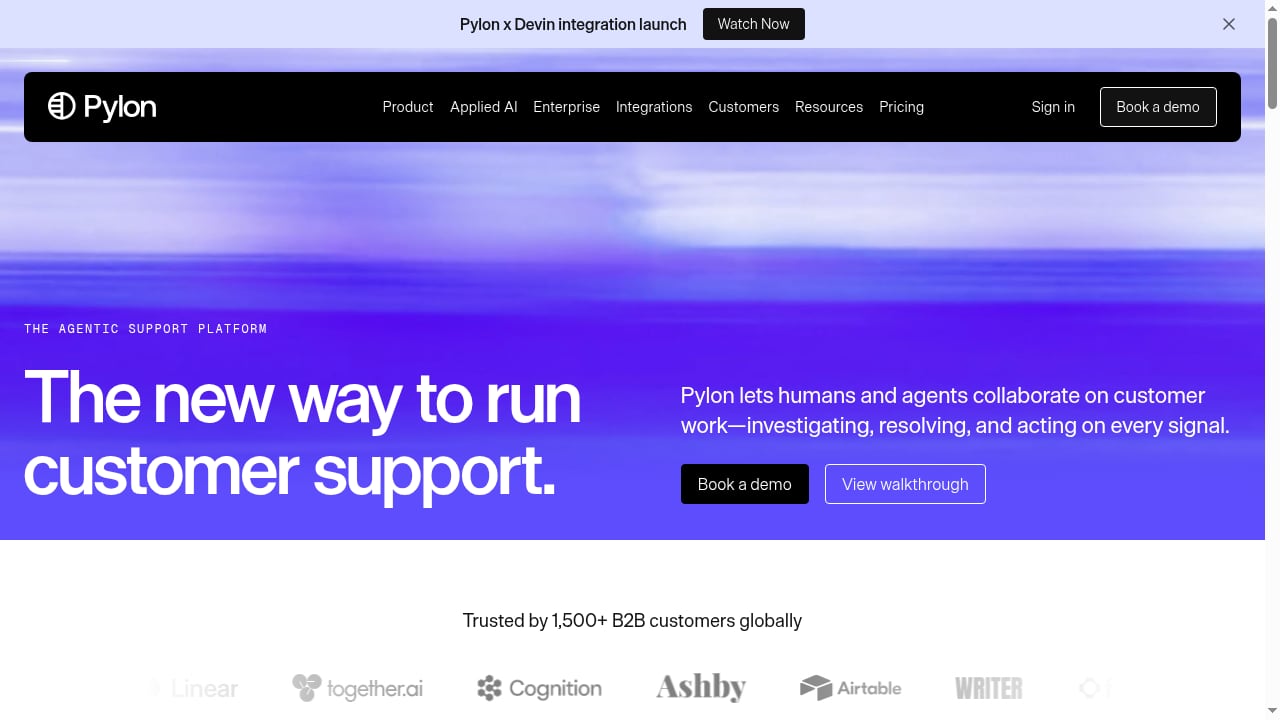
First viewport screenshot of www.usepylon.com.
All three products emphasize AI-human collaboration, but the focus of that collaboration differs.
SaleSmartly: Human-Led, AI-Supported
SaleSmartly's AI employees can handle intelligent reception, proactive follow-up, and intent recognition, seamlessly handing off to human agents when key sales opportunities arise. This "human-led, AI-assisted" model suits cross-border sales scenarios with higher order values that require a personal touch and negotiation skills. The system also provides real-time translation to help agents handle multilingual inquiries.
Kommunicate: AI Resolves First, Human Backs Up
Kommunicate's approach is to let AI agents handle a large volume of queries first and pass complex issues to humans. For teams with high inquiry volumes and highly repetitive questions, this model can quickly reduce the burden on human agents.
Pylon: AI Agents Lead, Humans Direct
Pylon emphasizes letting AI agents own and resolve issues end to end, while humans direct and handle escalations. It offers Assist Agent (a personal AI agent for investigating, drafting replies, and executing actions), Skills (reusable structured workflows), and Automations (event- or schedule-triggered workflows), making it suitable for B2B teams that want to systematize support processes and let AI take on more execution work.
Customer Operations and Data Capabilities Comparison
Whether a customer service system only solves "replying" or can also accumulate customer assets is key to long-term operations for cross-border businesses.
- SaleSmartly: Built-in SCRM capabilities support enterprise-level customer information, routing links and live QR codes, automatic customer assignment, tags and segmentation, and 360° customer profiles, and can perform multi-channel mass messaging and dormant customer reactivation based on tags and historical interactions. For teams that treat customer service as an entry point for repurchases and private domain operations, these capabilities can be reused directly.
- Kommunicate: More focused on customer service automation itself; customer operations and marketing capabilities are not its main selling point.
- Pylon: Offers account intelligence, analytics and reporting, workforce management, NPS and CSAT surveys, and ticketing capabilities; its strength lies in combining B2B account context with support work to help teams understand customer health and issue distribution.
If your goal is to "turn inquiries into manageable customer relationships," SaleSmartly's SCRM and remarketing chain is more complete; if your goal is to "help the support team better understand B2B accounts," Pylon's account context is more valuable.
Pricing and Deployment Cost Comparison
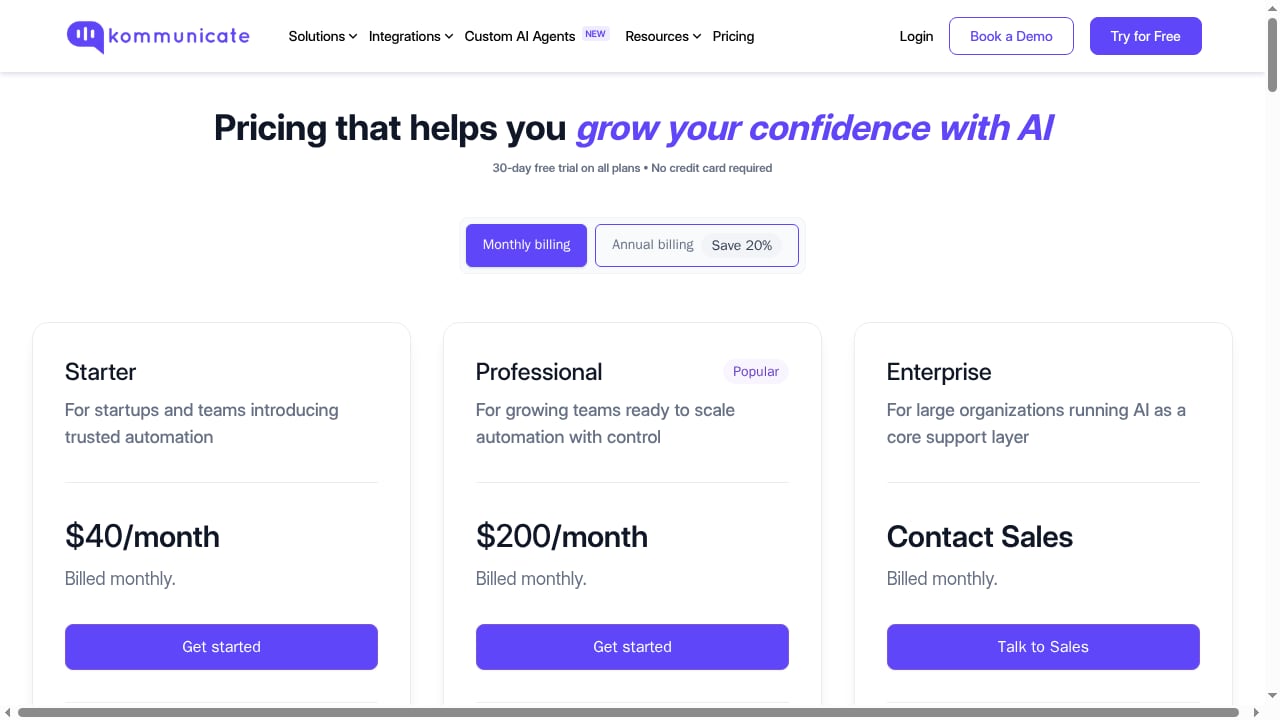
First viewport screenshot of www.kommunicate.io.
Pricing often determines whether a selection can be implemented.
- SaleSmartly: Offers a free trial and plans chosen on demand, with overall positioning that is friendlier to small and medium-sized cross-border teams.
- Kommunicate: Typically billed by conversation volume or feature plans, suited to a budget structure centered on AI automation.
- Pylon: Billed by seats and AI credits: Professional is $89/seat and Advanced is $139/seat (annual billing), with custom quotes for enterprise plans. For teams with few seats but heavy AI usage, credit consumption needs to be estimated in advance.
When selecting, don't just look at the list price; factor capabilities such as channel count, AI credits, translation, and SCRM into the total cost.
Use Cases: How to Choose More Reliably
- Choose SaleSmartly: Customers come from multiple social media and instant messaging channels, you need a unified inbox, real-time translation, and human-AI collaboration, and you want to turn customer service conversations into customer assets for repurchase operations.
- Choose Kommunicate: Inquiry volumes are high with many repetitive questions, you want to use AI automation as the primary way to quickly reduce the burden on human agents, and channels are mainly website chat, email, and WhatsApp.
- Choose Pylon: You are a B2B product team, customers are used to asking questions in Slack or Teams, and you need account context, end-to-end AI agent handling, and systematized support processes.
If you are still comparing other combinations, you can refer to SaleSmartly vs EngageLab vs Front: How to Choose a Cross-Border Customer Service System and SaleSmartly vs eesel AI vs NiCE CX: A Cross-Border Customer Service Selection Guide to cross-validate across channels, AI, and cost.
Frequently Asked Questions
Can SaleSmartly, Kommunicate, and Pylon be used at the same time?
Technically yes, but maintaining multiple customer service systems simultaneously is usually not recommended. A more common approach is to use one system as the primary inbox and supplement specific capabilities through integrations or APIs with other tools. For example, use the Zapier integration to connect the customer service system with business tools.
Which dimension should cross-border teams look at first?
Start with channel coverage and customer sources. If customers are mainly on instant messaging channels such as WhatsApp, LINE, and Zalo, channel completeness and a unified inbox are the top priority; if customers are mainly on website chat or email, AI automation capabilities can be prioritized.
Is Pylon suitable for cross-border e-commerce?
Pylon positions itself as a B2B support platform, with strengths in account context and B2B workflows. If cross-border e-commerce is mainly B2C social media private domain, SaleSmartly's channel and SCRM capabilities are a better fit; if you also run B2B business, you can evaluate Pylon's account intelligence capabilities.
Can Kommunicate's AI completely replace human agents?
No. Kommunicate emphasizes AI-human collaboration for complex queries; AI is better suited to handling repetitive, standardized questions, while complex complaints and high-value sales opportunities still require human involvement.
How can I verify which system is better for my team?
It is recommended to run a small-scale trial with real channels and real questions, focusing on response speed, translation accuracy, whether AI-to-human handoff is smooth, and whether data can be exported and used for subsequent operations.
Conclusion
SaleSmartly, Kommunicate, and Pylon are all products worth serious evaluation in their respective categories. Kommunicate has a clear path in AI customer service automation, and Pylon stands out in B2B account context and AI agent execution; but if your business is cross-border, multi-market, and multi-channel, centered on social media private domains and instant messaging, and you want to turn customer service conversations into manageable customer assets, SaleSmartly's omnichannel coverage, human-AI collaboration, and SCRM operations capabilities will fit daily use better. There is no single answer to selection; the key is to first clearly define channels, collaboration methods, and operational goals, then verify with a trial.
Reference sources:
Related reading
- SaleSmartly vs Fin: Key Differences in Cross-Border Customer Service Selection - Compare SaleSmartly and Fin across channel coverage, human collaboration, AI automation, pricing, and use cases to help cross-border businesses choose a live chat system that better fits their operations.
- SaleSmartly and Product Fruits Integration Guide: Cross-Border Customer Service and User Onboarding in Sync - A detailed look at how SaleSmartly's omnichannel customer service system and the Product Fruits user onboarding platform work together, covering setup steps, real-world scenarios, and FAQs to help cross-border businesses improve trial conversion and customer retention.