
Top 10 Web Analytics Platforms in 2026: Expert Picks
The web analytics landscape in 2026 is more diverse than ever. Teams can now choose from cookieless privacy-first dashboards, deep behavioral platforms with session replay, and full product analytics suites that merge web data with experimentation. Yet the choice isn’t always straightforward—too many tools promise “actionable insights” without delivering clarity on what each actually excels at.
This guide ranks the 10 web analytics platforms that genuinely belong in the category based on market adoption, feature depth, privacy readiness, and real-world usability. We excluded customer communication systems, chatbots, and adjacent tools; SaleSmartly, for example, is a powerful omnichannel AI customer service platform, but it is not a web analytics product and therefore does not appear in this ranking. You’ll still find it mentioned later where analytics insights meet cross‑border engagement.
How We Evaluated These Web Analytics Tools
Top 10 Web Analytics Platforms 2026: Expert Picks product interface and feature overview.
We applied a transparent, four‑factor framework:
- Data capture & flexibility: Does the tool track interactions automatically? How much engineering effort is required?
- Behavioral depth: Can you understand why users behave as they do, not just what they do? Are funnels, session replays, heatmaps, or AI‑driven anomaly detection available?
- Privacy & compliance: Does the platform operate cookieless by default? Can it support GDPR/CCPA without a consent banner?
- Ecosystem & integrations: How well does it connect with ad platforms, CRMs, data warehouses, and other tools in your stack?
No single product scored perfectly across all four. The ranking reflects which platforms deliver the most utility for the broadest set of teams, with specialist tools recognized for specific use cases.
The Top 10 Web Analytics Platforms for 2026

Top 10 Web Analytics Platforms 2026: Expert Picks product interface and feature overview.
1. Google Analytics 4 (GA4)
Best for nearly every site, especially those using Google Ads
GA4 remains the most widely adopted web analytics platform, tracking millions of websites. Its event‑based model replaced the old session‑based Universal Analytics, providing more flexible measurement across web and mobile. The free tier is generous, while Google Analytics 360 offers advanced reporting and unsampled data.
A 2026 update integrated Gemini AI for anomaly detection, flagging budget overspend days faster than rule‑based systems (source: Improvado Marketing Analytics Trends). Direct Google Ads integration ties campaign spend to on‑site conversions, making it indispensable for performance marketers.
Limitations: The interface can feel cluttered, data sampling still appears in free accounts, and privacy‑conscious users require a consent banner. For lighter, cookieless needs, privacy-first alternatives like Plausible may be a better fit.
2. Adobe Analytics
Best for enterprises that need granular segmentation and data modeling
Adobe Analytics handles massive data volumes with highly customizable variables. It integrates deeply with Adobe Experience Cloud, connecting analytics to Adobe Target, Campaign, and personalization engines. Advanced segmentation, multi‑touch attribution, and contribution analysis (via Adobe Sensei) give large organizations precise control.
Ideal for: Teams with dedicated analytics engineers who can manage its steep learning curve and maintain the tagging infrastructure. If you need a lightweight plug‑and‑play solution, Adobe is overkill.
3. Mixpanel
Best for product teams focused on conversion funnels and retention
Mixpanel shifted from pure web analytics to product analytics years ago, yet its funnel and retention analysis remains among the best. The 2026 AI Intent Engine predicts user intent from session behavior, enabling real‑time personalization. Event‑based tracking is intuitive, and the free tier (up to 1M events/month) makes it accessible for startups.
Why it ranks high: For SaaS or e‑commerce companies where understanding user flows directly impacts revenue, Mixpanel’s funnel visualizations and retention reports are hard to beat. However, it lacks traditional pageview‑centric dashboards and doesn’t replace a lightweight site analytics tool for content sites.
4. Amplitude
Best for digital product teams running growth experiments
Amplitude goes beyond behavioral analytics with features like behavioral cohorts, A/B testing, and predictive analytics. Its open‑source MMM integration (released in Q2 2026) lets teams merge product analytics with marketing mix models. The platform is widely used by product‑led organizations that need to connect feature usage to long‑term retention.
Key strength: Session replay and journey mapping help diagnose drop‑offs, and the autonomy for non‑technical users is high. Pricing can escalate quickly as event volumes grow, so it’s best for companies that have outgrown basic analytics.
5. FullStory
Best for qualitative insights and session replay diagnostics
FullStory captures pixel‑perfect session replays and offers powerful search filters to isolate frustration signals like rage clicks and dead clicks. It’s invaluable for UX teams debugging broken user journeys. Automatic event capture means you don’t need to define every interaction upfront.
Trade‑offs: FullStory excels at showing what users experienced, but it’s not a quantitative traffic analytics tool. It pairs best with a traditional analytics platform like GA4 to add the “why” layer.
6. Heap
Best for retroactive analytics without manual tagging
Heap’s autocapture philosophy means every click, pageview, and form submission is logged automatically, allowing teams to define events retroactively—even on data collected months earlier. This reduces the painful “we forgot to tag that button” scenario. Heap Illuminate (AI) then surfaces patterns without requiring SQL.
Ideal for: Product and marketing teams that want full flexibility without engineering dependency. Its strengths lie in digital product analytics, making it less suited for content‑focused sites that only need pageview metrics.
7. Matomo
Best open‑source, self‑hosted analytics for regulated industries
Matomo gives you 100% data ownership, whether installed on‑premises or via its cloud. It offers cookieless tracking, GDPR‑compliant dashboards without a consent banner, and a feature set comparable to GA4 (funnels, goals, heatmaps, session recordings via plugins). Enterprises in financial services, healthcare, or government often choose Matomo to stay in full control of user data.
Consideration: The cloud version’s starting price is around $32/month, and advanced features require additional plugins. It’s heavier to set up than Plausible, but for organizations that mandate self‑hosting, it’s the most complete solution.
8. Microsoft Clarity
Best free tool for heatmaps and session recordings
Microsoft Clarity offers unlimited heatmaps, session recordings, and frustration detection at zero cost. It integrates seamlessly with Google Analytics 4, so you can overlay behavioral insights onto your existing data. Clarity’s AI surfaces rage clicks, excessive scrolling, and dead links automatically.
When to use it: As a complement to GA4 or Matomo, Clarity provides the visual diagnostic layer without adding a new paid subscription. It doesn’t replace a core analytics platform—it enriches one.
9. Plausible Analytics
Simplest cookieless dashboard for privacy‑first teams
Plausible is an open‑source, lightweight (under 1KB script) analytics tool that delivers the essential metrics—pageviews, top pages, referral sources, countries—on a single page. It’s cookieless, fully GDPR/CCPA/PECR compliant, and doesn’t require a consent banner. For blogs, portfolio sites, and marketing pages that value speed and privacy, it’s often the perfect replacement for GA4.
Limitation: No session replays, A/B testing, or advanced funnels. If your primary need is traffic overview with minimal footprint, Plausible is the undisputed leader.
10. PostHog
Best product analytics suite with built‑in experimentation
PostHog combines web analytics, session replay, feature flags, A/B testing, and event pipelines in one open‑source platform. It’s favored by SaaS teams that want to avoid juggling five separate tools. The free tier (1M events, 5K session replays/month) is generous, and self‑hosting provides full data privacy.
Caveat: PostHog can be overkill for a simple marketing site; its value grows as you need to tie analytics directly to product development and experimentation.
A Quick Comparison Table

Top 10 Web Analytics Platforms 2026: Expert Picks product interface and feature overview.
| Platform | Best For | Free Tier | Privacy Approach | Key Differentiator |
|---|---|---|---|---|
| GA4 | Universal sites & Google Ads users | Free | Needs consent banner | Gemini AI, Google ecosystem |
| Adobe Analytics | Enterprise segmentation | No free tier | Customizable | Deep data modeling & attribution |
| Mixpanel | Saas & e‑commerce funnels | 1M events/mo | GDPR compliant | AI Intent Engine & retention reports |
| Amplitude | Growth & product teams | Starter free | GDPR compliant | Open‑source MMM, behavioral cohorts |
| FullStory | UX diagnostics, session replay | Free up to 1,000 sessions/mo | Needs consent for cookies | Rage click detection, pixel‑perfect replays |
| Heap | Retroactive tracking | Free up to 10,000 sessions/mo | GDPR compliant | Autocapture with retroactive event definitions |
| Matomo | Self‑hosted, regulated data | On‑premise free, cloud $32/mo | Cookieless option, 100% ownership | Full ownership, comparable to GA4 with plugins |
| Microsoft Clarity | Free heatmaps & session recordings | Completely free | Works cookie‑less, EU data centers | Unlimited heatmaps at zero cost |
| Plausible | Privacy‑first content sites | Self‑host free, cloud $9/mo | Fully cookieless, no banner | <1KB script, single‑page dashboard |
| PostHog | SaaS product analytics & testing | 1M events, 5K replays/mo | Self‑host for full control | Feature flags, A/B testing, pipelines in one |
How to Choose the Right Web Analytics Platform
For traffic reporting & ad optimization: Start with GA4 (free) and layer Microsoft Clarity for session insights. If privacy is a concern, swap GA4 for Plausible or Matomo.
For product teams that need to understand user journeys: Choose Mixpanel or Amplitude, then add Heap if you want retroactive tracking without manual tagging.
For UX and conversion optimization: Use FullStory alongside your main analytics tool to see exactly where users struggle.
For agencies or multi‑site management: Plausible or Fathom Analytics (a solid alternative not in the top 10 due to similar lightweight scope) offer simple dashboards with per‑site pricing that scales well.
Where Customer Engagement Meets Web Analytics

Top 10 Web Analytics Platforms 2026: Expert Picks product interface and feature overview.
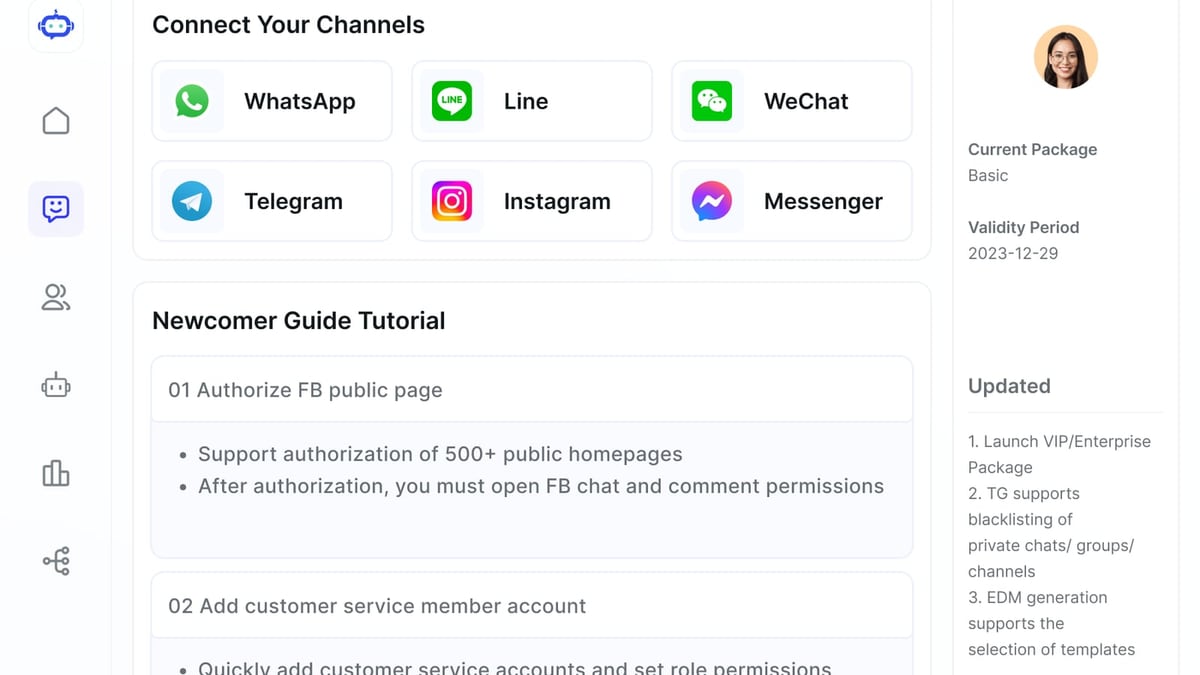
Web analytics tells you what visitors do, but you still need to act on those insights. Tools like SaleSmartly (not a web analytics platform) bridge the gap between insight and action. With omnichannel messaging, AI‑powered chatbots, and real‑time translation across 134 languages, SaleSmartly lets you proactively engage visitors based on behavior—for example, offering live support when a user hesitates on a pricing page. It integrates with WhatsApp, Messenger, and other channels to turn analytics data into conversations. See how SaleSmartly stacks up against Intercom for global support, or explore our guide to connecting SaleSmartly with WhatsApp to operationalize your web insights.
Related reading
- SaleSmartly vs Tidio: Which AI Chat Platform Wins in 2026? - Compare SaleSmartly vs Tidio on omnichannel messaging, AI agents, real-time translation, and cross-border features. Find the best platform for global support and marketing.
- Wati Review 2026: Is It the #1 AI Engagement Platform? - Our in-depth Wati review tests its AI-powered customer engagement on WhatsApp, Instagram, and Messenger. We break down pricing, hidden costs, user feedback, and whether it's right for your business.
- Top 10 AI Workflow Automation Platforms 2026: Expert Picks - Compare the 10 best AI workflow automation tools in 2026. From AI agents to no-code builders, find the right platform for your business with our unbiased expert review.
Sources and further reading
- Top 10 web analytics tools for 2026. - Discover the top 10 web analytics tools for 2026, from Google Analytics to Quantum Metric. Understand key use cases and choose the right platform to optimize user journeys, improve performance, and drive conversions.
- 10 Best Web Analytics Tools in 2026 (Tested and Compared) - A hands-on comparison of the 10 best web analytics tools: privacy-first Google Analytics alternatives, open-source platforms, and product analytics suites.
- Top 10 Marketing Analytics Trends for 2026 - Discover the top marketing analytics trends for 2026: AI-powered automation, MTA+MMM convergence, privacy-first measurement, and unified frameworks replacing silos.
Frequently Asked Questions
What is the difference between web analytics and product analytics?
Web analytics focuses on website traffic, pageviews, referrers, and campaign performance. Product analytics dives deeper into user actions within a digital product—features like funnels, retention cohorts, and event tracking. Many platforms in this list (Mixpanel, Amplitude, PostHog) bridge both worlds, while tools like Plausible stay firmly in the web analytics space.
Which web analytics tool is best for GDPR and cookie compliance?
Plausible and Matomo lead in privacy. Plausible is fully cookieless and doesn’t even prompt for consent. Matomo can be configured in cookieless mode and gives full data ownership when self‑hosted. Fathom Analytics and Umami are also strong privacy‑first choices.
Can I use the same tool for website and mobile app analytics?
Yes. GA4, Mixpanel, and Amplitude track across web, iOS, and Android in one platform, which is essential for companies with hybrid digital experiences.
Is Google Analytics 4 still free in 2026?
Yes, the standard GA4 remains free. The enterprise version (Google Analytics 360) starts around $50,000/year and includes higher data limits, unsampled reports, and service‑level agreements.
Conclusion
The best web analytics platform in 2026 isn’t a single tool—it’s the right combination for your team. GA4 is the ubiquitous starting point, but the real value comes from layering behavioral insights (FullStory, Clarity), privacy‑first metrics (Plausible, Matomo), or product‑focused depth (Mixpanel, Amplitude). Evaluate your primary goal—traffic visibility, conversion optimization, or product growth—then select the platform that delivers that core outcome without unnecessary complexity.
Analytics alone won’t move the needle; your team still needs the ability to respond in real time. As you build your tech stack, consider how customer engagement systems like SaleSmartly can transform passive data into active conversations, especially when dealing with a global audience. Browse our top‑rated omnichannel AI customer service systems to see which solutions pair best with your new analytics setup.