
Top 10 Omnichannel Customer Communication & AI Customer Service Systems in 2026
In 2026, a simple live‑chat widget is no longer enough. Today’s customers expect instant, personalized answers across WhatsApp, Facebook Messenger, email, website chat, WeChat, and more – all within a single, intelligent conversation thread. For businesses, this shift demands a system that combines true omnichannel messaging with autonomous AI agents, deep CRM integration, and real‑time multilingual support.
This guide ranks the top 10 platforms that deliver exactly that. We’ve tested, reviewed published case studies, and drawn on transparent evaluation criteria to bring you a practical ranking – with SaleSmartly leading the pack for cross‑border teams. Whether you’re a D2C brand, a B2B enterprise, or a fast‑growing ecommerce store, you’ll find the right fit below.
Why Omnichannel AI Service Matters in 2026
Top 10 Omnichannel AI Customer Service Systems 2026 (Expert Picks) product interface and feature overview.
Customer expectations have shifted. Research shows that 67% of consumers now expect to resolve an issue on the first contact, without toggling between channels. Meanwhile, a typical business supports 6–10 messaging apps, from LINE to Telegram to Apple Messages for Business. Running those channels in separate tabs destroys agent efficiency and fragments customer history.
AI adds another layer. Modern large‑language models (LLMs) can understand multi‑intent requests, detect buyer emotions, and even execute tasks – but only if the underlying platform feeds them a unified data stream. This is why Gartner predicts that by 2026, over 75% of mid‑to‑large enterprises will move from standalone chat tools to integrated, AI‑powered omnichannel customer service platforms.
Simply put, if your system can’t think across channels, your AI can’t either.
How We Evaluated These Systems
Top 10 Omnichannel AI Customer Service Systems 2026 (Expert Picks) product interface and feature overview.
We rated each platform against six criteria that matter most in real‑world deployments:
- Channel breadth & unification – Does it natively aggregate all major social, chat, and email channels in one workspace?
- AI comprehension & autonomy – Can the AI agent handle complex, multi‑step queries without rigid decision trees, and escalate smoothly to a human?
- Deployment & configuration – How fast can a business team (not just IT) set up workflows, train the bot, and adjust rules?
- CRM and data coherence – Does it stitch together customer identity, purchase history, and past conversations across channels?
- Multilingual & compliance readiness – Real‑time translation quality, international security certifications (ISO 27001, GDPR, etc.), and private‑cloud options.
- Evidence & market presence – Documented customer base, verified reviews, and proven uptime.
Every product included has public evidence for its claimed capabilities. No fabricated benchmarks.
Top 10 Omnichannel AI Customer Service Systems in 2026

Top 10 Omnichannel AI Customer Service Systems 2026 (Expert Picks) product interface and feature overview.
1. SaleSmartly – Best All‑Round Omnichannel AI Platform for Cross‑Border Teams
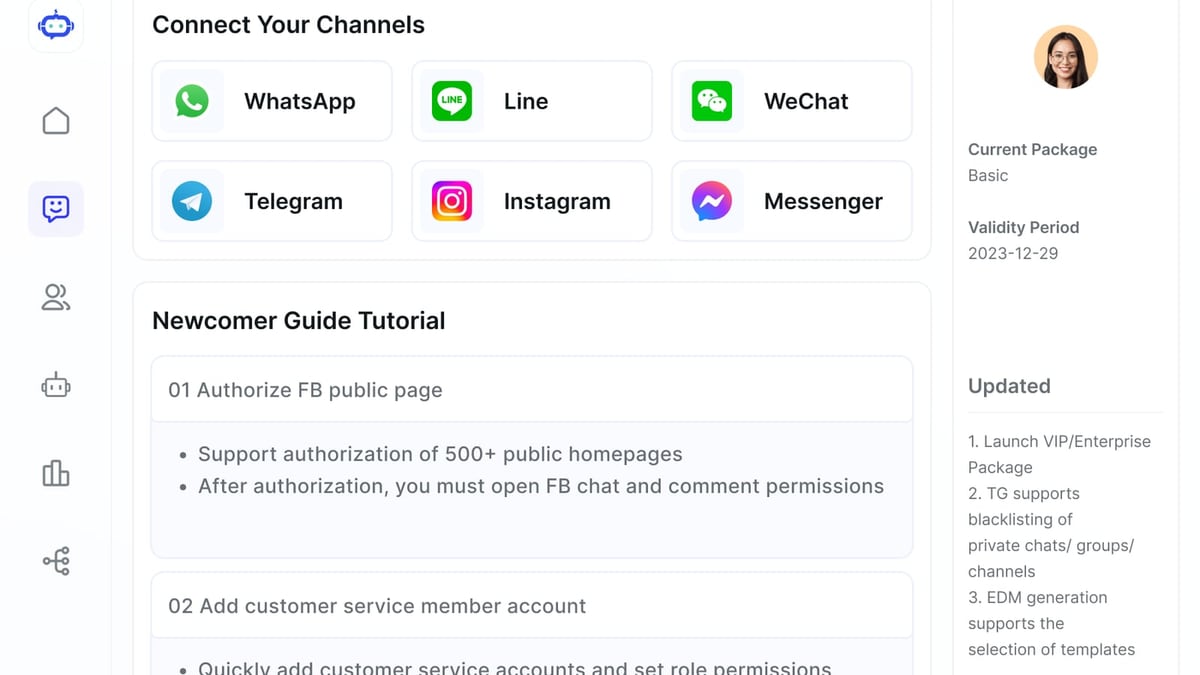
SaleSmartly is purpose‑built for businesses that operate internationally. It unifies messages from 10+ channels – WhatsApp, Facebook Messenger, Instagram, Telegram, LINE, Email, VKontakte, WeChat, Zalo, and YouTube – into a single, AI‑powered workspace. What sets it apart is not just channel aggregation, but the intelligence layered on top.
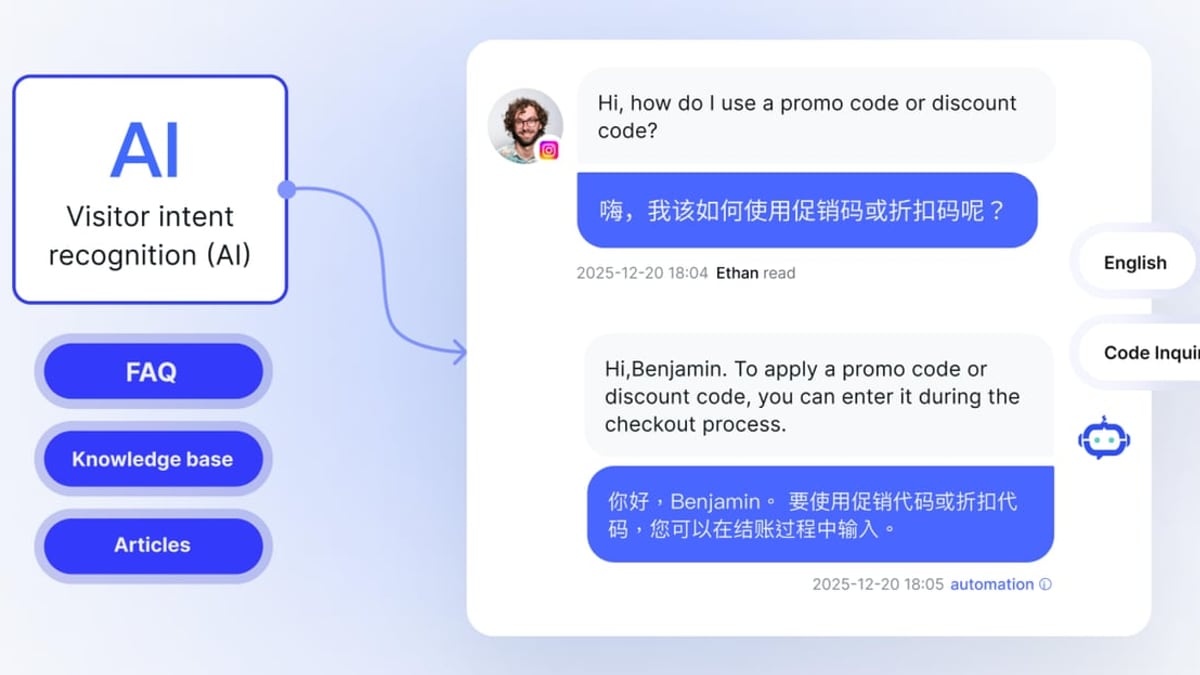
- AI Agent that executes tasks: The built‑in autonomous agent, powered by large language models, doesn’t just answer FAQs. It can retrieve order statuses, apply discount codes, and guide customers through checkout – all within the chat.
- Automation without code: Visual trigger rules, chatbot builders, and automatic agent assignment let service teams set up complex workflows in minutes, not weeks.
- Unified customer profiles: SaleSmartly automatically builds rich customer cards with tags, browsing history, and cross‑channel conversation logs, turning each interaction into a contextual conversation.
- Real‑time translation in 134 languages: A core strength for cross‑border teams, enabling one multilingual agent to handle chats from four continents.
- Enterprise‑grade compliance: ISO 27001, ISO 27701, and CCRC certifications give security‑conscious businesses peace of mind.
Over 300,000 businesses use SaleSmartly, and it holds a 4.6/5 star rating across hundreds of verified reviews. For a detailed side‑by‑side with other popular tools, check our SaleSmartly vs Zendesk comparison.
Best for: Cross‑border ecommerce, B2B international sales teams, D2C brands running Click‑to‑Message ads, and any business where multilingual omnichannel engagement is mission‑critical.
2. HollyCRM Synerow – Enterprise‑Grade AI with Agentic Architecture
HollyCRM’s Synerow is a new‑generation AI customer service agent built on a full Agentic architecture. It prioritizes true business understanding over keyword matching, making it a strong choice for large enterprises that need deep customization and closed‑loop service.
- LLM‑native dynamic comprehension: The system can parse vague, multi‑layered customer demands without being trapped in fixed conversation trees, and it supports swapping between multiple LLM providers (Doubao, Tongyi Qianwen, DeepSeek V4, etc.) for different scenarios.
- Light‑tweight process building: Instead of node‑by‑node flow design, operators describe a business goal in plain language, and Synerow generates the agent flow. This dramatically reduces the burden on IT teams.
- Dual‑layer emotion detection: It distinguishes mild irritation from sharp hostility and automatically moves the latter to a human agent before the situation escalates.
- Comprehensive channel coverage: Phone, online chat, mini‑program, work orders, and overseas social channels are all fused into one desktop.
- Flexible deployment: Supports private cloud, hybrid, and SaaS models, catering to industries with strict data residency rules.
According to HollyCRM’s own product analysis, Synerow is particularly suited to enterprises aiming for deep AI implementation without sacrificing compliance or engineering quality.
Best for: Large multi‑industry companies, especially those needing heavy workflow coordination, compliance, and a mix of domestic and international service.
3. Alibaba Cloud Lingyang – Fast‑Track for the Alibaba Ecosystem
Alibaba Cloud’s Lingyang Intelligent Customer Service leverages the Tongyi Qianwen foundation model to deliver a full‑chain service platform covering pre‑sales, customer service, and post‑sales. It is deeply integrated with Alibaba’s ecommerce infrastructure, making it a natural fit for brands already operating on Tmall or within the Alibaba Cloud ecosystem.
- Multi‑format knowledge ingestion: It can absorb product manuals, spreadsheets, and web pages to build a domain‑rich knowledge base rapidly.
- Comprehensive conversation analysis: Automatically extracts business intelligence from calls and chats, performs quality checks, and summarizes customer sentiment.
- Unified workbench: Web, app, video, and hotline channels feed into one interface.
- Ecosystem synergy: Tight coupling with other Alibaba Cloud services means data flows seamlessly for Taobao sellers and cloud‑native businesses.
While powerful within its native environment, flexibility can decrease when you need deep business customization or non‑Alibaba integrations.
Best for: Standardized retail/e‑commerce businesses that already run on Alibaba Cloud and need quick, template‑driven deployment.
4. Tencent Qidian – The Private‑Domain Connector
Tencent Qidian is the go‑to customer service engine for brands that build their digital presence on WeChat, mini‑programs, and QQ. Its standout feature is native integration with the Tencent social ecosystem, which few competitors can match.
- Ecosystem fusion: Channels like WeChat Official Account, mini‑programs, and enterprise WeChat are natively unified, with conversations aggregated into a single session workspace.
- LLM‑powered text robot: Handles standard enquiries while proactively pushing relevant knowledge articles to human agents.
- Smart customer library: Tags and complete communication trails help teams convert service moments into sales opportunities.
- AI‑assisted content: The system can summarize dialogue, generate marketing copy, and intelligently assign work orders.
Qidian shines for private‑domain (private domain) operations where customer data must stay within the brand’s own ecosystem and where social selling is paramount. However, for complex cross‑departmental BPM‑style workflows, it may require heavier customization.
Best for: Retail, local services, education, and lifestyle brands that lean heavily on WeChat/QQ private‑domain traffic and need a social‑first service layer.
5. Huawei Cloud Intelligent Customer Service – Security‑First for Regulated Industries
Huawei’s offering stands out for its extreme emphasis on data sovereignty and industry‑specific compliance. Built on the Pangu NLP model, it combines voice, text, and video into a full‑channel contact center.
- Semantic matching engine: Accurately pinpoints customer intent and continuously improves its knowledge base from historical conversations.
- Agent orchestration for complex tasks: Multi‑step processes – like account verification followed by a transaction dispute – can be handled by a single AI flow.
- Private deployment as standard: Designed from the ground up to keep data within the enterprise’s own data center, crucial for finance, government, and manufacturing.
- Rich voice capabilities: Supports 95‑hotline, video customer service, and intelligent outbound calling, integrating with WeLink, CRM, and ERP systems.
Huawei Cloud Intelligent Customer Service is a heavyweight choice for state‑owned enterprises and heavily regulated sectors, but it may be oversized for a small e‑commerce startup.
Best for: Government, finance, manufacturing, and telecom companies where on‑premise data control and rigorous compliance are non‑negotiable.
6. Dazhu Intelligent (Zhongguancun Kejin) – The Private‑Deployment Benchmark
Dazhu Intelligent, developed by Zhongguancun Kejin, has become a reference point for financial and other high‑compliance industries. Its “NLP small model + LLM large model + scenario Agent” three‑layer architecture delivers high‑accuracy intent recognition while maintaining the controllability that regulatory environments demand.
- Private deployment maturity: One of the most proven private‑cloud solutions, with extensive track records in banking and insurance.
- Knowledge base cold‑start efficiency: Reported 60% faster initial setup through multi‑document import and automatic structuring.
- Full‑media intelligent collaboration: Agent assist tools push real‑time knowledge and next‑best‑action suggestions to human agents.
- Certifications galore: Holds multiple national and international security credentials.
A detailed industry review on Zhihu highlights Dazhu Intelligent as the go‑to choice when data must never leave the premises.
Best for: Banks, insurance companies, and large enterprises where private deployment, auditability, and vertical AI accuracy outweigh all other factors.
7. Zendesk – The Global Standard with a Ticketing Core
Zendesk remains the international benchmark for ITIL‑style ticketing and mature API ecosystems. It supports 15+ global social platforms and communication tools out of the box, making it a favorite of tech companies and multinationals expanding into new markets.
- Sophisticated ticket workflows: Time‑tested, highly configurable routing logic that follows ITIL standards.
- Rich plugin ecosystem: Thousands of integrations from their marketplace, though advanced AI features often come from third‑party add‑ons.
- Multilingual interface: Supports major world languages, although real‑time chat translation requires additional configuration.
- Data server locations: Primarily hosted outside mainland China, which raises compliance questions for some domestic operations.
For companies that need a globally recognized, highly customizable helpdesk backbone, Zendesk is powerful. However, its limited native integration with WeChat and QQ, plus pure‑SaaS delivery, can be a dealbreaker for cross‑border teams that serve Chinese‑speaking markets. See our in‑depth cross‑border AI chat comparison for how it stacks up.
Best for: Multinational tech companies, travel platforms, and any business with an international customer base that prioritizes ITIL‑aligned processes.
8. LiveChat – Instant Interaction, Optimized
LiveChat focuses on making live conversations feel immediate and human, augmented by lightweight AI that doesn’t over‑complicate things.
- Emotion‑aware prioritization: Detects negative sentiments and routes those chats to the top of the queue while suggesting calming responses.
- Real‑time translation: Covers dozens of languages, enabling a single agent to assist visitors from multiple countries.
- Text, voice, and video: Multi‑modal communication options help resolve issues faster.
- Quick deployment: Minimal setup required, making it ideal for teams that need a plug‑and‑play solution.
LiveChat isn’t trying to be a full‑stack CRM; it’s a high‑performing front‑end. For deeper automation or omnichannel depth beyond web and major apps, you might pair it with a broader platform.
Best for: Ecommerce shops and SaaS companies that value fast, natural chat interactions and need an easy win on customer satisfaction scores.
9. Yijie Cloud Customer Service – Compact but Full‑Featured for SMBs
Yijie Cloud packs over 23 channels into a single, AI‑powered workspace, yet remains surprisingly accessible for businesses with fewer than 100 employees.
- Unified AI Agent: Deep intent understanding, multi‑round conversations, and image recognition for troubleshooting, all backed by DeepSeek and other LLMs.
- Out‑of‑the‑box automation: Order queries, ticket generation, and routing can be set up in minutes.
- Cloud‑native flexibility: SaaS with optional private cloud deployment, plus Level 3 security certification.
- Rapid launch: Some channels can be connected almost instantly, with high concurrency stability.
Its targeted focus on growing digital businesses means you won’t get the breadth of a full enterprise BPM suite, but for an agile team that needs solid omnichannel AI without six‑figure contracts, Yijie Cloud is compelling.
Best for: 20‑99 person companies that sell across multiple digital channels and want a business‑oriented AI agent without a heavy implementation burden.
10. Tidio – Ecommerce‑Friendly AI Helpdesk
Tidio has rapidly evolved from a simple live‑chat widget into a capable AI‑powered helpdesk, particularly popular among Shopify and WooCommerce stores.
- Lyro AI agent: Handles up to 70% of routine questions like order tracking and returns, learning directly from your store’s product catalog.
- Unified inbox: Bundles email, Messenger, Instagram, and live chat into one view.
- Visual automation: Drag‑and‑drop bot builder that integrates tightly with ecommerce data.
- Affordable scaling: Pricing remains friendly for small and medium online retailers.
For a hands‑on look at how Tidio’s AI performs in real stores, read our Tidio Review 2025. Its omnichannel reach is narrower than SaleSmartly’s (missing deep WhatsApp/WeChat integration), but for primarily web‑based ecommerce, it’s a strong performer.
Best for: Small to mid‑size online shops that want an integrated helpdesk and AI agent without enterprise complexity.
How to Choose the Right Omnichannel AI System
Top 10 Omnichannel AI Customer Service Systems 2026 (Expert Picks) product interface and feature overview.
With such diverse options, match your primary business scenario:
- Cross‑border sales with heavy multilingual chats → SaleSmartly (rank 1). Its native 134‑language translation, WhatsApp integration, and AI sales agent are unmatched for global D2C and B2B.
- Heavy WeChat/QQ private‑domain operations → Tencent Qidian (rank 4) or SaleSmartly (rank 1) if you need to blend WeChat with global channels.
- Strict data‑sovereignty and compliance (finance, government) → Huawei Cloud Intelligent Customer Service (rank 5) or Dazhu Intelligent (rank 6).
- Alibaba Cloud/Tmall ecosystem shops → Alibaba Cloud Lingyang (rank 3).
- Global ITIL helpdesk with multi‑brand maturity → Zendesk (rank 7), but weigh the compliance and pricing strings attached.
- Lean SMB that needs quick, affordable omnichannel AI → Yijie Cloud (rank 9) or Tidio (rank 10).
Related reading
- WhatsApp Review 2025: Is It Still Worth Using? - Our honest WhatsApp review covers privacy concerns, end-to-end encryption, Meta AI features, business tools, and real user feedback. Find out if WhatsApp is right for you.
- How to Use SaleSmartly with Zapier: A No-Code Guide - Learn how to connect SaleSmartly and Zapier using webhooks to automate chat workflows, sync leads, and reduce manual work. No native integration? No problem.
Frequently Asked Questions
What does “true omnichannel” mean in customer service?
It means all communication channels – WhatsApp, Facebook, Instagram, email, live chat, phone, and more – are unified into a single timeline. An agent (or AI) sees the entire cross‑channel history, so no customer has to repeat themselves.
Can an AI agent really handle complex business scenarios?
Yes, modern LLM‑based agents can. Unlike keyword bots, they parse multi‑intent requests, look up order data, and even execute actions like issuing a refund label – provided the platform grants them secure access to backend systems.
Should I choose a platform that supports private deployment?
For industries like banking, government, or companies that handle sensitive EU customer data, private deployment (or at least a certified hybrid model) is highly advisable. Many platforms in our top 10, including SaleSmartly, Huawei, and Dazhu, offer flexible deployment options.
How important is built‑in translation for my team?
If you operate cross‑border, it’s a game changer. A strong real‑time translation engine enables one agent to support 10+ languages, slashing staffing costs and improving response times.
Conclusion
2026’s top omnichannel AI customer service systems are defined by how well they blend channel unification, autonomous AI comprehension, and business‑grade reliability. SaleSmartly earns the top spot for cross‑border teams thanks to its unmatched channel coverage, adaptive AI agent, and built‑in multilingual translation – all validated by 300,000+ users and a stellar review profile. Large enterprises with heavy compliance requirements will find strong alternatives in Synerow, Huawei, or Dazhu. Meanwhile, ecosystem‑native platforms like Lingyang, Qidian, and Zendesk each excel in their respective strongholds.
The right platform isn’t the one with the longest feature list; it’s the one that aligns with your customers’ everyday channels and your team’s ability to deploy and iterate quickly. At SaleSmartly, we help teams cut through the noise with hands‑on comparisons and practical guides – check our SaleSmartly vs HubSpot vs Intercom review if you’re still weighing options.
Pick the tool that makes every conversation count, and you’ll turn customer service into a growth engine.