
Respond.io Review 2026: AI Customer Conversation Platform
Respond.io markets itself as the "#1 AI-Powered Customer Conversation Platform," and it has the review volume to back up the claim at least partially: a 4.8 rating across 500+ G2 reviews, plus a stated customer base of 10,000+ B2C businesses. But a marketing headline is not a buying decision. This review examines what respond.io actually does well, where it gets complicated, and which teams should shortlist it in 2026.
What respond.io actually is
First viewport screenshot of التسعير | خطط مصممة لتطوير أعمالك.
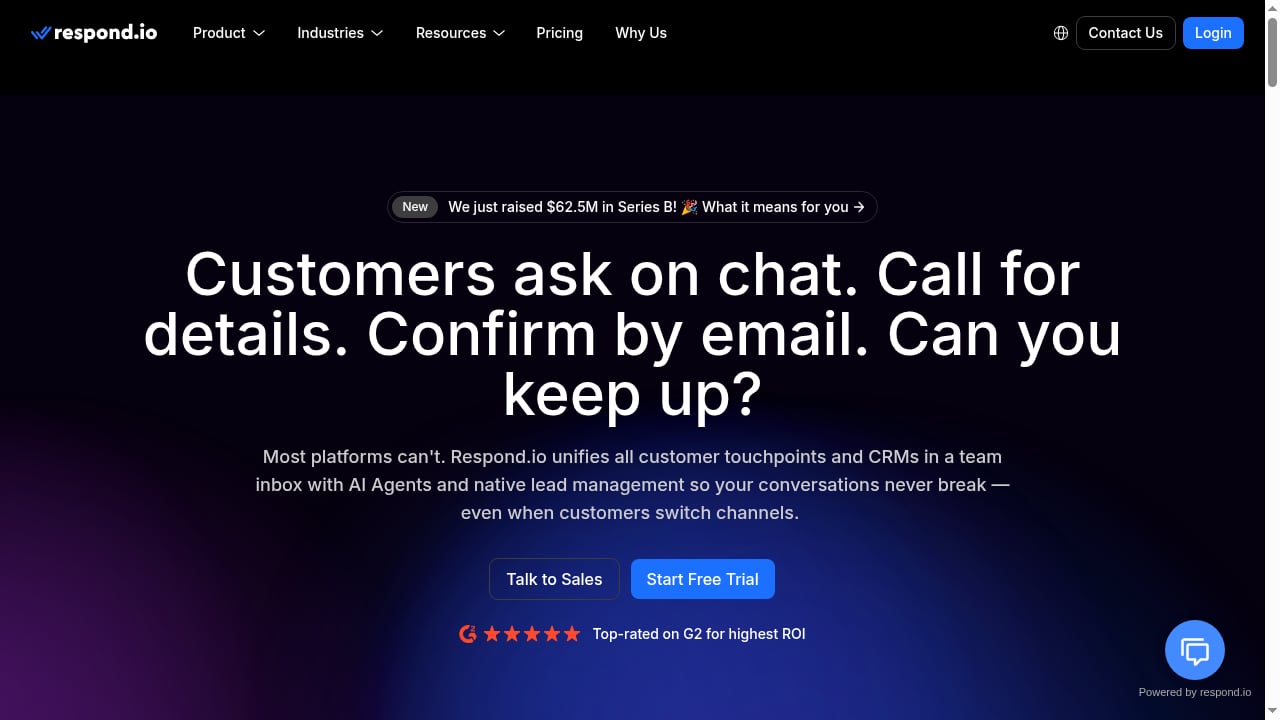
Respond.io is a customer conversation platform built for B2C companies that sell through chat. Its core promise is consolidation: WhatsApp, TikTok, Instagram, Facebook Messenger, email, and voice calls all land in one team inbox, with AI Agents handling routine conversations and native lead management tracking the customer journey.
The company frames this as "Conversation-Led Growth," a three-stage framework: capture leads across channels, convert them through AI-assisted conversations, and retain them with ongoing support. That framing matters because it positions respond.io closer to a revenue tool than a pure support desk.
Who respond.io is built for
First viewport screenshot of Respond.io | #1 AI-Powered Customer Conversation Platform.
The platform fits best when conversations are the primary sales channel, not a side function.
Strong fit:
- B2C businesses running paid social campaigns on WhatsApp, TikTok, or Instagram and needing to convert ad inquiries fast
- Teams handling high message volume where headcount cannot scale linearly with chat volume
- Companies in markets where WhatsApp is the default commerce channel (Southeast Asia, Latin America, parts of Europe and the Middle East)
- Sales and support teams that currently juggle multiple inbox tools and want one thread per customer
Weaker fit:
- B2B SaaS companies with low conversation volume and deep ticketing requirements
- Teams whose support already lives entirely inside Slack or a developer-first stack
- Organizations that need heavy custom reporting and data warehouse integrations out of the box
If your evaluation is support-first rather than conversation-first, a platform like Gladly or a broader comparison such as our top 10 AI customer service software breakdown may be a better starting point.
Core capabilities
Unified inbox across chat, calls, and email
The strongest structural feature is thread unification. A customer can start on WhatsApp, switch to a Messenger call, and follow up by email, and the team sees one continuous record. Respond.io also supports WhatsApp Business Calls, Messenger Calls, and VoIP inside the same thread, which is unusual. Most competitors treat voice as a separate product or a paid add-on.
AI Agents
Respond.io's AI Agents are designed to do more than answer FAQs. According to the vendor, they can update CRM records, recommend products, book appointments, and route serious buyers to human agents. The company emphasizes reliability and guardrails rather than open-ended autonomy, and offers templates so teams can launch without building flows from scratch.
Native lead management and CRM sync
Rather than bolting a CRM onto a chat tool, respond.io treats lead profiles as a first-class object. Profiles sync with external CRMs, so a conversation can update the customer record and vice versa. For teams running ad-driven funnels, this closes the gap between "someone messaged us" and "someone is in the pipeline."
Channel coverage
The channel list is genuinely broad: WhatsApp, TikTok, Instagram, Facebook Messenger, Telegram, Viber, Line, WeChat, email, and web chat. TikTok support is a differentiator. Few conversation platforms treat TikTok direct messages as a serious business channel, even though TikTok has become a major discovery-to-purchase surface for younger B2C audiences.
Pricing signals
First viewport screenshot of WhatsApp Business Messaging API Pricing Calculator.
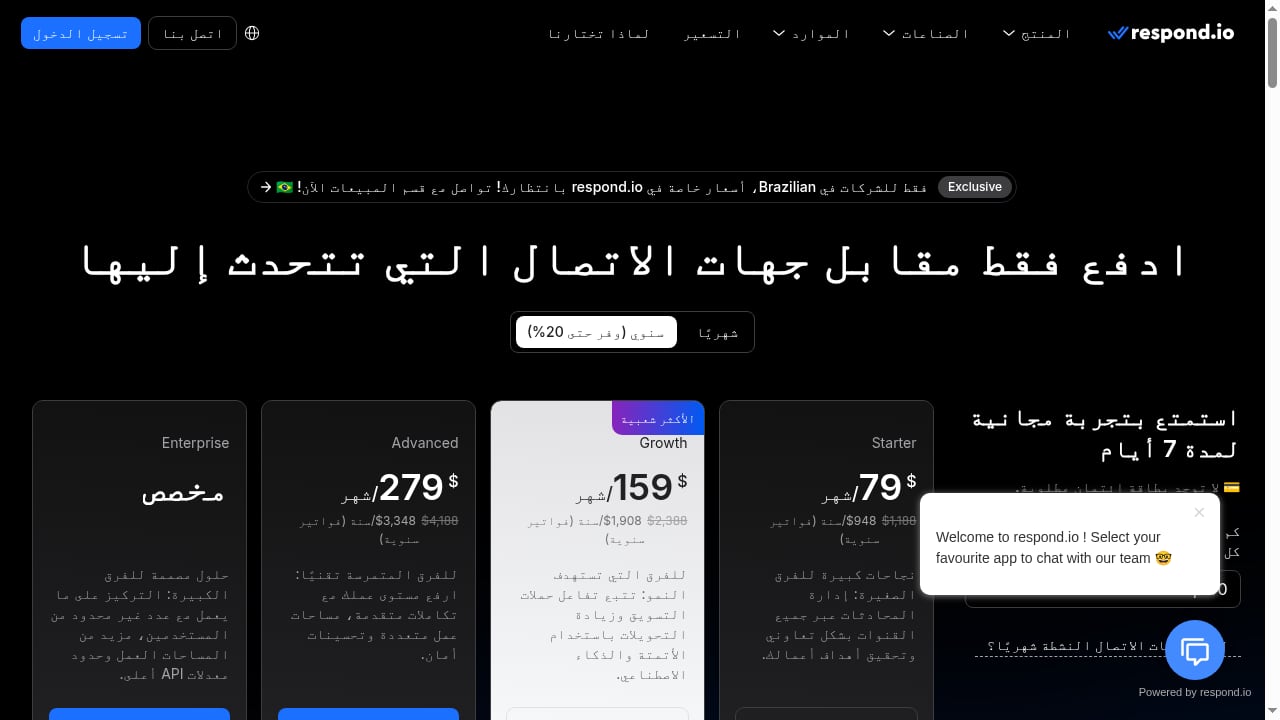
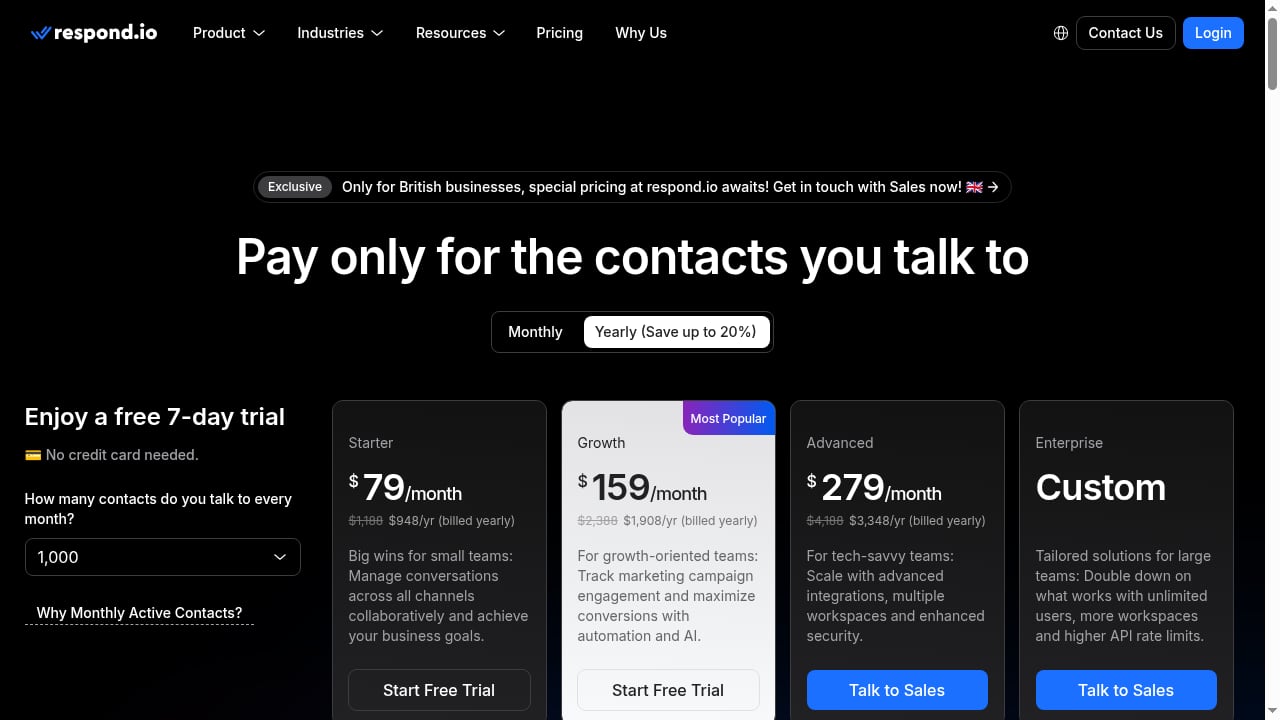
Respond.io does not publish a simple flat rate, and pricing depends on seats, channels, and AI usage. Based on publicly available plan information and vendor positioning, expect the following shape:
- A starter tier aimed at small teams, with limited seats and basic channel access
- A growth tier that unlocks more channels, automation, and AI Agent capacity
- An advanced or enterprise tier with higher limits, more control, and priority support
- AI Agent usage is typically metered or bundled at a defined volume, so heavy automation can push costs up
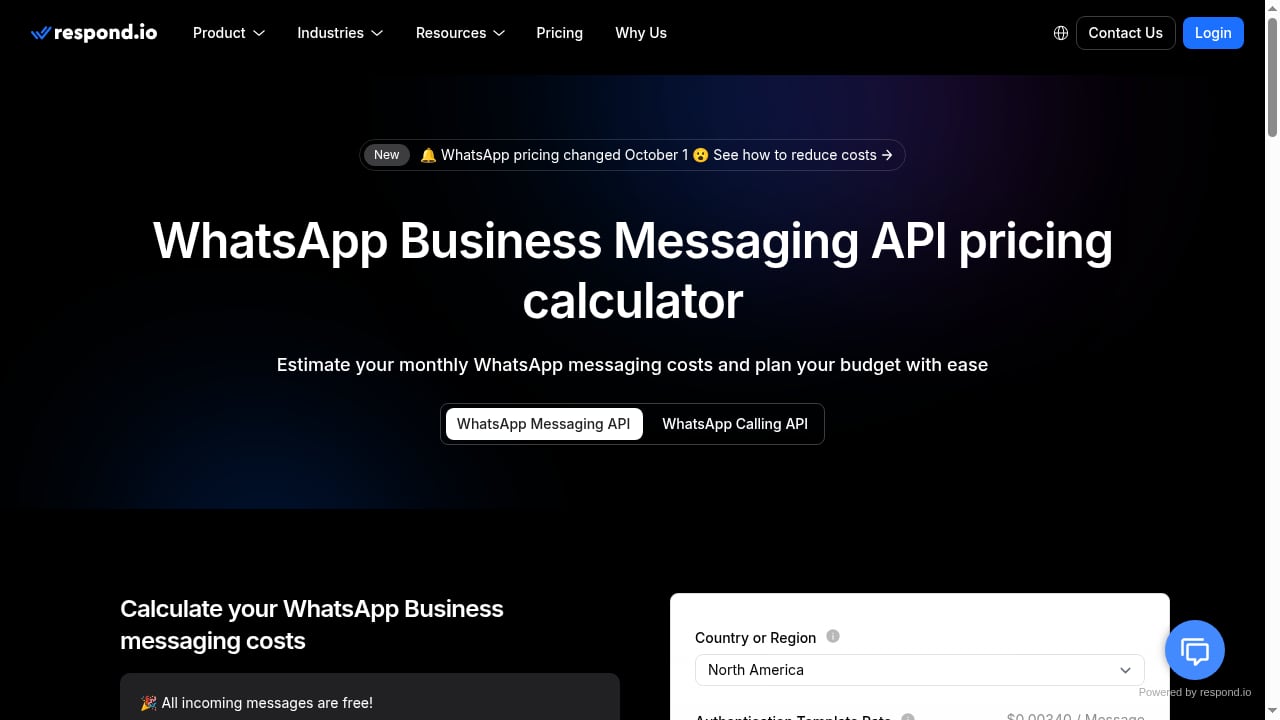
Because WhatsApp Business API messaging itself carries per-conversation fees from Meta, your total cost of ownership will always be higher than the subscription line item. Budget for messaging fees separately, and ask the vendor for a realistic monthly estimate based on your actual conversation volume before signing.
Setup and onboarding
Setup difficulty depends mostly on which channels you connect. Web chat and email are straightforward. WhatsApp Business API requires business verification through Meta, which can take days and occasionally longer if documentation is incomplete. TikTok and Instagram connections depend on having the right business accounts and permissions in place.
AI Agent configuration is where onboarding effort concentrates. Templates shorten the initial build, but accuracy depends on the quality of your knowledge base. Stale or contradictory help content produces bad AI answers regardless of how good the model is, a point that comes up repeatedly in practitioner discussions about AI support tools.
A realistic timeline for a mid-sized B2C team: one to two weeks to connect channels and configure the inbox, and two to four weeks of iteration before AI Agents handle a meaningful share of conversations without human review.
Strengths
- Channel breadth with real depth. TikTok, WhatsApp, and Instagram are treated as first-class channels, not afterthoughts.
- Voice inside the conversation thread. Combining calls and messages in one record reduces context loss during handoffs.
- Lead management built in. Teams running ad-driven funnels get pipeline visibility without a separate CRM layer.
- Review track record. A 4.8 G2 rating across 500+ reviews is a meaningful signal, though review platforms skew toward satisfied customers.
- Ecosystem relationships. Being an early-access partner for Meta and TikTok features has practical value when new channel capabilities launch.
Limitations and trade-offs
- Pricing opacity. Without published rates for every tier, comparison shopping requires a sales conversation, which slows evaluation.
- AI accuracy depends on your content. The platform cannot compensate for a disorganized knowledge base.
- Reporting depth. Teams accustomed to custom analytics and data warehouse exports may find native reporting thinner than enterprise BI expectations.
- B2C orientation. The lead-management model assumes high-volume, transactional conversations. Complex B2B sales cycles with long nurture sequences are not the design center.
- Total cost includes Meta fees. WhatsApp messaging costs sit outside the subscription and can surprise teams that only budgeted for the platform.
How respond.io compares
The honest comparison depends on what you are replacing.
- Versus Intercom: Intercom has stronger brand recognition and a mature AI resolution product, but per-resolution pricing can escalate quickly. Respond.io's advantage is channel breadth, particularly TikTok and voice-in-thread.
- Versus DelightChat: DelightChat is a lighter, Shopify-oriented option for smaller commerce teams. Respond.io scales further but costs more and takes longer to configure.
- Versus developer-first platforms: If your team wants SDK-level control over messaging infrastructure, a platform like Bird may fit better. Respond.io is a product, not a toolkit.
- Versus free tools: tawk.to wins on cost for basic live chat, but it is not built for WhatsApp-first B2C sales at scale.
Decision criteria: should you shortlist respond.io?
First viewport screenshot of Pricing | Plans Built to Scale Your Business.
Run through these questions before booking a demo:
- Is chat a primary revenue channel? If most of your revenue starts with a message, respond.io is a strong fit. If chat is incidental, you are paying for capability you will not use.
- Do you sell on WhatsApp or TikTok? These channels are where respond.io differentiates most clearly.
- Can you absorb variable messaging costs? Meta's per-conversation fees scale with volume. Model this before committing.
- Do you have clean help content? AI Agent quality tracks knowledge base quality. If your documentation is a mess, fix that first.
- How many seats do you actually need? Seat-based pricing rewards lean teams. Count real users, not anticipated ones.
- What does your handoff look like? Test the AI-to-human escalation path during the trial. Preserved context is the difference between a smooth handoff and a frustrated customer.
Related reading
- Sierra Review 2026: AI Customer Experience Platform - Evidence-based Sierra review for 2026: AI customer experience platform, ideal users, use cases, pricing signals, setup, limits, and decision criteria.
- Olark Review 2026: AI Agent for Marketing Funnels - Evidence-based Olark review for 2026: the AI website agent, live chat plans, pricing signals, setup, limits, and who should buy it.
Sources and further reading
- respond.io Reviews 2026: Details, Pricing, & Features - G2 - Respond.io is a customer conversation platform designed to help B2C businesses generate more leads and maximize revenue over chat, calls, and emails from ...
- Respond.io | #1 AI-Powered Customer Conversation Platform - Trusted by 10,000+ B2C businesses to scale customer chats, calls & campaigns. Unify WhatsApp, TikTok, Instagram & Facebook in a team inbox with AI Agents on respond.io
- Best AIs for customer support? Tested a bunch. Some thoughts… : r/CRM - Mar 4, 2026 ... If you're already on Zendesk, this is might bd the easiest move. AI triage, suggests responses from past cases, good routing. Very much a ...
FAQ
Is respond.io good for small businesses?
It can be, particularly for small B2C teams selling through WhatsApp or Instagram. The starter tier keeps entry costs manageable, but the platform's value grows with conversation volume. A business handling a few dozen chats per week may find lighter tools more economical.
Does respond.io support voice calls?
Yes. Respond.io unifies WhatsApp Business Calls, Messenger Calls, and VoIP within the same conversation thread as messages and emails, which is less common than it sounds among omnichannel platforms.
How much does respond.io cost?
Pricing depends on seats, channels, and AI Agent usage, and is generally quoted through sales rather than published as a flat rate. Factor in Meta's WhatsApp per-conversation fees separately, since those sit outside the subscription.
What is Conversation-Led Growth?
It is respond.io's framework for treating customer conversations as the primary growth engine: capture leads across channels, convert them with AI-assisted conversations, and retain customers through ongoing support. It is a positioning framework, not a distinct technology.
Can respond.io replace a CRM?
Not fully. It provides native lead management and syncs with external CRMs, but it is designed to complement a CRM rather than replace one. Teams with complex pipeline requirements will still need dedicated CRM software.
How long does setup take?
Connecting channels takes days, with WhatsApp Business API verification adding time. AI Agent tuning typically takes two to four weeks of iteration before it handles meaningful volume without human review.
Conclusion
Respond.io earns its positioning for a specific kind of buyer: B2C businesses where conversations drive revenue, WhatsApp and TikTok matter, and chat volume is outgrowing the team's ability to handle it manually. The unified thread across chat, calls, and email is a genuine structural advantage, and the review record supports the reliability claims.
The trade-offs are real. Pricing requires a sales conversation, AI quality depends on your own content, and total cost includes Meta messaging fees that are easy to underestimate. Teams that treat chat as a secondary channel will find better value elsewhere.
If conversations are your growth engine, respond.io belongs on the shortlist. Test it against your actual edge cases, measure the handoff experience, and model the full cost before you commit.